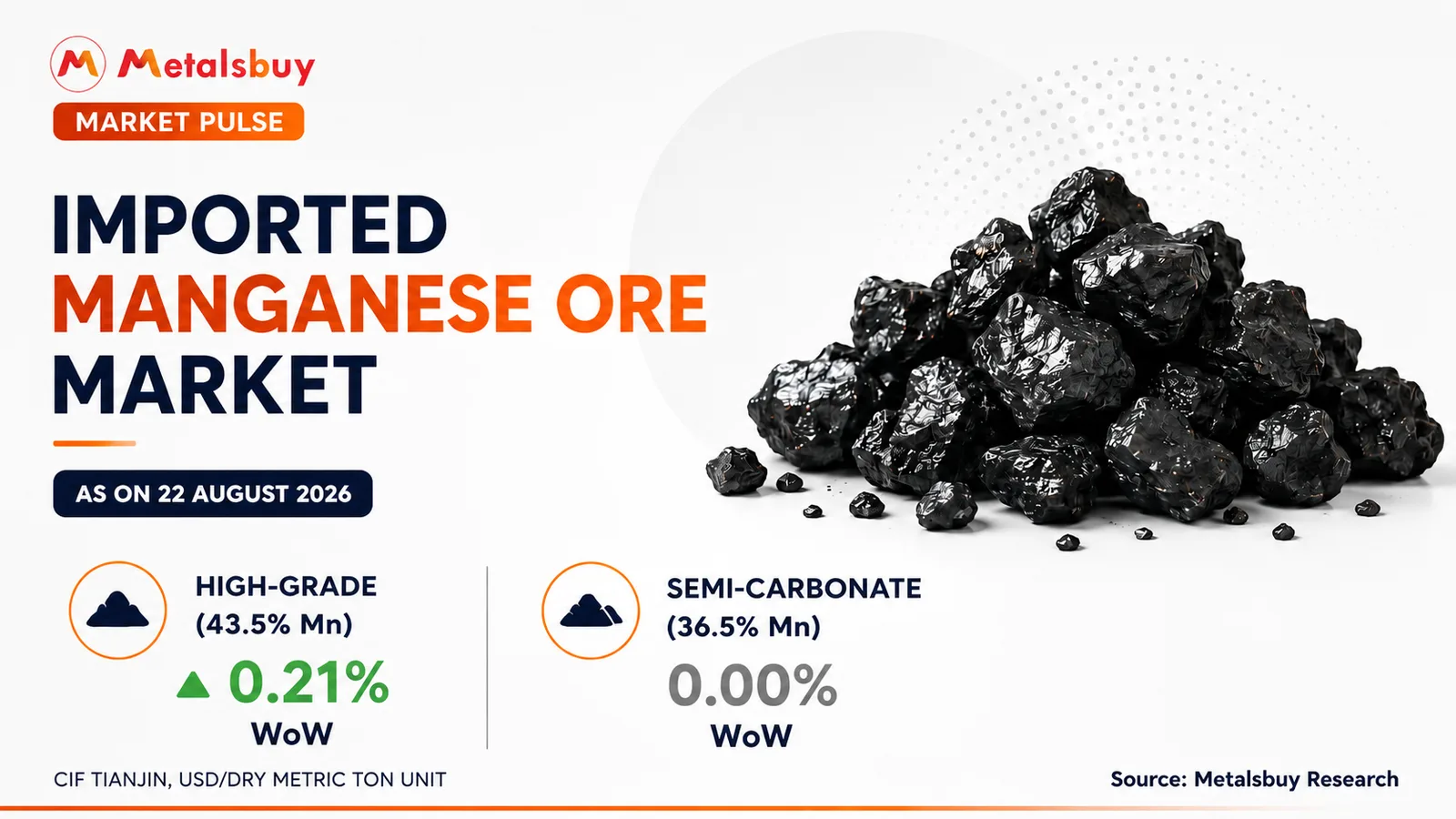
- 43.5% Mn high-grade ore index: Up 0.21% WoW
- 36.5% Mn semi-carbonate index: Unchanged WoW
- Assessment date: August 22, 2026
- Market direction: High-grade marginally firmer, semi-carbonate stable
- Overall sentiment: Consolidation after recent weakness
- Indian SiMn market: Buyers remain cautious while producers show resistance to lower offers
Market Analysis
The imported manganese ore market showed signs of stability this week, with the latest assessment indicating that the pressure seen in the market over the previous period has eased. The 43.5% Mn high-grade ore index moved up 0.21% week on week, while the 36.5% Mn semi-carbonate index remained unchanged. The movements are marginal, but they are important because both grades have moved away from the sharper downward trend witnessed earlier. For now, the market appears to be entering a consolidation phase rather than signalling a strong recovery.
The difference between the two grades is also worth watching. High-grade material has shown a small improvement, while semi-carbonate has remained flat, suggesting that buyers are continuing to assess different grades based on their individual economics and blending requirements. However, the current movement is too small to indicate any major shift in purchasing behaviour. If the divergence continues in the coming weeks, grade economics could become increasingly important for manganese alloy producers when deciding their procurement mix.
China remains the key market influencing the international manganese ore trade. Chinese manganese ore imports increased by around 2.27% month on month in July, indicating that overall availability has remained reasonably comfortable despite changes in shipment volumes from individual origins. At the same time, buyers have continued to remain selective, particularly where port inventories provide enough flexibility to delay fresh purchases. This combination of adequate availability and cautious procurement is keeping the market from developing a strong upward momentum.
Port availability remains one of the most important factors to monitor. When sufficient material is available at Chinese ports, buyers have less reason to chase spot cargoes aggressively and can negotiate based on immediate requirements. Sellers, on the other hand, have to balance the need to clear existing inventory against expectations that the market may have already reached a lower range. If port availability begins to tighten, even a moderate improvement in alloy demand could provide support to ore prices, but that trigger is not clearly visible yet.
Impact on Indian SiMn Market
For Indian silico-manganese producers, the latest movement provides some relief from the earlier downward pressure on imported ore, but it does not yet represent a significant change in production economics. A stable international ore market means producers are unlikely to see substantial additional cost relief in the immediate term, particularly if suppliers maintain their current offers. At the same time, domestic SiMn buyers continue to remain measured in their procurement, preventing producers from passing through higher costs aggressively. The result is a market where raw-material prices are providing some support to sellers, while downstream demand continues to keep a lid on the upside.
This balance is important because manganese ore remains a major component of SiMn production costs. When ore prices are falling consistently, buyers tend to delay procurement in anticipation of better offers, while producers are forced to compete more aggressively for alloy orders. Once the ore market stabilises, however, the incentive for buyers to wait indefinitely becomes weaker and producers become more reluctant to reduce finished alloy prices. This could gradually create a firmer floor for SiMn, provided domestic steel demand improves enough to support fresh buying.
The Chinese alloy market also needs to be watched because its performance has a direct bearing on global manganese ore demand. Recent developments indicate that Chinese steel production has remained under pressure, with July crude steel output declining year on year, while steelmaker profitability has also faced challenges. Since manganese alloys are ultimately consumed in steelmaking, prolonged weakness in Chinese steel production would limit the potential for a sustained increase in manganese ore demand. Until downstream steel demand improves more convincingly, the international ore market is likely to remain sensitive to inventory levels and short-term procurement requirements.
For Indian producers, the immediate scenario is therefore relatively balanced. The ore market is no longer giving buyers the same downward momentum, but the finished alloy market has not yet developed the demand strength required for a significant price rally. If domestic steel demand improves while imported ore remains stable, SiMn producers could gain some room to strengthen their offers. Conversely, if steel demand remains subdued and Chinese port availability stays comfortable, the current range-bound behaviour could continue.
What to Watch Next
The next few weeks will be important in determining whether the current stability represents a genuine floor or simply a temporary pause in the correction. The 43.5% Mn high-grade index will be particularly important after its marginal weekly increase, as continued gains would suggest that sellers are gradually regaining pricing confidence. The 36.5% semi-carbonate index will also need to be monitored for signs of movement because a simultaneous increase across grades would provide a stronger indication of improving market sentiment. Until then, it would be premature to call the current movement a sustained recovery.
Chinese port inventories, alloy production, steel output and fresh procurement activity should remain the key indicators. Any meaningful reduction in available ore combined with stronger alloy buying could quickly change the current balance and push prices higher. On the other hand, continued availability and weak downstream steel margins could keep buyers defensive and prevent sellers from gaining significant pricing power. For Indian SiMn producers and buyers, domestic steel demand and alloy buying will ultimately determine how much of any international ore movement gets reflected in the Indian market.
Metalsbuy Market Pulse View
Imported manganese ore appears to be moving from correction towards consolidation. The 43.5% Mn high-grade index has edged up by 0.21% this week, while the 36.5% Mn semi-carbonate index has remained unchanged, indicating that the recent selling pressure has eased but has not yet been replaced by strong buying momentum. For Indian SiMn producers, this means the raw-material market is beginning to provide a more stable cost environment, although downstream demand remains the bigger concern. The market may be finding a floor, but stronger steel and alloy demand will be needed before a sustained upward move can be confirmed.