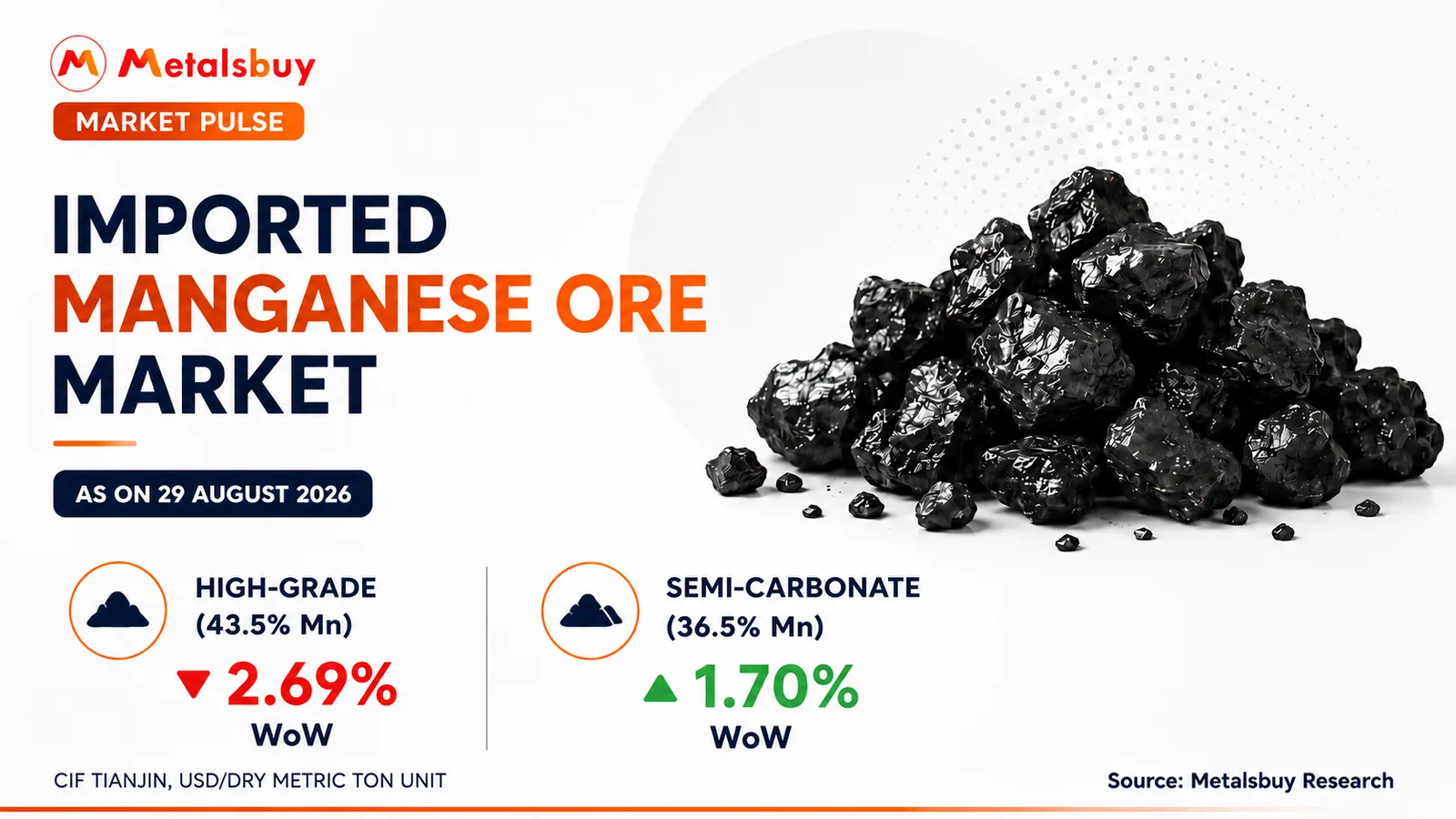
Imported manganese ore prices moved in opposite directions this week, with high-grade material losing ground while semi-carbonate ore posted a modest recovery.
The 43.5% Mn high-grade index, CIF Tianjin, was assessed at $4.71 per dmtu, down $0.13 per dmtu or 2.69% from the previous assessment. In contrast, the 36.5% Mn semi-carbonate index rose by $0.07 per dmtu, or 1.70%, to $4.19 per dmtu CIF Tianjin.
The split is interesting because the broader market has not shown signs of a strong recovery. Recent market assessments from China continue to point towards high inventories and cautious buying, with different ore grades reacting differently to available supply and buying interest.
High-grade ore comes under pressure
The decline in the high-grade index takes it back below the $4.80 per dmtu level after the relative stability seen in the previous week. There has been no broad improvement in manganese ore demand strong enough to support a sustained rise across the market, and buyers have continued to purchase selectively.
High inventories remain a major part of the equation. Shanghai Metals Market noted this week that manganese ore inventories at Tianjin continued to build, while overall stocks remained high despite some destocking at Qinzhou. That has kept a lid on upward price momentum, particularly where buyers have sufficient availability of material at the ports.
The weakness in high-grade ore does not necessarily point to a sharp correction ahead, but it does show that the market is still struggling to build consistent buying momentum. Sellers may be reluctant to reduce offers aggressively, yet a cautious downstream market leaves limited room for prices to move higher without stronger physical demand.
Semi-carbonate finds some support
Semi-carbonate moved the other way. The 36.5% Mn index increased to $4.19 per dmtu this week, recovering some ground after the weakness seen earlier in the market.
Recent assessments have also pointed to relatively firmer sentiment for South African semi-carbonate material compared with some other grades. Market commentary published this week noted that semi-carbonate prices had strengthened slightly even as the overall manganese ore market remained constrained by high inventory levels.
The increase is modest and should probably be viewed in that context. One week's improvement does not signal a broad turnaround in the market, particularly when port inventories remain elevated. Still, the fact that semi-carbonate managed to move higher while the high-grade index declined shows that buying interest is becoming more selective rather than moving uniformly across imported ore grades.
The spread narrows
With high-grade ore falling and semi-carbonate rising, the price difference between the two benchmarks narrowed during the week.
The spread now stands at $0.52 per dmtu, compared with a wider gap in the previous assessment. For buyers and traders, relative pricing between different grades can become increasingly important when the overall market lacks a clear direction.
For now, the imported manganese ore market appears to be moving grade by grade rather than following a single trend. High inventories are still limiting the market's upside, but semi-carbonate has found enough support to move higher this week. High-grade ore, meanwhile, has gone in the opposite direction.
The coming assessments will show whether this divergence continues or whether the market moves back towards a more uniform direction. At the moment, there is little evidence of broad-based buying strength. The latest numbers instead point to a market where individual grades are responding differently to supply, inventories and spot buying conditions.
Latest Index Assessment
Disclaimer: This article is based on market information and publicly available price assessments and is intended for general industry discussion only.