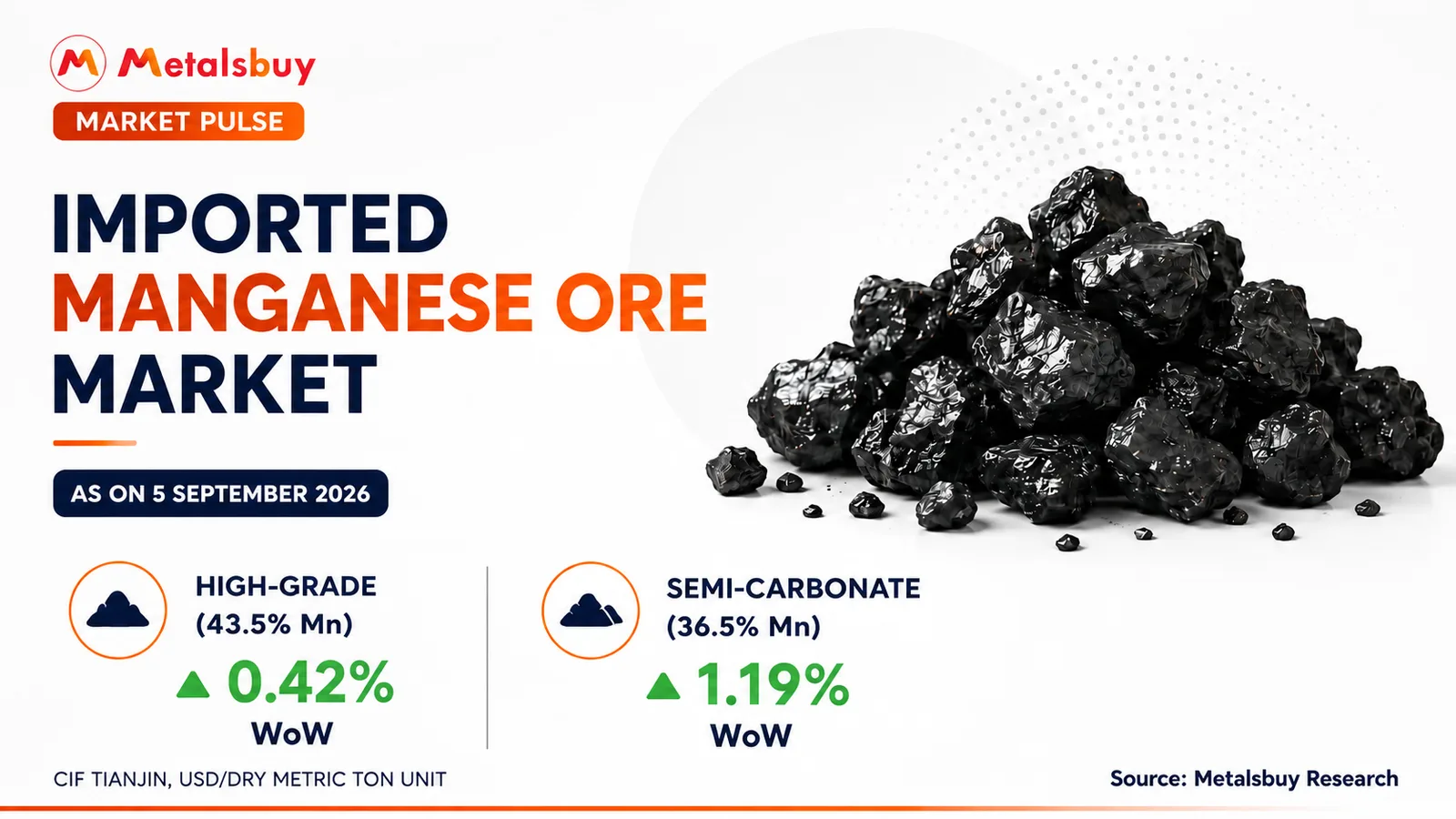
Imported manganese ore prices moved higher this week, with both the high-grade and semi-carbonate indices recording gains. The recovery comes after a mixed market in the previous week, when high-grade material had declined while semi-carbonate ore moved up.
The 43.5% Mn high-grade index, CIF Tianjin, was assessed at $4.73 per dmtu, up by $0.02 per dmtu or 0.42% from last week. The 36.5% Mn semi-carbonate index rose more sharply to $4.24 per dmtu, gaining $0.05 per dmtu or 1.19%.
The latest movement brings both indices into positive territory, although the increase is still relatively modest. More importantly, semi-carbonate continues to show better momentum than high-grade ore.
High-grade ore sees a small recovery
The high-grade index had fallen to $4.71 per dmtu last week after losing $0.13 per dmtu. This week's increase to $4.73 indicates some stabilisation, but the recovery so far has been limited.
The broader physical market in China also showed relatively steady conditions for some Australian-origin material during the week. Port transaction data showed modest increases in Tianjin for certain higher-grade Australian lump products, although price movements were not uniform across all grades and origins.
The small improvement in the index is notable because September shipment offers from several major suppliers had earlier been reduced from the previous month. Market data from August showed lower September offers for Australian and other high-grade manganese ore, reflecting the softer demand environment going into the new month. That makes the current increase more of a spot-market recovery than a clear indication of a broader shift in market fundamentals.
Semi-carbonate continues to perform better
The stronger movement this week came from semi-carbonate ore. The 36.5% Mn index increased from $4.19 to $4.24 per dmtu, extending the recovery seen in the previous week. Over the last two weekly assessments, semi-carbonate has moved up by a combined $0.12 per dmtu, while high-grade material is still below the level it was trading at before last week's correction.
The difference in performance between the two grades remains one of the more interesting features of the market. Current physical market indications for South African semi-carbonate material are also around the lower-$4 per dmtu range on a CIF China basis, broadly in line with the movement seen in the index.
Semi-carbonate had faced considerable pressure earlier as port inventories remained high and alloy producers maintained a cautious approach towards raw material purchases. But the latest two weeks suggest that the grade has found some support at lower levels.
Port inventories and alloy demand remain important
The price increase should also be viewed against a market that is still carrying a relatively comfortable level of material at Chinese ports. Recent market assessments have pointed to continued arrivals and high port inventories, particularly in Tianjin. Downstream silico-manganese producers have also remained cautious, with buying largely focused on immediate requirements rather than aggressive restocking. Some alloy producers have reportedly reduced operating rates amid pressure on margins.
These factors remain important because manganese ore demand is closely linked to the operating levels of alloy producers. The market therefore does not appear to be seeing a broad demand-led rally at this stage. The weekly index movement shows prices improving, but the underlying buying environment is still selective.
September begins with a firmer index picture
The first week of September has nevertheless produced a more positive result for both benchmark grades. High-grade 43.5% Mn ore is now at $4.73 per dmtu, while 36.5% Mn semi-carbonate has reached $4.24 per dmtu. The gap between the two remains narrow compared with historical periods, which reflects the differing supply and demand dynamics currently affecting individual grades.
For now, semi-carbonate is showing the stronger weekly momentum, while high-grade ore has only recovered a small part of last week's decline. The next few assessments will be important in determining whether this is the beginning of a more sustained recovery or simply a short-term adjustment after recent price weakness. With port inventories still relatively high and downstream alloy demand remaining cautious, the market will need stronger buying activity for a broader price recovery to develop.