Key Highlights
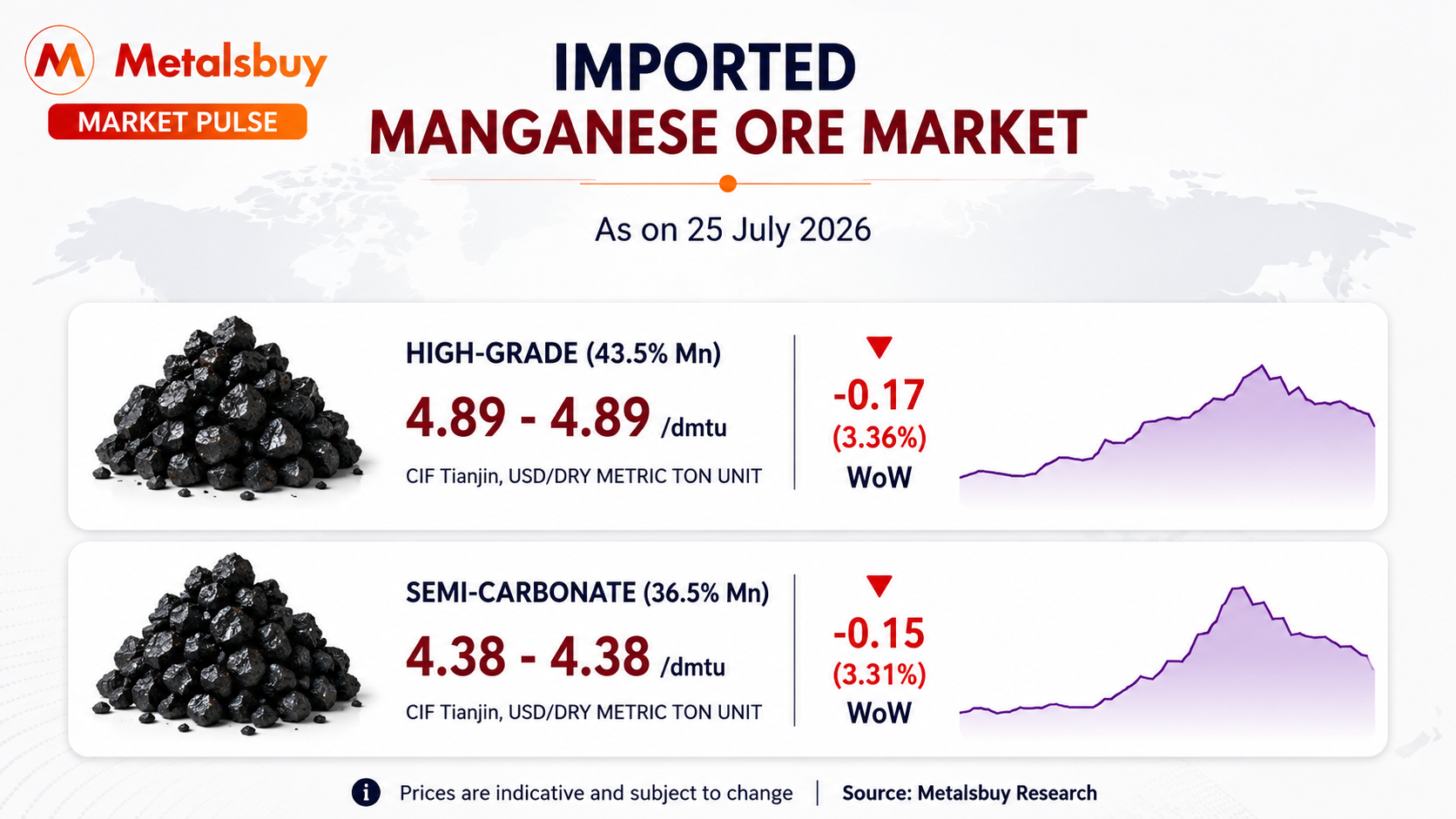
- Imported High Grade (43.5% Mn) manganese ore index declined 3.36% during the week ended 24 July 2026.
- Semi Carbonate (36.5% Mn) manganese ore index also fell 3.31%, reflecting broad weakness across imported ore grades.
- Weak buying interest from Chinese ferroalloy producers continued to weigh on market sentiment.
- Comfortable inventories at Chinese ports and cautious procurement strategies kept prices under pressure.
- Indian buyers remained selective, with most ferroalloy producers purchasing only to meet immediate production requirements.
The imported manganese ore market witnessed another week of correction as both High Grade (43.5% Mn) and Semi Carbonate (36.5% Mn) ore indices declined by more than three percent. The price correction reflects persistent weakness in downstream ferroalloy demand, particularly in China, where alloy producers continue to operate under margin pressure. Although global ore supply remains stable, subdued buying activity and adequate inventories have limited any upward momentum in the market.
For the manganese ore industry, the current market environment is characterised by cautious procurement rather than aggressive restocking. Buyers across major consuming regions are closely monitoring alloy demand, steel production trends, and inventory levels before committing to fresh purchases. This has resulted in slower trading activity and increased price negotiations between suppliers and consumers.
India, one of the world's major manganese ore importing countries for ferroalloy production, is also witnessing a measured buying approach. Domestic silico manganese producers continue to monitor export demand, steel production, and finished alloy prices before increasing raw material purchases. Consequently, imported ore demand has remained stable but lacks the momentum required to support higher prices.
Imported Ore Market Analysis
The decline in both imported ore indices suggests that market weakness is not limited to a specific ore category but is affecting the broader manganese ore market. High Grade (43.5% Mn) ore, which is widely preferred by ferroalloy producers due to its superior recovery and operational efficiency, recorded a 3.36% weekly decline. Semi Carbonate (36.5% Mn) ore also registered a 3.31% correction, indicating that buyers remain cautious across different product segments.
Market participants attribute the softer sentiment primarily to reduced purchasing by Chinese alloy producers. Many consumers are adopting a just-in-time procurement strategy, buying only for immediate production requirements rather than rebuilding inventories. Since port stocks remain comfortable and vessel arrivals continue without significant disruptions, there is little urgency among buyers to secure additional cargoes.
The absence of major supply disruptions has further reinforced the weak sentiment. Exporters from South Africa, Gabon, Australia, and other producing regions continue to maintain regular shipments, ensuring sufficient material availability across Asian markets. As a result, negotiations have increasingly favoured buyers during the past week.
China Market Analysis
China remains the single largest driver of global manganese ore demand, making developments in its ferroalloy industry particularly important for international prices. During the week, alloy producers continued to face pressure from weak silico manganese prices and modest steel demand. Limited profitability has encouraged producers to optimise raw material inventories rather than undertake large-scale restocking.
Port inventories remain adequate to meet near-term production requirements, reducing the urgency for fresh purchases. Traders also reported that many buyers delayed procurement decisions in anticipation of further price corrections. This cautious approach has contributed directly to the decline in imported ore indices.
Seasonal factors have also influenced sentiment. Summer production schedules, periodic environmental inspections, and conservative steel mill procurement have collectively moderated alloy production. Until downstream demand improves, Chinese manganese ore consumption is expected to remain relatively subdued.
India Market Analysis
The Indian imported manganese ore market has largely mirrored global trends, although domestic demand has remained comparatively stable. Ferroalloy producers continue to operate at reasonable utilisation levels, supported by steady domestic steel production and export enquiries. However, buyers remain highly price-sensitive and are avoiding speculative inventory accumulation.
Most alloy manufacturers are purchasing imported ore based on immediate production schedules rather than long-term expectations. This disciplined procurement strategy has limited upward price movement despite healthy operational activity. Traders have also reported slower forward bookings as buyers prefer to wait for greater clarity on international market direction.
Demand from the stainless steel and carbon steel sectors remains an important factor influencing alloy production. While India's long-term steel demand outlook continues to remain positive, current raw material purchasing reflects short-term caution rather than aggressive expansion.
Supply Side Analysis
Supply conditions remain largely balanced across the global manganese ore market. Major exporting countries including South Africa, Gabon, Australia, and Brazil continue to maintain stable mining operations and regular shipment schedules. Weather conditions have generally supported uninterrupted production, allowing exporters to fulfil contractual commitments without significant delays.
The availability of imported cargoes at major Asian ports has prevented any immediate supply tightness. Vessel arrivals remain consistent, and there have been no major logistical disruptions affecting global manganese ore trade. Consequently, buyers continue to enjoy comfortable supply availability, reducing the likelihood of any short-term supply-driven price recovery.
Although some miners continue to exercise production discipline, overall seaborne supply remains sufficient to satisfy current demand levels. Unless unexpected disruptions occur, supply is unlikely to become a bullish factor in the immediate future.
Demand Side Analysis
Demand remains the primary weakness in the current manganese ore market. Chinese ferroalloy producers continue to face pressure from weaker alloy prices and cautious steel mill procurement. This has directly affected manganese ore consumption and purchasing behaviour.
Indian demand has remained relatively healthier than China, supported by ongoing infrastructure activity and stable steel production. However, Indian buyers are equally cautious regarding inventory management, preferring incremental purchases rather than large-volume commitments.
Globally, steel producers continue to monitor economic conditions, infrastructure spending, and manufacturing activity. These downstream indicators will determine future manganese alloy production and, consequently, imported ore demand during the coming weeks.
Freight and Logistics Analysis
Freight conditions remained broadly stable during the week, with no significant disruption to manganese ore shipments into Asia. Vessel availability remained adequate, and port operations continued smoothly across key exporting and importing regions.
However, freight markets continue to face uncertainty due to seasonal shipping demand across multiple bulk commodities. While current freight costs have not materially affected manganese ore pricing, any increase in shipping rates during the coming months could influence import economics, particularly for price-sensitive buyers.
Efficient logistics continue to support regular cargo movement, ensuring that inventories remain comfortable at major consuming destinations.
Metalsbuy Market Pulse Insight
The decline in the imported manganese ore indices should not be interpreted solely as a supply issue. Instead, it reflects a market where demand has temporarily lost momentum while supply remains adequate. Buyers currently possess stronger negotiating power because they have sufficient inventories and face limited pressure to secure additional cargoes immediately.
Looking ahead, the direction of the manganese ore market will depend largely on downstream ferroalloy demand rather than mining supply. A recovery in Chinese silico manganese margins, stronger steel production, or supportive economic stimulus could quickly improve buying sentiment. Until such catalysts emerge, imported manganese ore prices are likely to remain under pressure with limited upside potential.
For Indian ferroalloy producers, the current correction offers an opportunity to optimise raw material procurement costs. However, purchasing decisions should continue to be aligned with actual production schedules rather than expectations of an immediate market rebound.
Outlook for Next Week
The imported manganese ore market is expected to remain range-bound with a weak bias during the coming week. Chinese alloy production, port inventory movements, steel mill purchasing activity, and freight developments will remain the key indicators to watch. While the current correction may encourage selective buying at lower levels, sustained price recovery is likely to require stronger downstream demand from the ferroalloy and steel industries.
Disclaimer
This article has been prepared by Metalsbuy Market Pulse using publicly available market information and independent editorial analysis. Market commentary is intended solely for informational purposes and should not be construed as commercial or investment advice. For real-time and historical manganese ore price trends, users can access Metalsbuy Price Edge, which provides comprehensive pricing intelligence and market insights.