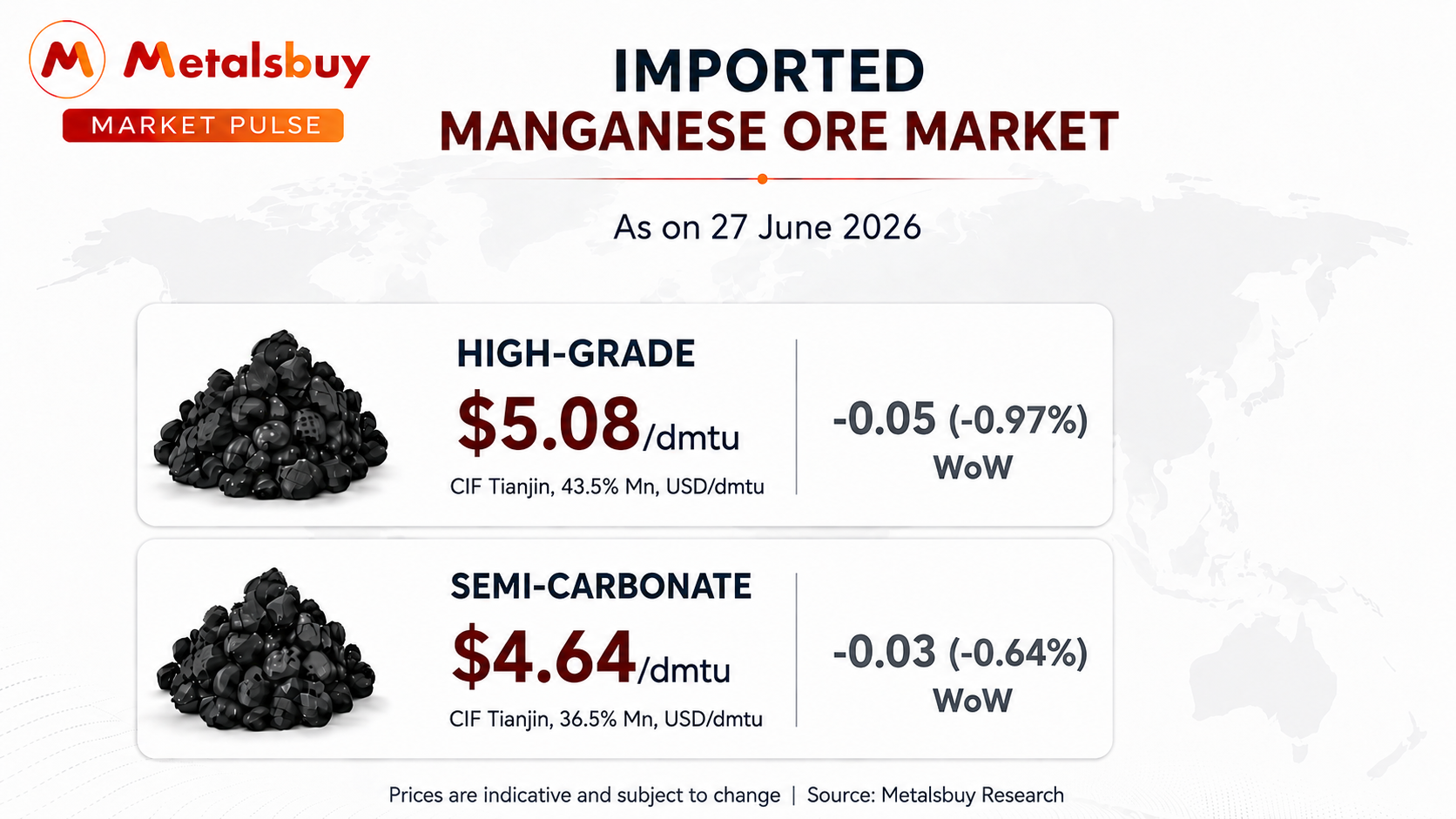
Key Numbers
Imported Manganese Ore Market (Week Ending 27 June 2026)
• High Grade (43.5% Mn) CIF Tianjin: USD 5.08/dmtu (▼0.97% WoW)
• Semi Carbonate (36.5% Mn) CIF Tianjin: USD 4.64/dmtu (▼0.64% WoW)
Market Analysis
Imported Ore Prices Ease as Market Enters a Consolidation Phase
The imported manganese ore market witnessed a mild correction during the week ending 27 June 2026, with both high-grade and semi-carbonate ore indices declining from the previous assessment. The High Grade (43.5% Mn) CIF Tianjin Index closed at USD 5.08/dmtu, down 0.97% week-on-week, while the Semi Carbonate (36.5% Mn) CIF Tianjin Index settled at USD 4.64/dmtu, registering a 0.64% weekly decline. The correction follows several weeks of stronger prices and appears to reflect softer buying activity in China rather than any significant deterioration in global ore fundamentals.
Despite the decline, the market remains considerably more stable than it was during the sharp volatility witnessed earlier this year. Sellers have generally maintained disciplined offers, while buyers have become increasingly selective, preferring to purchase according to immediate production requirements rather than build large inventories. The result has been a balanced market where prices have softened modestly without triggering aggressive selling pressure.
Chinese Demand Remains the Primary Market Driver
China continues to dictate global manganese ore pricing, accounting for the largest share of international imports. During recent weeks, alloy producers and steel mills have adopted a cautious procurement strategy as seasonal weakness in steel demand and softer alloy margins have reduced the urgency for fresh ore purchases. This moderation in buying activity has contributed to the slight correction observed in imported ore indices.
At the same time, China's steel industry continues operating at relatively high production levels compared with many other global markets. While finished steel demand has slowed in certain segments due to seasonal factors, production has not declined sharply enough to create a significant oversupply of imported manganese ore. Consequently, buyers have become more price-sensitive rather than withdrawing from the market altogether, allowing prices to ease in a gradual and orderly manner.
Supply Conditions Continue to Remain Comfortable
On the supply side, seaborne shipments from major exporting countries have remained broadly stable. South Africa continues to dominate global manganese ore exports, supported by consistent mining operations and steady logistics through its export terminals. Gabon and Australia have also maintained regular shipments, ensuring adequate availability of high-grade ore for Asian consumers.
Unlike previous periods when logistics disruptions or weather-related events significantly influenced market sentiment, the current supply environment remains comparatively balanced. Freight conditions have also remained relatively stable, reducing the likelihood of sudden supply-side price shocks. This has enabled buyers to negotiate purchases more comfortably while allowing sellers to maintain steady export programmes.
Indian Alloy Producers Continue Need-Based Procurement
For Indian silico manganese producers, imported manganese ore remains one of the most important raw material inputs. However, procurement activity during the week continued to reflect cautious purchasing behaviour rather than aggressive inventory accumulation. Alloy manufacturers have largely aligned ore purchases with production schedules, supported by relatively stable domestic silico manganese prices and balanced order books.
The domestic SiMn market has shown resilience in recent weeks due to limited spot availability and disciplined producer pricing. This stability has helped maintain regular ore consumption despite the absence of strong speculative buying. Producers continue monitoring both imported ore prices and domestic alloy demand before committing to larger procurement volumes, particularly as export enquiries remain mixed.
Raw Material Costs Continue to Influence Alloy Economics
Although imported ore prices declined modestly during the week, manganese ore continues to represent only one component of overall silico manganese production costs. Electricity, reductants, coke, electrodes, freight and financing expenses remain significant contributors to manufacturing economics. As a result, the latest correction in ore prices is unlikely to translate immediately into lower domestic alloy prices.
Instead, the decline offers producers a modest improvement in raw material procurement costs while allowing them to preserve operating margins. If ore prices remain stable over the coming weeks, alloy manufacturers may benefit from improved cost visibility without facing major disruptions to their pricing strategies.
Market Sentiment Reflects Stability Rather Than Weakness
The current correction should be viewed as a period of market consolidation rather than the beginning of a sustained downward trend. The absence of panic selling, combined with steady seaborne supply and continued steel production in China and India, suggests that the underlying fundamentals of the manganese ore market remain broadly balanced.
Buyers are taking advantage of softer prices to negotiate more favourable purchasing terms, while suppliers continue to demonstrate pricing discipline. This equilibrium has prevented sharper price corrections and indicates that the market remains fundamentally supported despite weaker short-term buying activity.
Industry Impact
The modest decline in imported manganese ore prices provides temporary relief for ferro alloy producers, particularly those dependent on imported raw materials. Stable ore availability, combined with relatively balanced freight conditions, continues to support uninterrupted procurement across the Indian ferro alloy industry.
For steel producers, the latest movement is unlikely to materially alter alloy procurement costs in the immediate term. Instead, market participants are expected to remain focused on developments in Chinese steel production, alloy demand and global ore shipments, which will continue shaping pricing trends during the second half of the year.
Outlook
The imported manganese ore market is expected to remain stable in the near term, with pricing likely to be influenced primarily by Chinese procurement activity and seaborne supply conditions. If steel production in China remains resilient and alloy demand improves after the seasonal slowdown, buying interest could strengthen again during the coming weeks.
For Indian alloy manufacturers, attention will remain on the interaction between imported ore prices, domestic silico manganese demand and export opportunities. While the current correction offers some support to production economics, broader market direction will continue to depend on global steel activity rather than isolated weekly price movements.
Disclaimer: This analysis is based on the Metalsbuy Imported Manganese Ore Index, publicly available industry information and independently validated market developments. Market conditions are subject to change based on demand, trade flows, supply availability and macroeconomic factors.