KEY NUMBERS
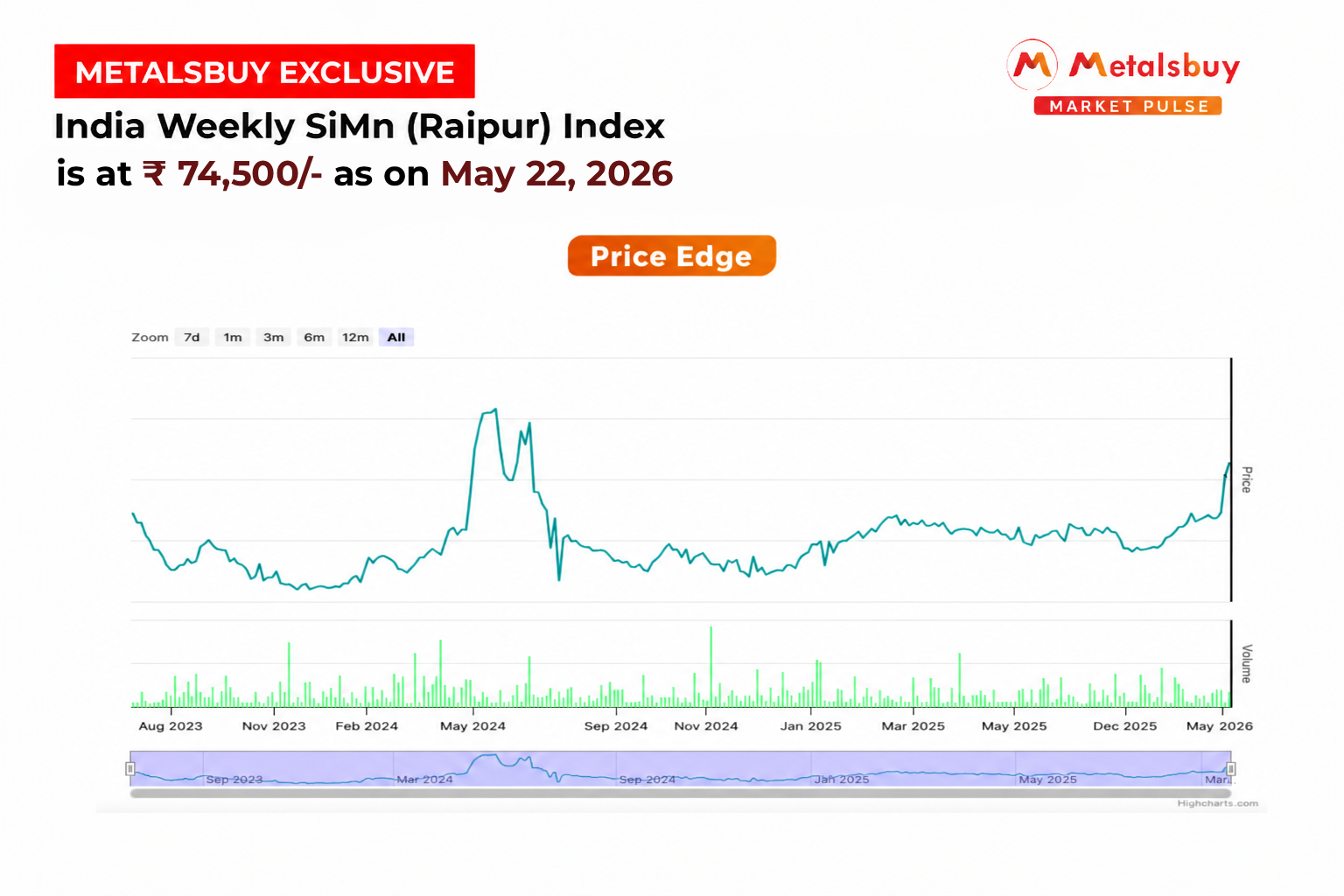
- SiMn (ExW–Raipur): ₹74,500/MT
- SiMn (ExW–Raigarh): ₹74,000/MT
- Market sentiment remained cautious despite stable transaction activity
- Imported manganese ore continued showing weakness
- Producers increasingly shifting away from standard 60/14 grades
- Inventory levels remained comfortable across the market
- Logistics costs showing early signs of pressure
- Export competitiveness expected to improve with stronger USD movement
MARKET ANALYSIS
The domestic silico manganese market continued operating under a cautious environment this week as buyers and producers remained focused on cost management rather than aggressive market participation. As on 22 May 2026, SiMn (ExW–Raipur) stood at ₹74,500/MT, while ExW–Raigarh was assessed at ₹74,000/MT. Compared with last week, the market did not witness any strong directional trigger and remained influenced by multiple factors simultaneously. The current situation reflects a market that is not under significant stress, but is also not receiving enough support to move decisively higher.
Imported Manganese Ore
Imported manganese ore prices have continued moving lower over the last several weeks and remain one of the most important factors influencing the alloy market at present. Softer downstream buying activity and cautious procurement behavior have kept international ore prices under pressure. Current market discussions suggest that imported ore values may continue witnessing weakness in the coming week as immediate demand visibility remains limited.
The market is increasingly beginning to price in expectations of lower raw material costs ahead. While falling ore prices provide some cost relief to alloy manufacturers, they also create a tendency among buyers to postpone purchases in anticipation of even better prices. This behavior naturally slows fresh buying activity because consumers become more focused on timing their procurement decisions.
The larger concern for the market is not only the imported ore movement itself but its possible impact on domestic ore prices. Historically, domestic manganese ore prices tend to follow international movements with a time lag. If the present trend continues over the next few weeks, domestic manganese ore prices could also witness further correction during the coming month, creating additional pressure on market sentiment.
Steel Demand Scenario
The demand side continues to remain one of the most important variables for the domestic silico manganese market. India's long-term steel demand outlook remains positive because of infrastructure development, manufacturing expansion, railway investments, and increasing industrial activity. Finished steel consumption in India continues showing healthy structural growth, supporting long-term confidence across the value chain.
However, immediate demand sentiment continues reflecting a more measured approach. Steel mills are currently focusing more on procurement efficiency and cost optimization rather than aggressive inventory building. Buying activity continues, but urgency remains limited because producers are trying to maintain balanced operating margins. Since silico manganese consumption directly depends on steel production activity, alloy demand is also reflecting similar caution.
The current market therefore does not indicate weak steel demand, but rather a situation where consumers are purchasing according to immediate requirements instead of creating large inventory positions.
Supply Situation for SiMn
Supply-side behavior is currently witnessing an important shift that could gradually influence future market dynamics. A noticeable number of silico manganese producers are increasingly shifting their focus toward grades other than the traditional 60/14 segment. This movement appears to be influenced by both changing international demand patterns and efforts to avoid intense domestic competition.
The standard 60/14 grade has recently witnessed stronger competitive pressure within the domestic market. Producers therefore appear to be exploring alternative grades that offer relatively better realizations and allow them to diversify their customer base. The shift also reflects a strategy to reduce dependence on a highly competitive market environment where price wars can quickly impact margins.
While this does not immediately reduce overall market supply, it gradually changes the supply composition within the market. If this trend continues, standard grade availability may eventually become more controlled while other grades gain a larger share within production portfolios.
Inventory Position
Inventory levels currently remain comfortable across most sections of the supply chain and continue influencing overall market behavior. Traders, consumers, and several market participants are reportedly maintaining sufficient stock positions, reducing the urgency for fresh spot purchases. When inventories remain healthy, buyers generally become more patient and focus on procurement timing rather than availability concerns.
This inventory situation is one of the reasons behind relatively measured transaction activity despite stable demand fundamentals. Market participants are currently avoiding aggressive accumulation because there is no immediate concern regarding material availability. As a result, inventory comfort is acting as a stabilizing factor while also limiting strong upward price movement.
Logistics
Logistics costs have started emerging as an important factor for market participants to monitor over the coming weeks. Diesel prices have recently witnessed increases across several regions, while continuing geopolitical tensions have also created uncertainty regarding energy markets and transportation economics. Recent fuel price revisions have already started influencing freight discussions within the market.
Transport cost movements become particularly important for the alloy industry because freight forms a meaningful component within delivered cost calculations. Industry estimates suggest that even moderate increases in diesel prices can eventually translate into higher freight expenses and pressure transporter margins.
While the current impact remains manageable, continued geopolitical tensions and higher energy costs could create additional logistics pressure in the coming weeks. Rising transportation costs may not immediately influence alloy prices but could gradually affect delivered realizations and overall profitability.
Rising USD Prices and Export Parity
The movement in the US dollar may become one of the support factors for the domestic silico manganese market. A stronger dollar generally improves export realizations for Indian producers because export prices become relatively more attractive when converted into rupee terms. Better export economics can create opportunities for manufacturers to diversify demand away from the domestic market.
Improving export parity becomes particularly important during periods when domestic demand remains moderate. Producers often become more active in export markets because stronger realizations can support profitability and reduce dependence on local price movements. If the dollar continues strengthening and international demand remains stable, export-oriented players may gradually witness better opportunities.
This could eventually provide some support to domestic sentiment because stronger export demand often helps absorb excess market supply and improves confidence levels.
MARKET OUTLOOK
The domestic ExW–Raipur silico manganese market currently appears to be moving through a consolidation phase where multiple factors are balancing each other. Falling imported ore prices and comfortable inventories continue creating pressure, while improving export opportunities and changing production strategies are providing some underlying support.
The near-term market direction will likely depend on how raw material prices evolve and whether steel procurement activity begins showing stronger momentum. Until stronger demand signals emerge, the market is expected to remain cautious with a balanced outlook rather than witnessing aggressive movement in either direction.