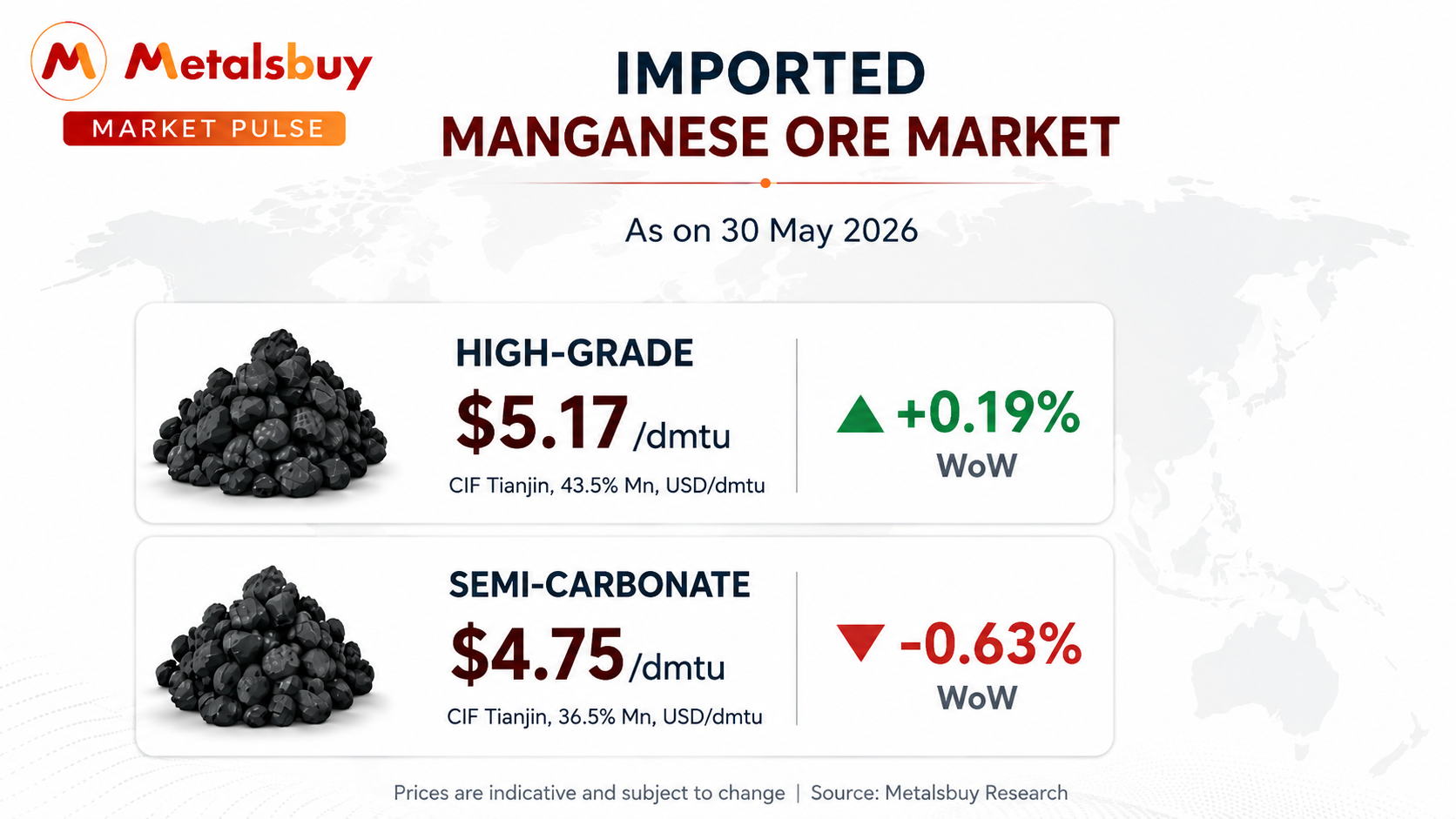
KEY NUMBERS
- High-Grade (43.5% Mn, CIF Tianjin): $5.17/dmtu
- WoW Movement: ▲0.19%
- Semi-Carbonate (36.5% Mn, CIF Tianjin): $4.75/dmtu
- WoW Movement: ▼0.63%
- Price Spread: $0.42/dmtu between High-Grade and Semi-Carbonate Ore
- International manganese ore market remains largely buyer-driven
- Domestic manganese ore prices expected to face further pressure
- Global alloy demand remains subdued
- Steel market sentiment continues to remain cautious
- Buyers continue following requirement-based procurement strategy
MARKET ANALYSIS
The imported manganese ore market witnessed another week of mixed movement, reflecting the ongoing struggle between supply-side stability and weak downstream demand. As on 30 May 2026, the High-Grade (43.5% Mn) CIF Tianjin index edged up to $5.17/dmtu, registering a marginal gain of 0.19% week-on-week, while the Semi-Carbonate (36.5% Mn) index declined to $4.75/dmtu, down 0.63% during the same period.
Although the movement in high-grade ore appears positive on the surface, the broader market continues to remain cautious. The marginal increase does not necessarily indicate the beginning of a sustained recovery. Instead, it reflects a market attempting to find temporary equilibrium after several weeks of continuous correction. Trading activity remains selective, and buyers continue showing little urgency in building inventories.
The most important theme currently shaping the manganese ore market remains weak downstream demand. The global silico manganese industry continues facing pricing pressure, and alloy producers across major consuming regions remain cautious regarding raw material procurement. Most buyers continue purchasing only against confirmed production requirements rather than building forward inventories. This behaviour has reduced spot market liquidity and prevented stronger upward momentum in ore prices.
Imported Manganese Ore Market
Over the last month, imported manganese ore prices have largely remained under pressure as demand from alloy producers weakened. The slight improvement witnessed in high-grade material this week appears more technical in nature than fundamentally driven. Market participants continue reporting limited buying enthusiasm, and transaction volumes remain below levels typically associated with a strong recovery phase.
The divergence between high-grade and semi-carbonate material is also becoming increasingly visible. While high-grade ore managed to stabilize, semi-carbonate ore continued facing pressure. This reflects changing procurement preferences among consumers, many of whom are currently focused on minimizing production costs rather than maximizing output.
Several buyers are carefully evaluating their raw material mix to protect margins amid weak finished alloy prices. This has resulted in selective procurement patterns rather than broad-based demand growth. Until alloy margins improve, manganese ore prices may continue facing resistance despite occasional weekly gains.
Impact on Domestic Manganese Ore Market
The imported manganese ore trend is particularly important for India because domestic ore pricing generally follows international benchmarks with a time lag. Over the last few weeks, international ore prices have shown more weakness than strength, and market participants increasingly expect domestic manganese ore suppliers to adjust pricing accordingly.
The domestic ore market is therefore entering a phase where supplier pressure is likely to increase. Consumers remain aware of softer international prices and are becoming increasingly reluctant to commit to higher-priced domestic purchases. This has created a negotiating advantage for buyers, making the current environment clearly buyer-dominated.
If imported ore prices continue moving sideways or lower over the coming weeks, additional pressure on domestic ore pricing cannot be ruled out. Many market participants are already expecting further corrections during June.
Steel Market Scenario
The steel market continues to provide limited support to the manganese ore segment. While India's long-term steel consumption story remains strong, immediate market sentiment remains cautious. Several steel producers continue focusing on inventory management and margin preservation rather than aggressive expansion of production schedules.
Across Asia, steel prices remain under pressure due to slower buying activity and abundant supply availability. Chinese steel demand continues showing signs of weakness, which has created additional pressure on regional steel markets. Since manganese ore demand ultimately originates from steel production, weak steel sentiment continues influencing the entire manganese value chain.
The absence of strong steel demand recovery has therefore become one of the biggest obstacles preventing a meaningful rebound in manganese ore prices.
Supply and Trade Behaviour
From a supply perspective, the market currently remains comfortable. There are no significant concerns regarding material availability, and port inventories remain sufficient to meet near-term requirements. The absence of supply disruptions means buyers are not under pressure to secure cargo aggressively.
Trade behaviour continues reflecting caution rather than confidence. Buyers remain focused on procurement efficiency and continue delaying purchases wherever possible. Most transactions are being executed against immediate consumption requirements, while speculative buying remains almost completely absent.
Traders are also maintaining conservative inventory positions because expectations of further corrections continue limiting risk appetite. Market participants appear more interested in preserving liquidity than taking directional positions.
This combination of comfortable supply and cautious demand is creating a market environment where prices struggle to find sustained upward momentum.
Impact of SiMn Market Dynamics
The manganese ore market is also closely linked to developments in the silico manganese sector. Recent weeks have witnessed increasing pressure on alloy producers, leading several manufacturers to shift production away from traditional grades such as SiMn 60/14 toward other products including SiMn 60/16, FeMn 65%, and FeMn 70%.
This shift reflects both margin pressure and attempts to avoid aggressive domestic price competition. While production continues, alloy manufacturers remain highly selective regarding raw material purchases. As a result, manganese ore demand growth remains constrained despite stable operating levels.
Until the alloy market begins showing stronger profitability and improved demand visibility, manganese ore procurement is likely to remain disciplined.
INDUSTRY IMPACT
For alloy producers, the current manganese ore environment provides some relief from a raw material cost perspective. Lower ore prices help reduce production costs, but the benefit remains partially offset by weak alloy realizations and subdued demand.
For domestic ore suppliers, the situation remains considerably more challenging. Softer international benchmarks are increasing pressure on local pricing structures, while buyers continue demanding greater flexibility in negotiations.
For traders, current market conditions favour inventory discipline and shorter procurement cycles. Most participants continue avoiding large speculative positions because confidence regarding future price direction remains limited.
MARKET OUTLOOK
The imported manganese ore market appears to be entering a consolidation phase rather than a recovery phase. The slight improvement in high-grade ore prices this week may provide temporary support to sentiment, but the broader market continues facing headwinds from weak alloy demand, cautious steel procurement, and comfortable supply availability.
The key factor to monitor over the coming weeks will be the direction of steel and silico manganese demand. If downstream demand improves, ore prices could gradually stabilize. However, if current buying behaviour persists, the market may continue experiencing range-bound movement with a mild downside bias.
For now, the manganese ore market remains fundamentally a buyer's market where procurement decisions are driven more by cost optimization than by growth expectations.