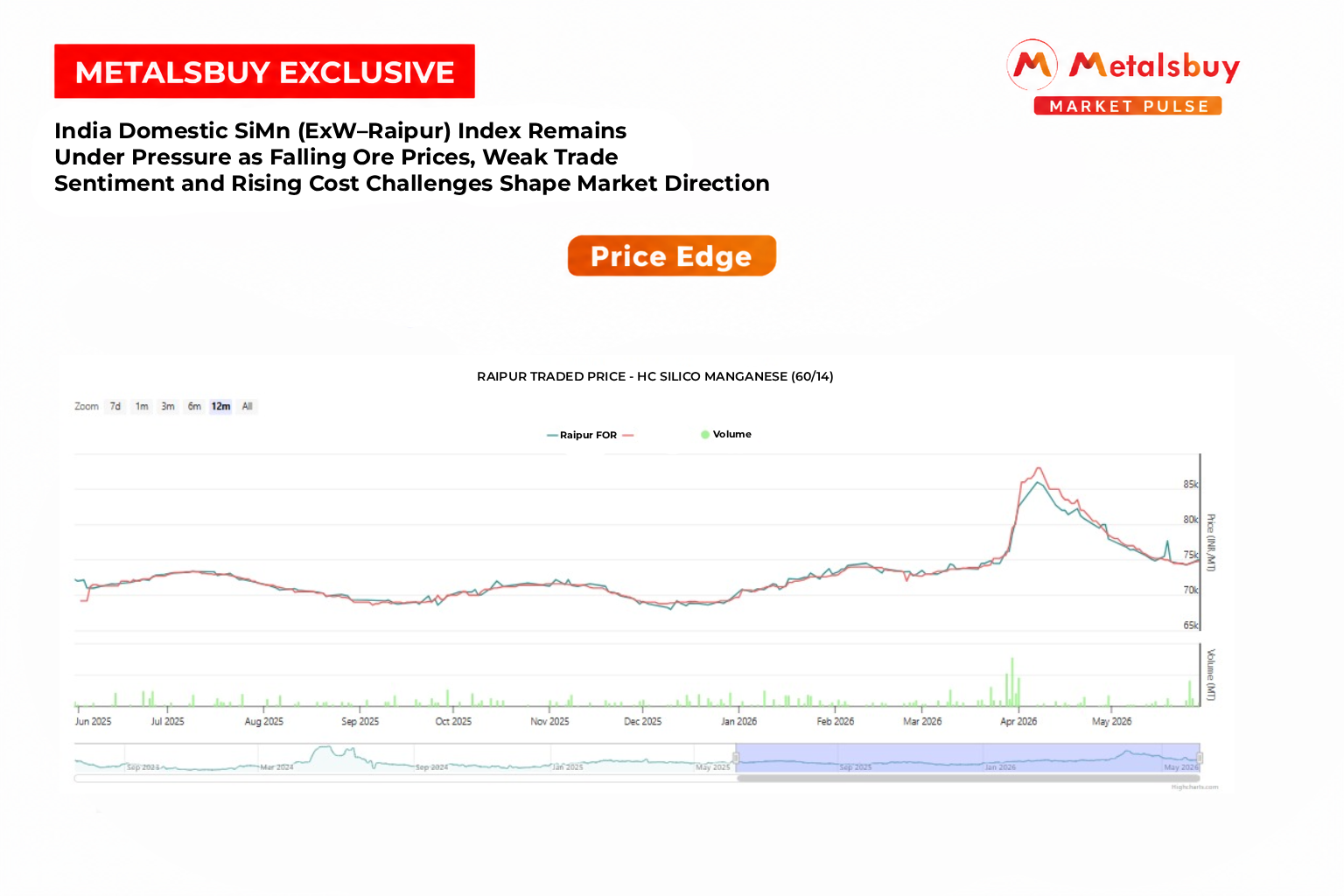
KEY NUMBERS BOX
- SiMn (ExW–Raipur): ₹74,800/MT
- SiMn (ExW–Raigarh): ₹74,000/MT
- WoW Movement (Raipur): ▲ ₹300/MT
- Imported manganese ore prices continued showing weakness across major international benchmarks
- Domestic manganese ore suppliers expected to face additional pricing pressure
- Producers increasingly shifting away from conventional SiMn 60/14 production
- Fuel and freight costs continued moving higher this week
- Stronger USD-INR levels expected to improve export competitiveness
- Trade sentiment remained weak with buyers maintaining a cautious procurement approach
MARKET ANALYSIS
The domestic silico manganese market continued operating under a cautious environment this week as pressure from multiple directions kept overall sentiment subdued. As on 29 May 2026, SiMn (ExW–Raipur) was assessed at ₹74,800/MT, while SiMn (ExW–Raigarh) stood at ₹74,000/MT. Although prices witnessed a marginal increase compared with the previous week, market participants largely viewed the movement as technical rather than demand-driven. The broader market continues facing challenges from weak trade activity, softer raw material trends, and cautious buying behaviour across the value chain.
The current market is increasingly reflecting a buyer-dominated environment where consumers continue holding stronger negotiating power. Most transactions are being concluded based on immediate requirements rather than forward demand expectations. Market participants generally remain reluctant to take large positions because visibility regarding downstream demand remains limited. This has resulted in slower market activity despite stable production and material availability.
Imported and Domestic Manganese Ore Market
One of the most important developments influencing the market remains the continued weakness in imported manganese ore prices. Most major international manganese ore indexes have shown a downward trend over recent weeks, reflecting softer alloy demand and cautious procurement activity across major consuming regions. The correction in imported ore prices has gradually increased pressure across the raw material chain, and market participants widely expect this trend to continue in the near term.
The impact is not limited to imported ore alone. Domestic manganese ore suppliers are also expected to face increasing pressure because international price movements generally influence local pricing with some delay. If imported ore values continue correcting over the coming weeks, domestic ore prices may also witness additional reductions during the next month. Buyers are increasingly expecting lower procurement costs ahead and therefore remain selective regarding fresh purchases.
The current environment has increasingly become a buyer's market. Suppliers are facing significant pressure because consumers continue delaying procurement decisions wherever possible in anticipation of better prices. This has reduced transaction urgency and created a situation where sellers are finding it increasingly difficult to maintain stronger pricing levels.
Steel Market Scenario
The steel market continues sending mixed signals, creating uncertainty across the ferro alloy sector. On one side, India's long-term steel demand fundamentals remain supported by infrastructure expansion, industrial investments, and capacity additions. Recent industry data continues showing healthy production and consumption growth, highlighting that structural demand remains intact. India's finished steel consumption in April 2026 increased by over 8% year-on-year, supported by infrastructure and manufacturing activity.
However, immediate market sentiment remains considerably more cautious. Steel prices across several segments continue facing pressure due to competitive supply conditions and slower buying activity in some regions. Industry discussions suggest that procurement behaviour has become increasingly requirement-based, with buyers avoiding large inventory accumulation. Global steel demand growth also remains relatively weak, particularly due to continued softness in China, which continues influencing international pricing dynamics.
This cautious steel market sentiment is directly affecting silico manganese demand because alloy consumption ultimately depends on steel production activity. While steel demand has not collapsed, it has not yet shown enough strength to create aggressive buying momentum across the alloy segment.
Supply Situation for SiMn
The supply side of the market is also witnessing noticeable changes. A growing number of producers have shifted their focus away from traditional SiMn 60/14 production, primarily because of margin pressure and intense competition within the domestic market. Several manufacturers are increasingly allocating production toward other grades including SiMn 60/16, FeMn 65%, and FeMn 70%, where realizations are relatively better and competitive pressure is comparatively lower.
The move reflects a broader attempt by producers to protect margins and avoid participating in aggressive domestic price competition. Over recent months, standard-grade silico manganese has witnessed strong pricing pressure because multiple producers were competing for limited demand. Diversification toward alternative grades is therefore becoming an increasingly important strategy for maintaining profitability.
Although this shift is gradually changing the product mix within the market, overall material availability remains comfortable. The market is not currently facing any major supply shortages, but production strategies are clearly evolving in response to changing economic realities.
Logistics and Rising Fuel Costs
Logistics costs have once again emerged as an important concern for market participants. Fuel prices witnessed another increase this week, adding fresh pressure on transportation expenses across several regions. Freight costs had already been moving higher because of ongoing geopolitical uncertainty and elevated energy market volatility. The latest fuel price adjustments are expected to further increase transportation costs for raw materials and finished alloy products.
The alloy industry remains particularly sensitive to logistics costs because freight forms a meaningful portion of delivered product pricing. Even moderate increases in diesel prices can eventually influence transportation charges and reduce margins for both producers and traders. While freight escalation has not yet become the primary market driver, it is increasingly becoming a factor that participants are monitoring closely.
USD-INR Movement and Export Parity
The movement in the USD-INR exchange rate continues providing some support to export-oriented market participants. A stronger dollar generally improves export parity because realizations become more attractive when converted into rupee terms. This becomes particularly important during periods when domestic demand remains moderate and producers seek alternative demand channels.
Several producers continue actively monitoring export opportunities because overseas sales can help reduce dependence on domestic market conditions. Improved export competitiveness may gradually support market sentiment if international demand remains stable. While exports alone may not completely offset domestic weakness, they can provide some relief to producers facing margin pressure.
Trade Behaviour and Market Sentiment
The overall trade environment continues reflecting caution rather than confidence. Market participants across the supply chain remain focused on inventory discipline and procurement efficiency. Buyers are largely purchasing according to immediate requirements and continue avoiding aggressive stock-building activity.
Traders also remain conservative because expectations of further raw material correction continue limiting risk appetite. Many participants believe that imported manganese ore and domestic manganese ore prices may soften further, encouraging a wait-and-watch approach. As a result, transaction activity continues taking place, but the market lacks the urgency normally associated with stronger recovery phases.
The prevailing sentiment therefore remains weak, not because demand has disappeared, but because confidence regarding near-term price direction remains limited.
INDUSTRY IMPACT
For alloy producers, falling ore prices may provide some raw material cost relief over the coming weeks. However, softer demand conditions and competitive pricing pressure continue limiting the immediate benefit of lower input costs. Producers are therefore expected to remain focused on product diversification, operational efficiency, and selective sales strategies.
For traders, comfortable inventory availability and expectations of further raw material correction may continue restricting aggressive procurement behaviour. Inventory management remains a key priority as participants attempt to reduce exposure to market volatility.
Export-oriented manufacturers may gradually benefit from improving currency dynamics. Better export parity can provide alternative demand opportunities and partially offset weakness within the domestic market.
MARKET OUTLOOK
The domestic ExW–Raipur silico manganese market currently remains in a consolidation phase where multiple factors continue pulling sentiment in different directions. Falling manganese ore prices and weak trade confidence remain negative influences, while export competitiveness and long-term steel demand fundamentals continue providing underlying support.
The near-term market direction will largely depend on how quickly steel demand improves and whether buyers regain confidence regarding procurement activity. Until stronger downstream demand signals emerge, the market is expected to remain cautious with limited directional movement.
------------