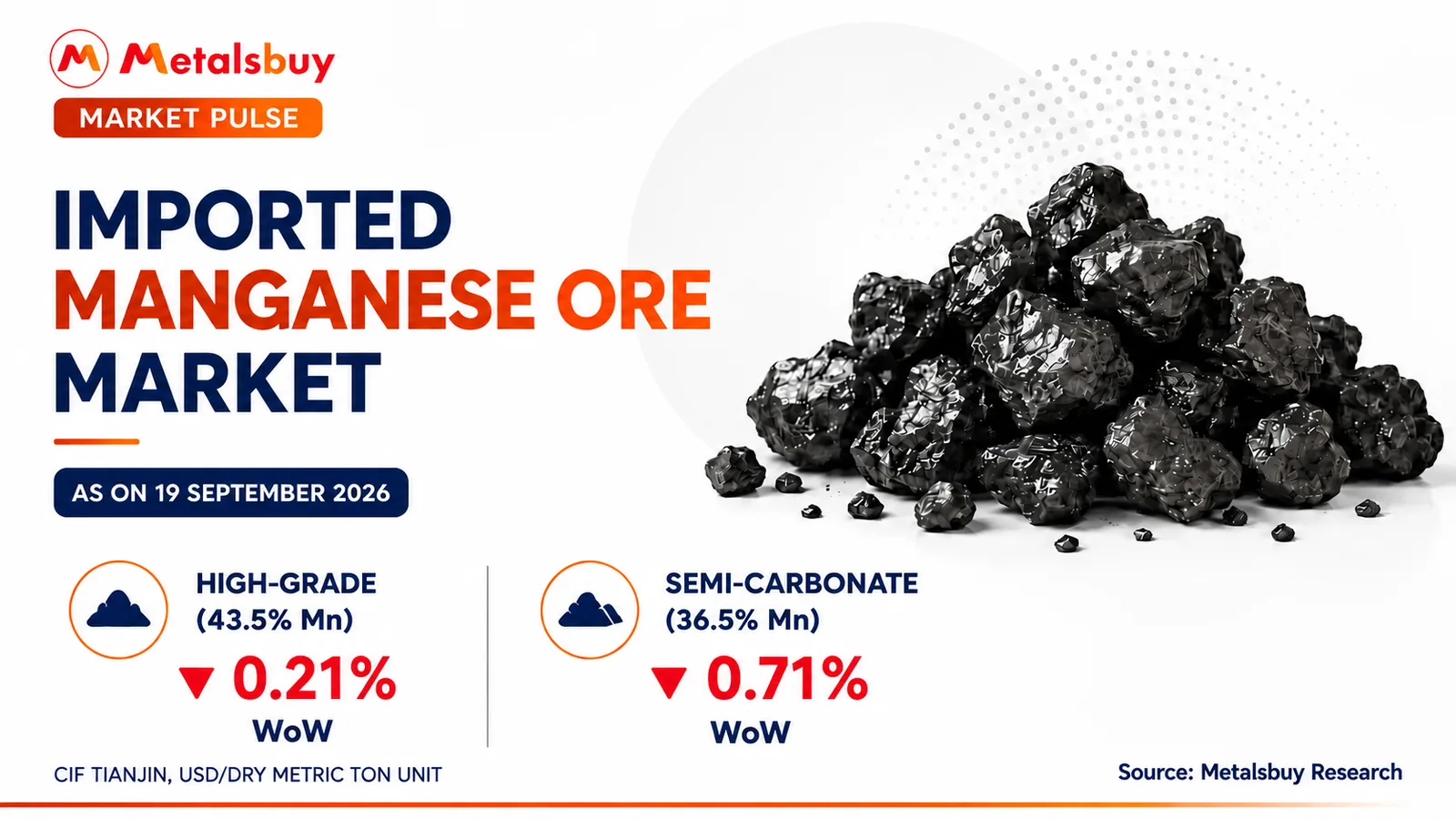
Imported manganese ore prices moved slightly lower during the week ending 18 September 2026, with both high-grade and semi-carbonate benchmarks recording a decline. The movement was still limited, but unlike the previous week when semi-carbonate had remained unchanged, this time both grades moved lower.
The 43.5% Mn high-grade index declined marginally to $4.71/dmtu, while the 36.5% Mn semi-carbonate index fell to $4.21/dmtu. The sharper correction in semi-carbonate was the more noticeable development during the week, although neither grade saw a major price movement.
Key Numbers
• Current spread between the two grades: $0.50/dmtu
High-grade ore slips for the second consecutive week
The 43.5% Mn high-grade index moved down from $4.72/dmtu to $4.71/dmtu, a decline of $0.01/dmtu or 0.21%. This follows an identical $0.01/dmtu correction in the previous week, when the index had slipped from $4.73/dmtu to $4.72/dmtu. The cumulative movement over the last two weekly assessments has therefore remained small at just $0.02/dmtu.
The limited change is also broadly visible in the physical Chinese port market. On September 18, Australian 42-43% Mn lump at Tianjin was transacting at around CNY 38.5-39/dmtu, down CNY 0.2/dmtu, while several other imported Australian and South African grades remained unchanged on the day. This indicates that the high-grade market continues to move within a relatively narrow range rather than showing a sharp correction.
Semi-carbonate gives up last week's stability
The bigger change this week came from the 36.5% Mn semi-carbonate index. After remaining unchanged at $4.24/dmtu in the previous assessment, the index declined by $0.03/dmtu to $4.21/dmtu, representing a weekly fall of 0.71%.
The decline is still modest in absolute terms, but it is larger than the movement seen in high-grade ore. Chinese spot-market data also showed some weakness in South African semi-carbonate material on September 18, with Tianjin prices for South African semi-carbonate ore assessed lower on the day. This gives some support to the softer direction visible in the weekly seaborne benchmark.
Both indices are now moving in the same direction
Last week's market had shown a slightly different pattern. High-grade ore had slipped by 0.21%, while the 36.5% semi-carbonate index remained unchanged at $4.24/dmtu. This week, both indices have moved lower, although the size of the correction remains limited.
The spread between the two benchmarks has consequently widened slightly to $0.50/dmtu, compared with $0.48/dmtu in the previous week. High-grade ore has therefore shown better relative stability, while semi-carbonate has experienced the larger weekly adjustment.
Chinese port market remains largely range-bound
Physical manganese ore trading at Chinese ports did not show a broad-based fall across all grades during the latest assessment. At Tianjin on September 18, Australian 42-43% Mn lump was at CNY 38.5-39/dmtu, while Australian 45-46% Mn lump remained at around CNY 40.5-41/dmtu. South African mid-Fe 42% Mn lump was also unchanged at around CNY 35.5-36/dmtu.
The mixed movement is important because it suggests that the latest decline in the international indices should not be read as a sharp fall across the manganese ore market. Some grades have softened, while others continue to trade within their recent ranges. The current market is therefore showing more of a gradual adjustment than a broad correction.
India continues to import more manganese ore
For Indian ferro-alloy producers, developments in the international manganese ore market remain important because India continues to depend significantly on imported ore. India's manganese ore imports increased by around 4% year-on-year in 2025, supported by new alloy capacity, steel demand and periods when imported material became more competitive against domestic ore. New submerged arc furnace capacity across Raipur, Durgapur, Jharkhand and Raigarh also contributed to additional ore requirements.
Globally, manganese ore imports increased from 41.5 million tonnes in 2024 to 45.4 million tonnes in 2025, an increase of around 10%. China remained by far the largest importer, with its purchases increasing 12% to 32.84 million tonnes. The size of the Chinese market means that movements in Chinese port prices and seaborne benchmarks continue to have a direct bearing on replacement costs for buyers in other importing markets, including India.
Domestic ore prices remain unchanged in September
Interestingly, the small correction in imported ore has not been accompanied by a similar revision in India's major domestic manganese ore prices. MOIL continued its September prices for ferro-grade manganese ore containing 44% Mn and above at August levels. Prices for ferro grades below 44% Mn, chemical grades, SMGR grades and fines were also maintained at the previous month's levels.
This creates a useful comparison for Indian ferro-alloy producers. International benchmarks have softened marginally over the last two weeks, while domestic ore prices have remained unchanged for September. The difference is not yet large enough to indicate a major shift in raw-material economics, but the direction of imported ore prices will remain important if the decline continues in the coming assessments.
Silico manganese market remains the next key indicator
The movement in manganese ore ultimately needs to be viewed alongside the downstream silico manganese market. As of September 18, Indian assessments continued to show active pricing for HC 60-14 silico manganese across Raipur, Raigarh, Durgapur and Vizag, with export assessments also available from Vizag and Haldia.
For producers, a $0.01-0.03/dmtu weekly movement in manganese ore by itself does not represent a major change in production economics. What becomes more important is whether the decline continues over several weeks and whether it is accompanied by changes in alloy realisations, freight and other input costs.
Market ends the week slightly softer
The week therefore closes with a mildly softer tone for imported manganese ore. The 43.5% Mn high-grade index at $4.71/dmtu has declined only 0.21%, while the 36.5% Mn semi-carbonate index at $4.21/dmtu has recorded the relatively larger 0.71% correction.
For now, the numbers point to a gradual softening rather than a sharp downward move. The next few weekly assessments will be important in establishing whether semi-carbonate continues to move lower or whether the market settles back into the narrow range seen over recent weeks.