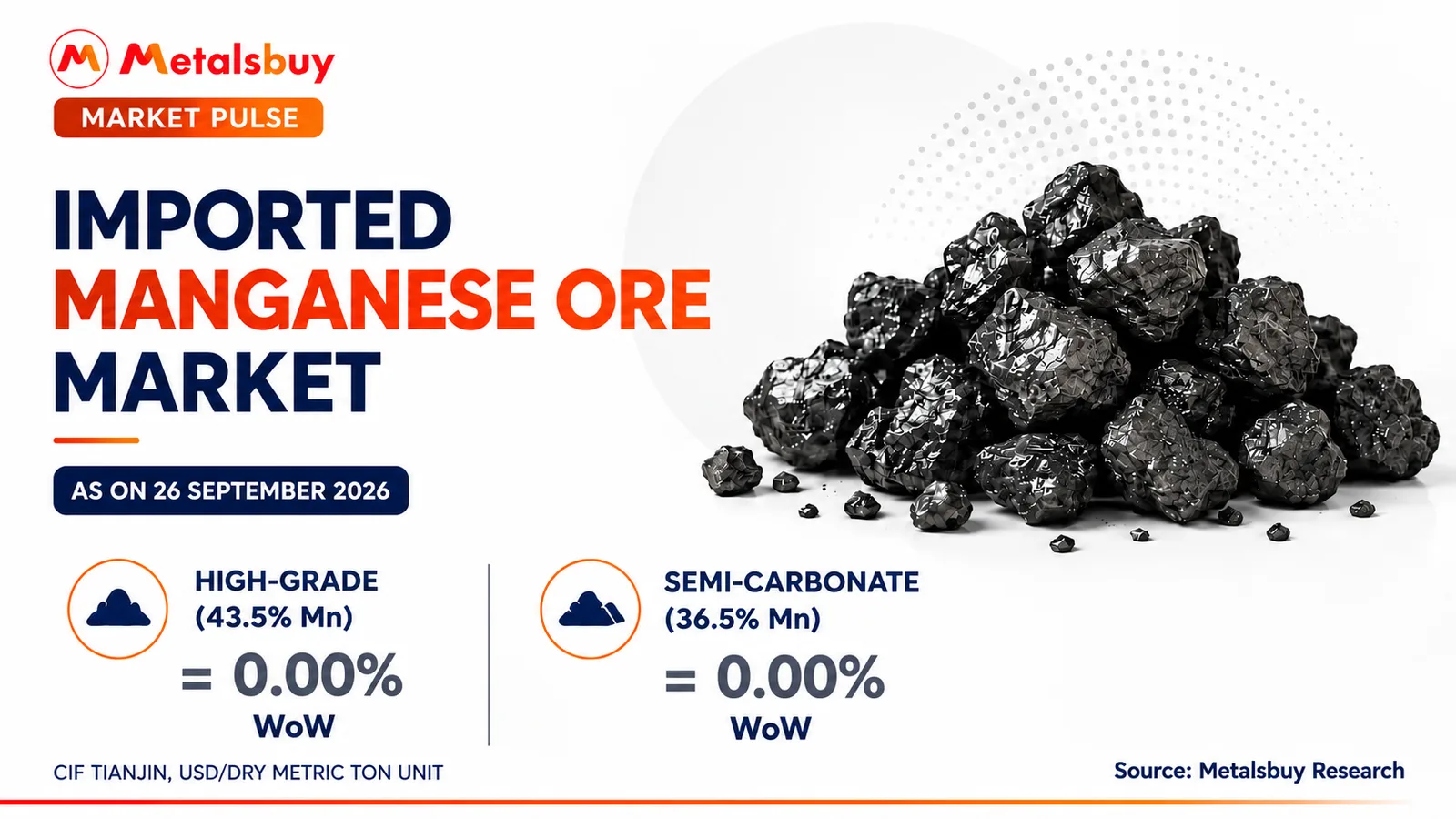
Imported manganese ore benchmarks remained unchanged during the latest weekly assessment, bringing a pause to the gradual decline seen over the previous two weeks. The 43.5% Mn high-grade index remained at $4.71/dmtu, while the 36.5% Mn semi-carbonate index held at $4.21/dmtu, both on a CIF Tianjin basis.
The stability is important after both grades moved lower in the previous week. High-grade ore had slipped by 0.21% and semi-carbonate by 0.71% in the September 18 assessment. This week, neither benchmark recorded any further movement, suggesting that the market has settled around current levels for the time being.
Key Numbers
• Spread between the two grades: $0.50/dmtu
• High-grade movement since 5 September: Down $0.02/dmtu
• Semi-carbonate movement since 5 September: Down $0.03/dmtu
High-grade ore stabilises at $4.71/dmtu
The 43.5% Mn high-grade index remained unchanged at $4.71/dmtu this week. This ends, at least for now, two consecutive weekly declines. The index had stood at $4.73/dmtu on September 5 before falling to $4.72/dmtu and then $4.71/dmtu over the following two assessments.
The overall correction has therefore been small. From September 5 to the latest assessment, high-grade ore has lost only $0.02/dmtu, or around 0.4%. The latest unchanged assessment reinforces the view that high-grade ore is currently moving within a narrow range rather than entering a sustained downward correction.
For buyers, this is an important distinction. The market has certainly lost some of the strength seen earlier in September, but there has not yet been enough movement to indicate a major change in replacement costs.
Semi-carbonate also finds support at $4.21/dmtu
The 36.5% Mn semi-carbonate index also remained unchanged this week at $4.21/dmtu. This follows the sharper $0.03/dmtu decline recorded in the previous assessment, when the index moved down from $4.24/dmtu to $4.21/dmtu.
Semi-carbonate had been the stronger of the two benchmarks at the beginning of September. The index rose to $4.24/dmtu on September 5 after gaining $0.05/dmtu, or 1.19%, before subsequently giving back part of that increase.
The latest unchanged number therefore suggests that the correction has paused. At $4.21/dmtu, semi-carbonate remains $0.03/dmtu below its September 5 level, but there has been no further erosion during the latest weekly assessment.
Spread remains unchanged at $0.50/dmtu
With neither benchmark moving this week, the difference between high-grade and semi-carbonate ore remains at $0.50/dmtu. The spread had widened in the previous week after semi-carbonate declined more sharply than high-grade ore.
The unchanged spread also reflects the broader stability in this week's numbers. Neither grade has gained an obvious advantage from the latest assessment, and buyers are now looking at essentially the same benchmark levels that prevailed a week ago.
This also makes the next weekly assessment more relevant. Another unchanged week would strengthen the case that imported ore has established a short-term floor around current levels, while a renewed decline would suggest that the September correction is still working through the market.
September movement remains limited
Looking beyond a single week gives a clearer picture of the market. On September 5, the 43.5% Mn high-grade index stood at $4.73/dmtu, while semi-carbonate was at $4.24/dmtu. The latest levels of $4.71 and $4.21 respectively mean that both benchmarks remain only marginally below where they started earlier this month.
High-grade ore is down around 0.4% from September 5, while semi-carbonate is lower by around 0.7%. These are still relatively small changes for manganese ore and support the view that September has so far been more about consolidation than a major change in market direction.
The pattern has nevertheless been different between the two grades. High-grade ore has moved down in very small increments, while semi-carbonate recorded a stronger increase at the beginning of the month followed by a larger correction. Both have now arrived at a week of stability.
China remains central to the direction of imported ore
China remains the largest manganese ore importing market globally and continues to have a major influence on seaborne pricing. Global manganese ore imports increased by around 10% in 2025 to 45.4 million tonnes, while China's imports increased by around 12% to 32.84 million tonnes. India was also among the markets recording higher imports during the year.
This is why Chinese port inventories, alloy production and purchasing behaviour remain important indicators for Indian buyers as well. Even when Indian producers are purchasing material on different delivery terms and from different origins, changes in the much larger Chinese market can influence international offers and replacement costs.
The latest weekly stability therefore needs to be watched alongside developments in China's silico manganese market and physical ore buying. A meaningful change in alloy production or ore procurement there can quickly feed back into seaborne manganese ore offers.
South African supply chain remains another factor to watch
There was also an important development on the supply side this week. South Africa's Transnet has started the process of selecting a private-sector partner for a new manganese export terminal as part of plans to expand the country's manganese export capacity by around 20%. The proposed arrangement would cover development and operation of the terminal over a 25-year period.
This is a longer-term development rather than something likely to affect next week's index. However, South Africa is a major supplier of manganese ore to global markets, including material used by Indian ferro-alloy producers, making improvements in its rail and port infrastructure relevant to future seaborne supply.
For buyers, logistics from producing countries remain an important part of the manganese ore equation. Ore availability alone does not determine seaborne supply; rail capacity, port handling and vessel movement can all influence the volumes reaching consuming markets.
Indian silico manganese market remains important for buyers
The Indian downstream market continues to provide the other side of the equation. Silico manganese assessments were active across Raipur, Raigarh, Durgapur and Vizag during the week, while export assessments were also available for material shipped through Vizag and Haldia.
For Indian producers, unchanged manganese ore benchmarks mean there is no fresh raw-material relief from this particular part of the cost structure this week, but equally there is no additional upward pressure from the international index. Actual production economics will continue to depend on the landed ore mix, power costs, coke and other inputs, along with achievable silico manganese realisations.
That makes the relationship between ore costs and alloy prices more important than looking at the ore index in isolation. A stable manganese ore market can provide some visibility on replacement costs, but margins will still depend heavily on what happens in the domestic alloy market.
Market pauses after the recent correction
The latest assessment leaves the imported manganese ore market in a relatively straightforward position. High-grade 43.5% Mn remains at $4.71/dmtu and semi-carbonate 36.5% Mn remains at $4.21/dmtu, with both recording zero week-on-week movement.
After two weeks of gradual softness, the market has stopped moving lower for now. The September correction remains limited, and there is not yet enough evidence to call either a fresh recovery or another leg of decline.
For Indian ferro-alloy producers and manganese ore buyers, the next few assessments will therefore be worth watching closely. If the benchmarks continue to hold around current levels, September may end as a period of consolidation after the volatility seen around the beginning of the month. If buying weakens again, however, the current stability could prove to be only a temporary pause.