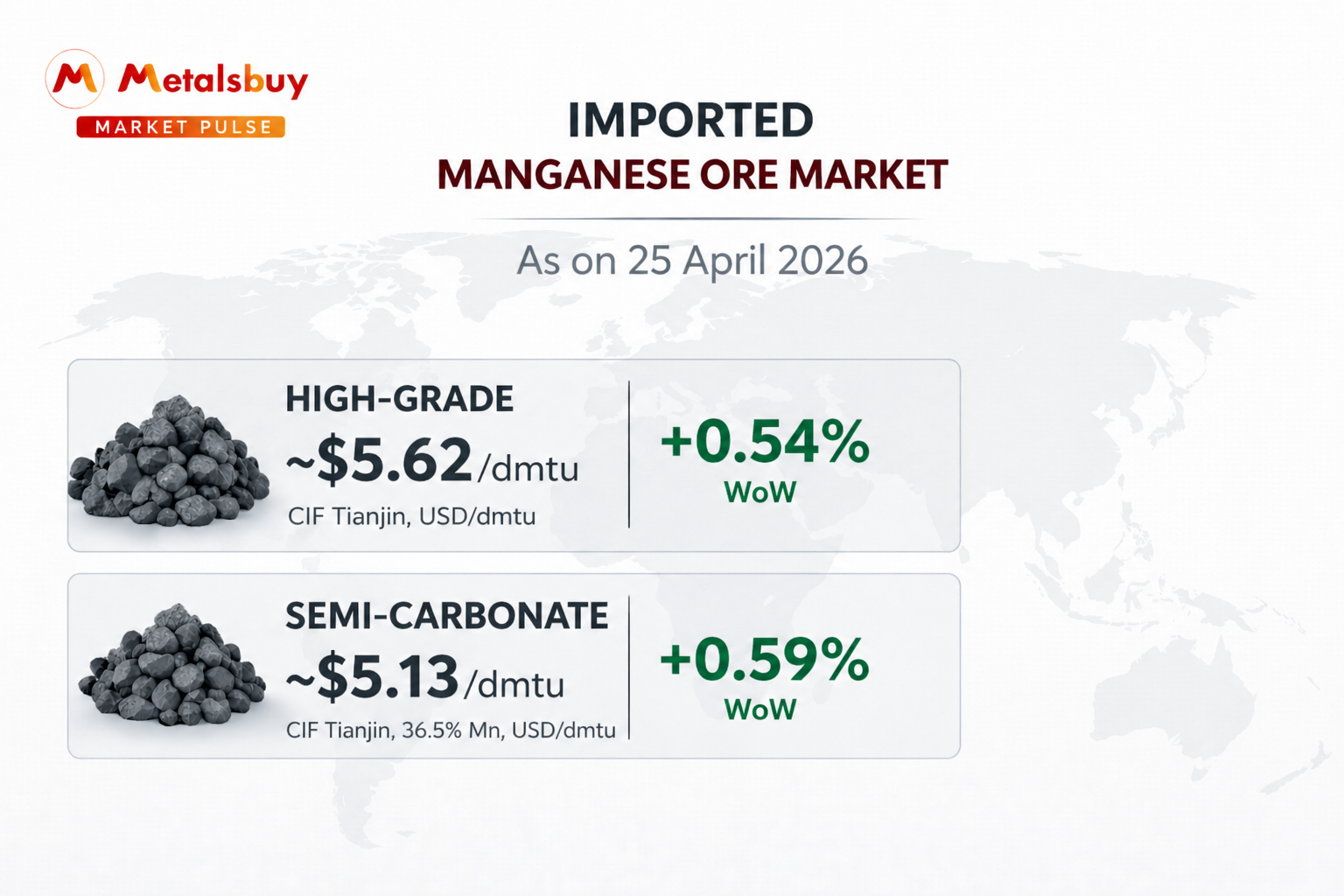
Key Numbers
- High Grade Ore (CIF Tianjin): ↑ 0.54% WoW
- Semi-Carbonate Ore (36.5% Mn): ↑ 0.59% WoW
- Trend: Firm with gradual upward movement
- Supply: Higher export volumes supported by logistics improvements
- India Sentiment: Stable, cautious procurement
Market Analysis
The imported manganese ore market recorded a measured yet consistent upward movement in the week ending 25 April 2026, reflecting a phase of strengthening fundamentals supported by both supply-side improvements and resilient downstream demand.
Benchmark high-grade ore prices in the CIF Tianjin market moved higher on a week-on-week basis, with semi-carbonate ore also following a similar upward trajectory. This parallel movement across grades indicates that the firmness in prices is not driven by isolated supply constraints but rather by a broader alignment of global demand and improved supply conditions. The pace of increase remains moderate, reinforcing the view that the market is currently experiencing controlled strengthening rather than speculative volatility.
A significant development underpinning this trend has been the marked improvement in logistics performance across key mining regions, which has enabled a notable increase in export volumes during the first quarter of the year. Rail transportation of manganese ore from mining hubs to export ports has seen a meaningful rise compared to the same period last year, reflecting sustained investments aimed at improving infrastructure efficiency and removing bottlenecks in the supply chain. As a result, global markets are witnessing greater availability of material without the typical disruptions that often accompany volume expansion.
At the same time, the cost environment for producers has shown a gradual increase, influenced by currency movements and rising freight costs observed since the beginning of the year. However, these cost pressures have been effectively balanced by higher shipment volumes, allowing producers to maintain competitive positioning in international markets. This interplay between cost escalation and volume growth has ensured that prices continue to firm up in a stable and sustainable manner, rather than reacting sharply to short-term fluctuations.
On the demand side, the market continues to draw support from steady procurement by manganese alloy producers, particularly in major consumption centers. The demand for alloys has remained consistent, which in turn has sustained the appetite for imported ore. Even as supply improves, this steady demand has prevented any meaningful downside in prices, contributing to a market environment characterized by equilibrium rather than excess.
Overall, the imported manganese ore market appears to be entering a phase where efficiency-led supply growth and stable demand are working in tandem, creating conditions for gradual price strengthening with reduced volatility. This marks a shift from earlier periods of sharp movements driven either by supply disruptions or sudden demand spikes.
Industry Impact
The current phase of the manganese ore market carries important implications across the value chain, particularly for ferro alloy producers, traders, and downstream steel manufacturers.
For ferro alloy producers, the improved availability of imported ore offers a more reliable procurement environment, enabling better production planning and reducing the risk associated with supply disruptions. At the same time, the stability in price movement allows producers to manage input costs with greater visibility, which is especially critical in a market where margins are closely linked to raw material fluctuations.
Importers and traders are likely to benefit from the increase in global shipment volumes, as it enhances liquidity and creates more opportunities for structured trade flows. The relatively predictable pricing environment also supports more informed decision-making, allowing market participants to align their strategies with medium-term trends rather than reacting to short-term volatility.
From the perspective of the steel industry, the stability in the manganese ore market indirectly contributes to a more balanced cost structure for ferro alloys, which are essential inputs in steelmaking. This, in turn, supports overall cost predictability within the steel value chain, particularly at a time when demand conditions require careful inventory and procurement management.
Outlook
Looking ahead, the imported manganese ore market is expected to continue operating within a firm yet stable range, supported by ongoing improvements in supply-side efficiency and sustained demand from alloy producers.
The increase in export volumes, driven by better logistics and infrastructure performance, is likely to ensure that supply remains adequate in the near term. At the same time, steady demand and persistent freight-related cost pressures are expected to provide a floor to prices, limiting any significant downside.
In this context, the market appears well-positioned to maintain its current trajectory of gradual strengthening with controlled volatility, reinforcing confidence across the broader ferro alloy and steel ecosystem.