KEY NUMBERS
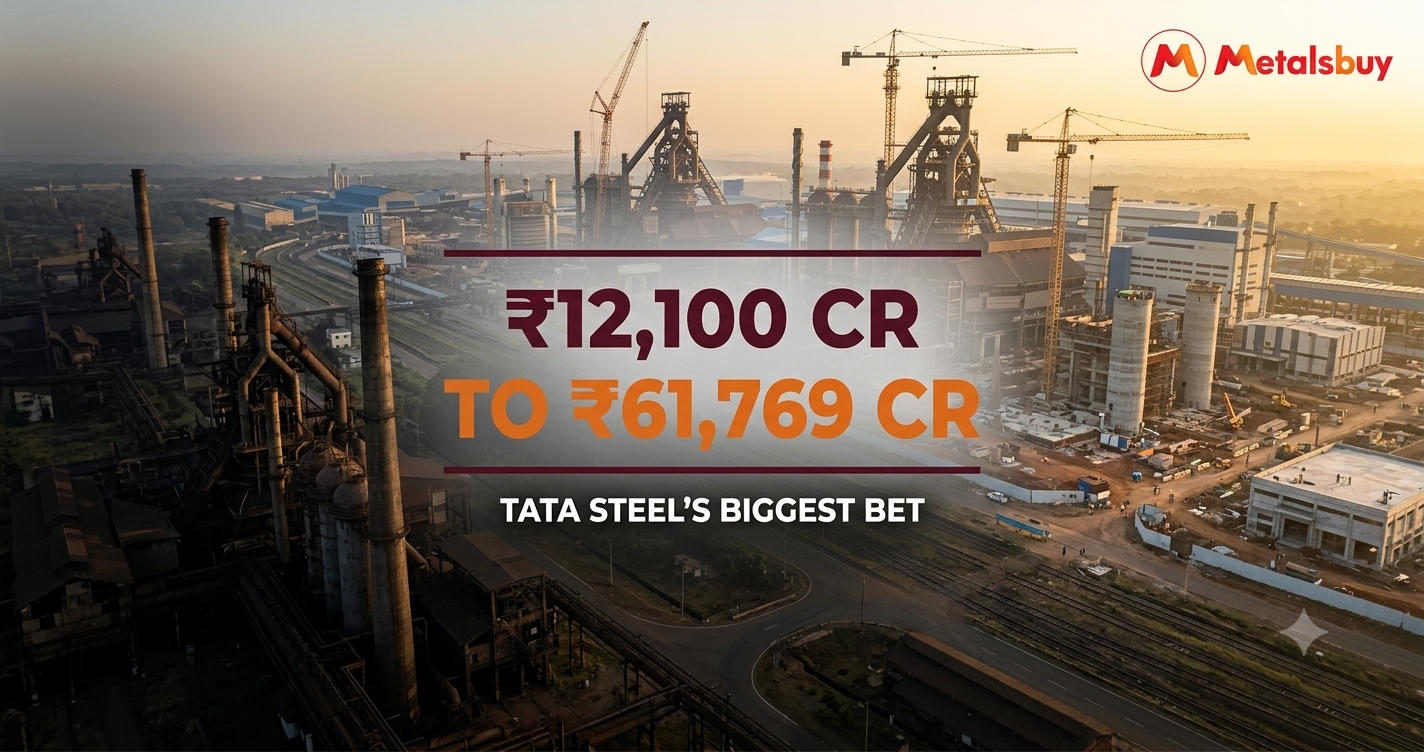
₹12,100 Crore : Tata Steel acquisition value for NINL
99.66% : Tata Steel’s ownership stake
2020 : Year NINL operations shut down
2022 : Tata Steel acquisition completed
₹61,769 Crore : Planned expansion investment
1 MTPA : Current production capacity
8.52 MTPA : Planned first-phase capacity
14,000 Jobs : Expected direct employment generation
₹1,417 Crore : Q4 FY25 revenue
₹313 Crore : Q4 FY25 EBITDA
4x Growth : Increase in EBITDA year-on-year
Odisha : Location of the expansion project
MARKET ANALYSIS
Some steel plants are built.
Some are expanded.
Very few are brought back from the dead.
That is what makes NINL one of the most fascinating stories in the Indian steel industry today.
Just a few years ago, the Neelachal Ispat Nigam Limited plant in Odisha had become a symbol of industrial distress. Burdened by debt, operational challenges and financial uncertainty, the facility shut down in 2020. Many believed the story had ended.
Instead, it was only beginning.
In 2022, Tata Steel acquired a 99.66 percent stake in NINL through the insolvency process for ₹12,100 crore. At the time, the acquisition generated headlines because of its scale. Today, the real story is what happened afterward.
Within nine months of restarting operations, the plant achieved full rated production capacity.
Now Tata Steel is preparing something far bigger.
A massive ₹61,769 crore investment program designed to transform NINL from a 1 million tonne steel plant into an 8.52 million tonne integrated steelmaking complex.
The numbers are staggering.
Tata Steel paid ₹12,100 crore to acquire the asset.
It now plans to invest more than five times that amount to rebuild it.
That is not a turnaround.
That is a complete reinvention.
FROM DISTRESSED ASSET TO STRATEGIC ASSET
Industrial history is full of failed plants.
Most remain failed.
What separates NINL is the speed with which its trajectory changed.
When Tata Steel entered the picture, the immediate challenge was restarting operations. Workforce confidence needed rebuilding. Supply chains needed restoring. Equipment required recommissioning. Market relationships had to be re-established.
Those steps alone would have been considered a success.
Instead, Tata Steel moved much faster.
The company successfully restored production, stabilized operations and brought the facility back to full rated capacity within months.
That operational recovery created the foundation for something much larger.
Expansion.
The planned increase from 1 MTPA to 8.52 MTPA represents one of the most ambitious steel growth projects currently underway in India.
Few companies commit ₹61,769 crore unless they see decades of future demand.
WHY ODISHA IS BECOMING INDIA’S STEEL POWERHOUSE
The NINL story is also an Odisha story.
The state already hosts some of India’s largest steel investments. JSW Steel recently began construction of its landmark Paradip project. Tata Steel continues expanding its footprint across the region. Multiple pellet, mining and downstream projects continue attracting investment.
NINL strengthens that trend.
The planned expansion will create approximately 14,000 direct jobs while supporting thousands of additional indirect opportunities across logistics, engineering, construction and industrial services.
For Odisha, this is not simply another steel project.
It is another step toward becoming one of the most important steelmaking regions in the world.
The concentration of steel investment now occurring in the state is difficult to ignore.
THE FINANCIAL TURNAROUND IS ALREADY VISIBLE
The market often focuses on future plans.
The current performance is equally important.
NINL reported revenue of ₹1,417 crore during Q4 FY25, representing growth of approximately 25 percent year-on-year.
More impressive was profitability.
Quarterly EBITDA reached ₹313 crore, nearly four times higher than the previous year.
Those numbers matter because they demonstrate that the turnaround is already producing results.
The plant is not simply surviving.
It is generating meaningful operating performance.
That gives credibility to the larger expansion story.
WHAT IT MEANS FOR FERRO ALLOYS
Every major steel expansion eventually becomes a ferro alloy story.
Steelmaking capacity does not increase without increasing demand for alloying materials.
Ferro manganese.
Silico manganese.
Ferrochrome.
All remain essential inputs in modern steel production.
An increase from 1 MTPA to 8.52 MTPA represents a substantial future source of alloy demand. The scale of the expansion could create long-term procurement opportunities across the ferro alloy value chain.
For suppliers, projects like NINL matter because they create visibility.
Large integrated steel plants consume materials for decades.
That is the kind of demand foundation industries are built upon.
WHY THIS MAY BE TATA STEEL’S MOST IMPORTANT PROJECT
Tata Steel has built steel plants.
Expanded steel plants.
Acquired steel plants.
NINL is different.
Because it combines all three.
The company acquired a distressed asset, restored operations, returned it to full production and is now preparing to build something significantly larger than what existed before.
Few projects illustrate operational execution more clearly.
The story is not about rescuing a steel plant.
The story is about creating a new one from the remains of an old one.
MARKET OUTLOOK
The Indian steel industry is entering a period defined by expansion.
Capacity additions are accelerating.
Infrastructure demand remains strong.
Manufacturing activity continues growing.
Companies are investing not for today’s market, but for the next generation.
NINL is one of the clearest examples of that confidence.
A plant that shut down in 2020 is now preparing for a ₹61,769 crore transformation.
A facility acquired for ₹12,100 crore is being rebuilt at more than five times that value.
That kind of commitment sends a powerful message.
Some companies see a distressed asset.
Tata Steel saw an opportunity.
And if current plans are realized, NINL may become one of the most successful industrial turnarounds India has ever seen.