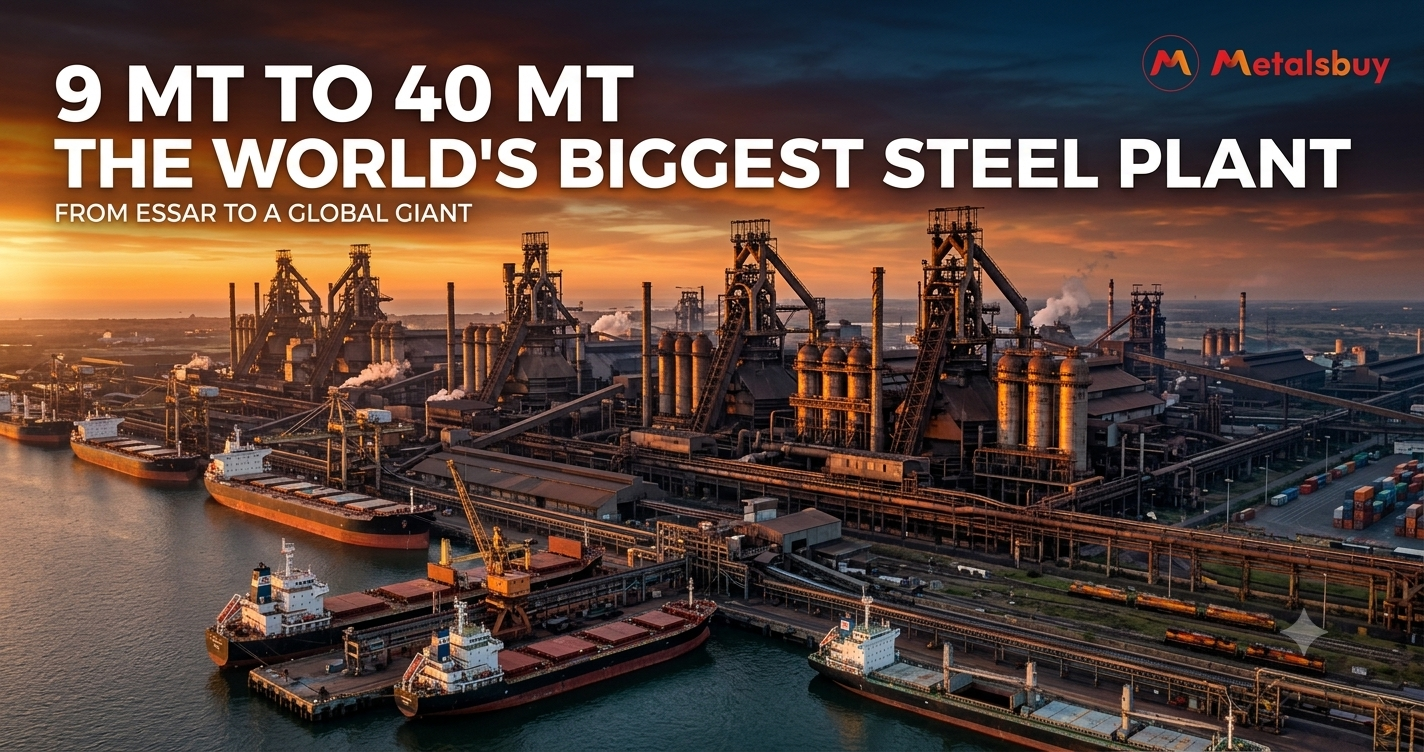
KEY NUMBERS
9 MTPA : Current crude steel capacity at Hazira
15 MTPA : Capacity after Phase 2 expansion completion
18 MTPA : Planned capacity under Phase 2A
24 MTPA : Planned capacity under Phase 2B by the end of the decade
40 MTPA : Long-term expansion potential under future phases
January 1, 2026 : Groundbreaking for Phase 2 expansion
2019 : ArcelorMittal and Nippon Steel acquired Essar Steel
Hazira, Gujarat : Location of the integrated coastal steel complex
AM/NS India : Joint venture between ArcelorMittal and Nippon Steel
World Scale : Potential to become the largest single-site coastal steel plant globally
MARKET ANALYSIS
Seven years ago, it was one of India’s biggest corporate insolvency stories.
Today, it could become the largest steel plant on Earth.
The transformation of Hazira may ultimately be remembered as one of the most remarkable turnarounds in modern industrial history.
When ArcelorMittal and Nippon Steel acquired Essar Steel through India’s insolvency process in 2019, the objective was straightforward: revive a distressed steel asset and restore production.
Few imagined what would come next.
What started as a turnaround story is rapidly becoming a mega-expansion story.
AM/NS India officially commenced Phase 2 expansion activities at Hazira on January 1, 2026. The project will increase crude steel production capacity from 9 million tonnes per annum to 15 million tonnes per annum.
For most steel companies, that would be the end of the story.
At Hazira, it is only the beginning.
Future expansion phases could lift capacity to 18 MTPA by 2028 and 24 MTPA by the end of the decade. Longer-term greenfield options under consideration could eventually take the complex to an astonishing 40 million tonnes per annum.
If achieved, Hazira would become the largest single-site coastal steelmaking facility in the world.
That is not an incremental expansion.
That is a complete redefinition of scale.
FROM BANKRUPTCY TO GLOBAL LEADERSHIP
The significance of the Hazira story lies in the contrast.
The asset entered insolvency proceedings as part of one of India’s largest corporate debt crises.
At the time, the focus was survival.
Operational continuity.
Debt resolution.
Workforce stability.
Today, the conversation has shifted dramatically.
The discussion is no longer about whether the plant survives.
The discussion is about whether it becomes the largest steelmaking complex on the planet.
Few industrial assets anywhere in the world have experienced such a dramatic change in trajectory within a single decade.
The turnaround reflects not only operational improvements but also the confidence global steelmakers now place in India’s long-term steel demand growth.
ArcelorMittal and Nippon Steel are not investing for today’s market.
They are investing for the next twenty years.
WHY HAZIRA MATTERS
Location is one of Hazira’s greatest advantages.
Unlike many inland steel plants, Hazira operates as a coastal integrated facility with direct access to maritime logistics infrastructure. Raw materials can be imported efficiently, and finished steel can be exported to global markets with lower logistics costs.
That matters enormously at scale.
As capacity expands beyond 15 million tonnes and eventually toward 24 million tonnes, logistics become just as important as steelmaking technology.
Hazira’s coastal position gives it a structural advantage that very few steel plants around the world can replicate.
It is one reason analysts believe the facility can continue growing for decades.
WHAT IT MEANS FOR THE INDIAN STEEL INDUSTRY
India is already the world’s second-largest steel producer.
The next challenge is scale.
The country’s steel demand continues growing faster than most major economies. Infrastructure development, manufacturing expansion, urbanisation and renewable energy investments all require enormous quantities of steel.
To meet that demand, India needs world-scale assets.
Hazira is becoming one of them.
The project also signals growing confidence among global steel majors regarding India’s long-term outlook. Few companies commit tens of billions of dollars to expansion projects unless they see sustained demand growth over decades.
Hazira is therefore not just a steel plant.
It is a statement about India’s industrial future.
WHAT IT MEANS FOR FERRO ALLOYS
Every additional tonne of steel capacity creates demand for raw materials and alloying inputs.
As Hazira expands from 9 MTPA toward 15 MTPA and beyond, consumption of ferro alloys is expected to increase significantly. Ferro manganese, silico manganese and other alloying materials remain critical components of steelmaking operations.
The impact becomes even larger when considering the scale of the planned expansion.
A plant producing 24 million tonnes of steel annually represents one of the largest sources of alloy demand anywhere in the world.
For suppliers across the ferro alloy value chain, projects of this magnitude strengthen long-term demand visibility.
MARKET OUTLOOK
Industrial history is full of large steel plants.
Very few become legends.
Hazira has the potential to join that category.
The journey from a distressed asset in insolvency proceedings to a potential 40 million tonne steelmaking complex would represent one of the most dramatic industrial transformations ever seen in India.
The expansion will take years.
Execution challenges remain.
Market conditions will change.
But one fact is already clear.
The future of Hazira looks very different from its past.
And if current plans are realised, the world’s largest steel plant may not be built in China, Japan or Korea.
It may be built in Gujarat.