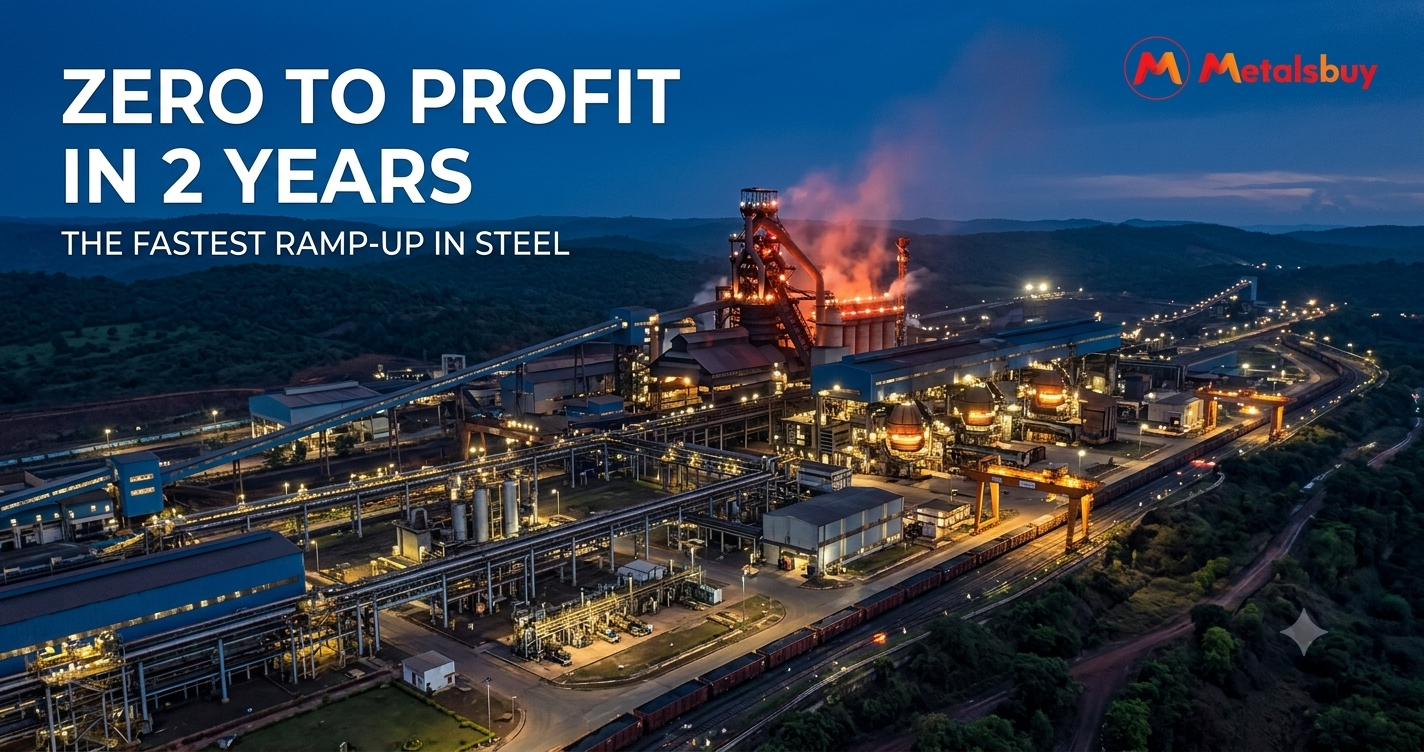
KEY NUMBERS
23.25 Lakh Metric Tonnes : Highest-ever annual production in FY26
62% Growth : Increase in production compared to FY25
24.55 Lakh Metric Tonnes : Steel sales achieved during FY26
74% Growth : Increase in sales compared to FY25
80% Capacity Utilisation : Average utilisation achieved during FY26
2 Years : Time taken to achieve profitability after commissioning
Nagarnar, Chhattisgarh : Location of the integrated steel plant
FY26 : First profitable year of operations
NMDC Steel : India’s newest large integrated steel producer
MARKET ANALYSIS
Most steel plants spend years trying to become profitable.
NMDC Steel did it in two.
That is what makes this story remarkable.
When the Nagarnar Steel Plant was commissioned, many industry observers viewed the project with skepticism. NMDC had decades of experience mining iron ore, but steelmaking is an entirely different business. Building a steel plant is difficult. Running one efficiently is even harder.
The assumption was simple.
A government-owned mining company could produce iron ore.
Whether it could compete in steel was another question entirely.
Two years later, the answer appears to be clear.
NMDC Steel has reported its first profitable year of operations while simultaneously delivering its highest-ever production and sales performance. During FY26, the company produced 23.25 lakh metric tonnes of steel, representing a 62 percent increase over the previous year. Sales rose even faster, climbing 74 percent to 24.55 lakh metric tonnes.
For a newly commissioned integrated steel plant, those numbers are exceptional.
But the most impressive number may be the one that receives the least attention.
Capacity utilisation.
The plant achieved an average utilisation rate of approximately 80 percent during FY26.
In the steel industry, reaching those levels so quickly is rare. Greenfield steel projects often require years of operational fine-tuning before approaching optimal utilisation. Technical challenges, supply chain issues, workforce training and market development frequently slow the process.
Nagarnar appears to have skipped much of that learning curve.
WHY THE RAMP-UP IS SO IMPORTANT
Steelmaking is a scale business.
A blast furnace operating at low utilisation loses money. Fixed costs remain high while production volumes remain limited. Profitability generally comes only after plants achieve sustained operational stability and meaningful utilisation rates.
That is why new steel projects often spend years moving through the ramp-up phase.
NMDC Steel accelerated that process dramatically.
Within two years, the company moved from commissioning to profitability while simultaneously reaching utilisation levels that many producers take significantly longer to achieve.
The achievement becomes even more significant when viewed against the backdrop of global steel history.
Few large integrated steel plants anywhere in the world have achieved profitability this quickly after commencing operations.
That is what makes Nagarnar more than a company story.
It is becoming a case study.
THE CHHATTISGARH ADVANTAGE
The location matters.
Nagarnar sits in one of India’s most resource-rich regions.
Chhattisgarh already hosts iron ore mines, sponge iron plants, ferro alloy units, rolling mills and integrated steel facilities. Raw material availability, industrial infrastructure and logistics networks provide a natural advantage for steel production.
The state’s steel ecosystem has matured steadily over the last decade.
Today, Bhilai, Raipur and Nagarnar are emerging as three pillars of a rapidly expanding metals cluster.
The success of NMDC Steel reinforces that trend.
Every tonne produced at Nagarnar supports mining activity, transportation networks, ancillary industries and downstream manufacturing across the region.
The benefits extend well beyond the plant gates.
WHAT IT MEANS FOR FERRO ALLOYS
For the ferro alloy industry, this story matters more than it may initially appear.
Higher steel production means higher alloy consumption.
As Nagarnar ramps up production, demand for ferro manganese, silico manganese and other steelmaking inputs rises alongside it. The stronger the plant performs, the stronger the long-term demand outlook becomes for suppliers across the value chain.
The significance is amplified by geography.
Many ferro alloy producers operate within the broader Chhattisgarh and eastern India industrial corridor. A successful large-scale steel producer creates stable demand and strengthens the regional ecosystem.
In simple terms, every steel success story eventually becomes a ferro alloy success story.
WHY THIS CHANGES THE NMDC STORY
For decades, NMDC’s identity was straightforward.
India’s largest iron ore producer.
That reputation remains intact.
What has changed is the company’s role within the value chain.
Instead of simply supplying raw materials to steelmakers, NMDC is now proving that it can successfully compete as a steel producer itself.
That transformation is strategically important.
It creates greater value addition within the company, diversifies revenue streams and reduces dependence on the cyclical nature of iron ore markets.
Most importantly, it demonstrates that the move from mining to steelmaking can work.
Many questioned whether it would.
The market now has its answer.
MARKET OUTLOOK
The first profitable year is important.
The next few years are even more important.
The challenge for NMDC Steel now shifts from proving viability to sustaining performance. Higher utilisation, operational efficiency improvements and market expansion will determine how large a role Nagarnar eventually plays within India’s steel landscape.
The early signs are encouraging.
Production is growing.
Sales are growing.
Profitability has arrived faster than expected.
For a project many doubted, the turnaround has been remarkable.
Two years ago, Nagarnar was a new steel plant searching for its place in the market.
Today, it is one of the most compelling growth stories in the Indian steel industry.