KEY NUMBERS
₹30,000 Crore : Estimated Bhilai Steel Plant expansion investment
3.5 MTPA : Additional capacity expected from Bhilai expansion
23.25 Lakh Tonnes : NMDC Steel production in FY26
80% : Capacity utilisation achieved by NMDC Steel
₹30,000 Crore Revenue Target : Godawari Power’s Vision 2031
₹7,000 Crore : Planned integrated steel plant investment by Godawari Power
Bhilai : India’s largest rail producer
Nagarnar : India’s fastest-ramping integrated steel plant
Raipur : One of India’s largest steel and ferro alloy clusters
Chhattisgarh : Emerging center of India’s steel growth story
MARKET ANALYSIS
For decades, India’s steel story revolved around a handful of places.
Jamshedpur.
Bokaro.
Rourkela.
Burnpur.
Today, another state is quietly building a case to join that list.
Chhattisgarh.
And unlike previous industrial success stories, this one is not being driven by a single company.
It is being driven by three.
Bhilai.
Nagarnar.
Raipur.
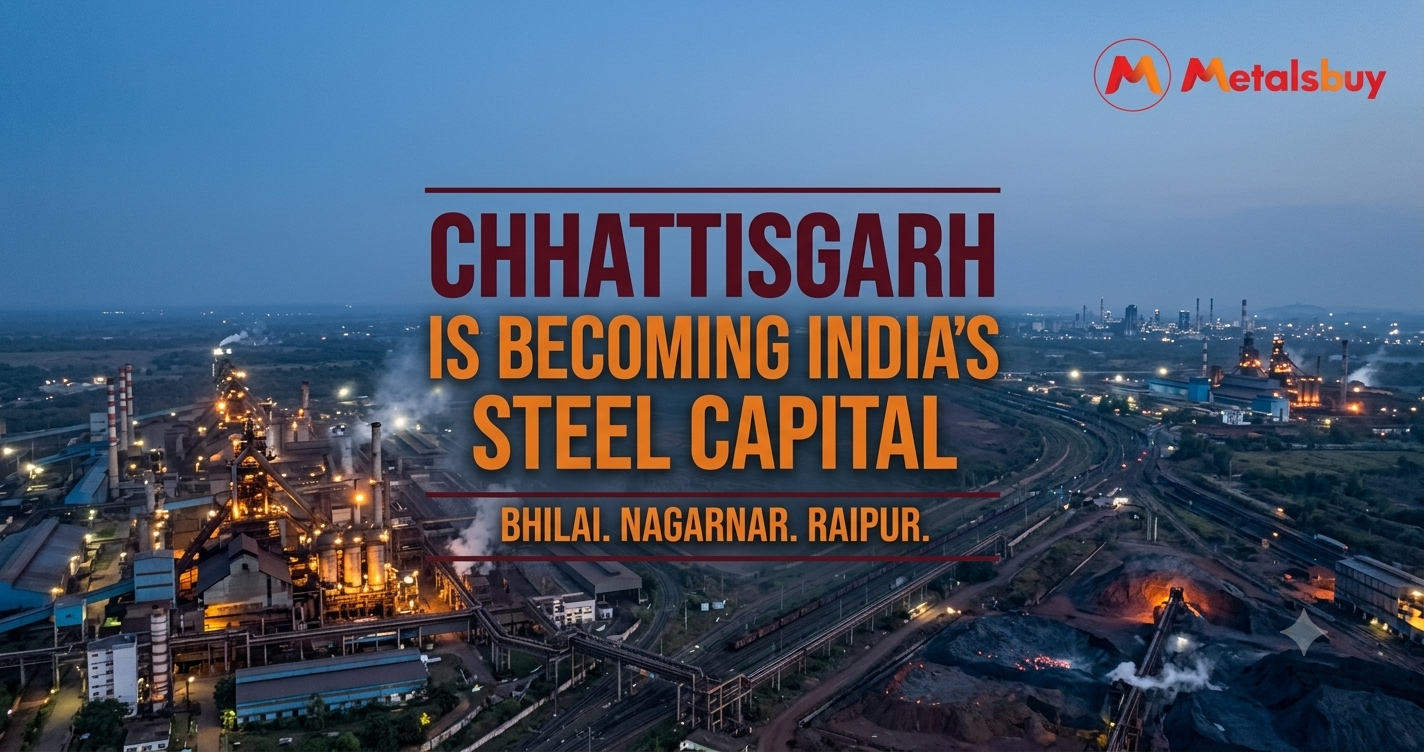
Three separate industrial centers. Three major expansion stories. Three different business models. One common outcome.
A state that is rapidly becoming one of the most important steel-producing regions in the country.
The remarkable part is that this transformation is happening largely outside the national spotlight.
While attention remains focused on Odisha’s mega projects, JSW’s expansion plans and global steel trade developments, Chhattisgarh is steadily building one of the most integrated steel ecosystems anywhere in India.
The evidence is becoming difficult to ignore.
BHILAI IS PREPARING FOR ITS BIGGEST EXPANSION IN DECADES
Every steel-producing nation has a flagship plant.
For India, Bhilai is one of them.
The plant remains the backbone of India’s railway infrastructure. Almost every railway line laid across the country traces part of its journey back to Bhilai. Rails, heavy structurals and specialty steel products have made the plant one of the most strategically important industrial assets in the nation.
Now it is preparing for another chapter.
Expansion plans estimated at approximately ₹30,000 crore could add around 3.5 million tonnes of additional capacity over the coming years. The project forms a key component of SAIL’s broader modernization and growth strategy.
The significance extends beyond steel production.
Every major expansion generates demand for contractors, engineering firms, transportation providers, equipment manufacturers and raw material suppliers.
For Chhattisgarh, Bhilai’s growth remains an economic multiplier.
NAGARNAR HAS ALREADY DONE WHAT MANY THOUGHT WAS IMPOSSIBLE
If Bhilai represents history, Nagarnar represents the future.
Just two years after commencing operations, NMDC Steel achieved profitability while reaching average capacity utilisation of approximately 80 percent.
Production surged 62 percent during FY26.
Sales increased 74 percent.
Few integrated steel plants anywhere in the world have scaled so quickly.
The achievement is important because it proves something many doubted.
A government-owned mining company successfully built and ramped up a large integrated steel operation faster than most private-sector projects.
Nagarnar is no longer viewed as a new plant.
It is becoming a benchmark.
RAIPUR IS BUILDING THE NEXT GENERATION OF STEEL COMPANIES
The third pillar of the story sits in Raipur.
For years, the city has been one of India’s most important centers for secondary steelmaking, sponge iron production and ferro alloy manufacturing. Thousands of businesses operate across the broader metals value chain.
Today, some of those companies are becoming national players.
Godawari Power and Ispat recently unveiled Vision 2031, targeting ₹30,000 crore in revenue through a combination of steel expansion, downstream value addition and energy infrastructure development. The plan includes a new integrated steel plant, cold rolling facilities and energy storage investments.
The significance is not limited to one company.
It demonstrates how the region’s industrial ecosystem is maturing.
What was once known primarily as a steel trading and processing hub is increasingly producing large-scale industrial champions.
WHY THIS MATTERS FOR FERRO ALLOYS
No state in India can become a steel capital without becoming a ferro alloy capital.
The two industries grow together.
Steel requires ferrochrome, silico manganese and ferro manganese. As steel capacity expands, alloy demand follows.
Chhattisgarh already possesses one of the largest concentrations of ferro alloy producers in India. The combination of Bhilai’s expansion, Nagarnar’s growth and Raipur’s industrial development creates a powerful demand foundation for the sector.
That is why this story matters beyond steel.
It reflects the strengthening of an entire industrial ecosystem.
Mines.
Steel plants.
Ferro alloy units.
Rolling mills.
Engineering companies.
Logistics providers.
Each expansion reinforces the others.
THE BIGGER SHIFT NOBODY IS TALKING ABOUT
For years, India’s steel growth story was concentrated in a few legacy centers.
That concentration is changing.
States like Chhattisgarh are becoming increasingly important because they offer something few regions can match:
Raw materials.
Industrial infrastructure.
Power availability.
Manufacturing expertise.
And perhaps most importantly, room to grow.
The next decade of Indian steel expansion will not be built entirely by traditional steel cities.
New centers are emerging.
Chhattisgarh is one of the strongest examples.
MARKET OUTLOOK
Industrial leadership is rarely announced.
It develops gradually.
One investment at a time.
One plant at a time.
One expansion at a time.
That is exactly what is happening in Chhattisgarh.
Bhilai is expanding.
Nagarnar is scaling.
Raipur is producing larger industrial champions.
Individually, each story is important.
Together, they tell something bigger.
India’s next steel capital may already be taking shape.
And it is happening faster than most people realize.