KEY NUMBERS
8 Billion Tonnes : Total iron ore shipped by Rio Tinto from Pilbara
60 Years : Since Rio Tinto’s first Pilbara shipment
19 May 2026 : Date of the milestone shipment
Juno Horizon : Vessel carrying the 8 billionth tonne shipment
Nippon Steel Corporation : Destination customer
Pilbara, Western Australia : Source of the iron ore
1966 : Year of Rio Tinto’s first Pilbara shipment
161,000+ : Equivalent number of Perth Optus Stadiums that could be built using the steel
134,000+ : Equivalent number of Tokyo Skytree towers
46,000+ : Equivalent number of Beijing National Stadiums
MARKET ANALYSIS
Some numbers are so large they become meaningless.
Eight billion tonnes is one of them.
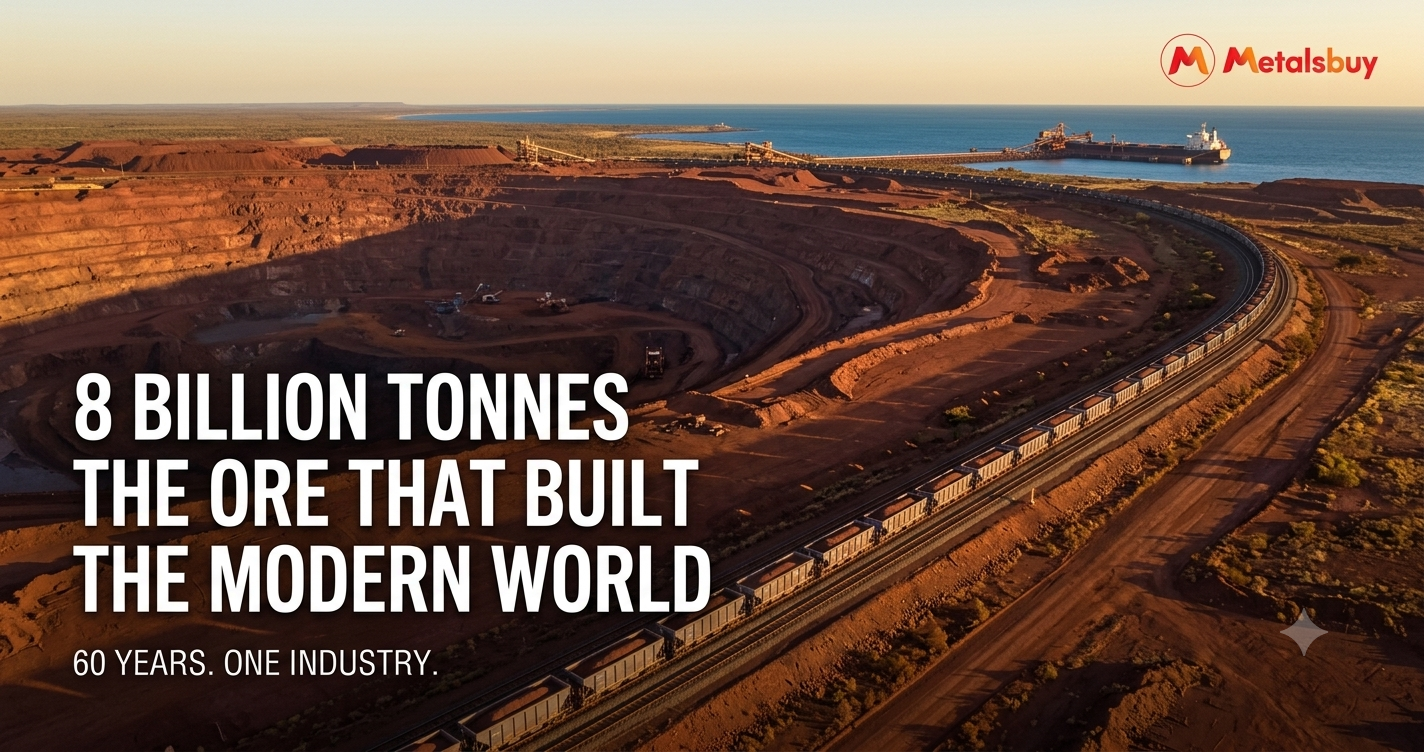
Most people cannot visualize one billion tonnes of anything, let alone eight billion. Yet that is exactly the milestone Rio Tinto crossed this month as it celebrated the shipment of its 8 billionth tonne of iron ore from Western Australia’s Pilbara region.
The milestone shipment departed from Cape Lambert aboard the Juno Horizon on May 19, bound for Nippon Steel Corporation in Japan.
On paper, it is simply another cargo.
In reality, it represents sixty years of industrial history.
Iron ore is rarely celebrated. Unlike finished steel, automobiles, skyscrapers or bridges, it remains hidden deep within supply chains. Yet nearly every modern city, railway network, airport, power station and manufacturing facility owes its existence to raw materials extracted from mines like those in Pilbara.
The story of modern industrialization is, in many ways, the story of iron ore.
And few companies have played a larger role in that story than Rio Tinto.
THE NUMBER IS ALMOST IMPOSSIBLE TO IMAGINE
Eight billion tonnes is such a large figure that it requires context.
According to Rio Tinto, that volume of iron ore could produce enough steel to build more than 161,000 Perth Optus Stadiums.
Or more than 134,000 Tokyo Skytrees.
Or more than 46,000 Beijing National Stadiums.
Those comparisons help illustrate the scale.
But perhaps the most important comparison is simpler.
A significant portion of the modern world’s infrastructure exists because of iron ore mined in Pilbara.
The region has become one of the most important raw material hubs on Earth, supplying steelmakers across Asia and beyond.
From Japan and South Korea to China and increasingly India, Pilbara ore has helped fuel decades of industrial growth.
WHY THIS MATTERS TO INDIA
At first glance, this may appear to be an Australian mining story.
It is not.
It is also an Indian steel story.
India is now the world’s second-largest steel producer and one of the fastest-growing steel markets globally. As steel production expands, demand for iron ore, metallurgical coal and ferro alloys rises alongside it.
While India possesses significant domestic iron ore reserves, global iron ore markets still influence pricing, trade flows and supply chain dynamics across the industry.
The next billion tonnes Rio Tinto ships will increasingly be influenced by Indian demand growth.
That is because India is one of the few major economies still adding large volumes of steelmaking capacity.
As China matures and growth slows, India is becoming the industry’s most important growth engine.
THE PILBARA EFFECT
Few mining regions have had a greater impact on global industry than Pilbara.
What began as a remote mining frontier evolved into one of the world’s largest resource-producing regions. Massive mines, rail networks, export terminals and logistics systems now move hundreds of millions of tonnes of iron ore annually.
The scale is extraordinary.
Entire towns exist because of iron ore.
Dedicated railways stretch hundreds of kilometres across the Australian outback.
Some of the world’s largest bulk carriers regularly transport Pilbara ore to steel mills across Asia.
The region has become an essential link in the global steel supply chain.
Without Pilbara, modern steelmaking would look very different.
WHAT IT MEANS FOR FERRO ALLOYS
Iron ore is the foundation of steelmaking.
Ferro alloys are what transform that steel into specialized products.
Every tonne of steel produced using iron ore ultimately requires alloying materials such as ferro manganese, silico manganese and ferrochrome to achieve the desired strength, durability and performance characteristics.
That is why iron ore milestones matter beyond mining.
When steel production grows, demand rises throughout the value chain.
The relationship between iron ore and ferro alloys is direct.
More steel means more alloy consumption.
The next phase of global steel growth therefore benefits not only miners but also alloy producers, logistics providers and industrial manufacturers.
THE BIGGER LESSON
The most interesting part of the story is not the number itself.
It is what the number represents.
Eight billion tonnes is not simply a mining achievement.
It is evidence of sixty years of industrialization.
Every major economic transformation of the last half-century required steel.
And every tonne of that steel began somewhere in the raw material chain.
Pilbara happened to become one of the world’s most important starting points.
Today, as countries invest in infrastructure, renewable energy, transportation networks and manufacturing, that demand continues.
The modern world still runs on steel.
And steel still begins with iron ore.
MARKET OUTLOOK
Rio Tinto’s 8 billion tonne milestone offers a reminder of something the commodity industry sometimes forgets.
Scale matters.
The largest industrial stories are often measured not in months or quarters, but in decades.
Sixty years after its first shipment left Western Australia, Pilbara remains one of the most strategically important mining regions on Earth.
The next billion tonnes may arrive faster than the last.
And increasingly, India’s growth story will help drive it.
Because while the first eight billion tonnes helped build the modern world, the next billion may help build India’s future.