KEY NUMBERS
A$2.88 Billion : State and federal support committed to Whyalla Steelworks
A$319 Million : Additional funding announced on June 4, 2026
1.2 MTPA : Current steelmaking capacity of Whyalla Steelworks
February 2025 : Whyalla entered administration
2 Final Bidders : Remaining contenders for the acquisition
200 PJ : Gas supply agreement signed with Santos
2030 : Planned transition toward DRI based steelmaking
South Australia : Location of the integrated steelworks
BlueScope : Eliminated from the bidding process
Jindal Steel : Final shortlisted international bidder
MARKET ANALYSIS
A decade ago, Indian steel companies were buying mines.
Today, they are bidding for entire steel industries.
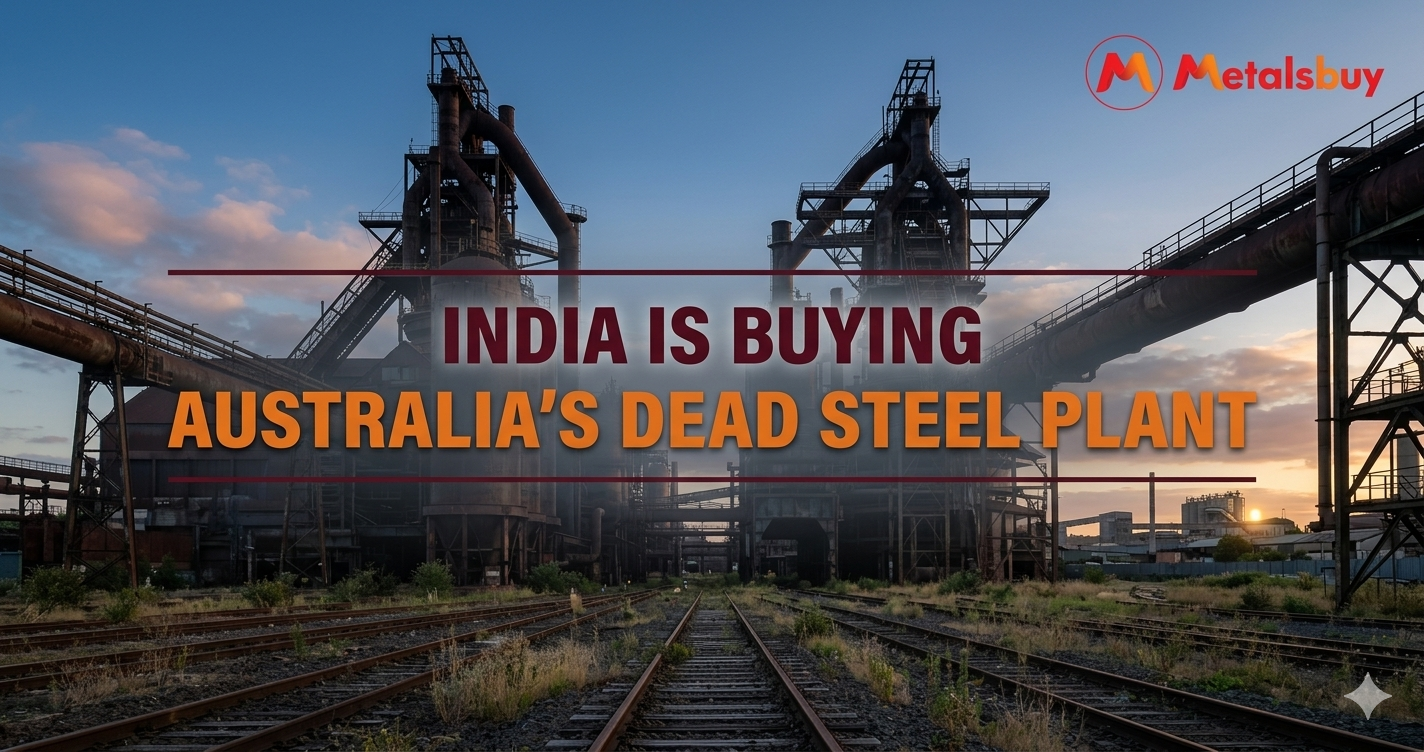
The race for Australia’s Whyalla Steelworks has entered its final stage, and one of the last two bidders standing is India’s Jindal Steel. The development is remarkable not only because of the asset involved, but because of what it says about the changing balance of industrial confidence between developed and emerging economies.
Whyalla is not a greenfield project. It is not a future investment. It is a steel plant that already exists, already produces steel and already sits on strategic infrastructure. The integrated operation includes mining assets, rail connectivity, port access and steelmaking facilities. In industrial terms, it is a complete pit to port ecosystem.
Yet the plant collapsed into administration in February 2025.
Since then, governments have stepped in repeatedly to prevent the operation from disappearing. State and federal authorities have now committed more than A$2.88 billion to stabilise the business, with another A$319 million announced this week. At the same time, a 200 petajoule gas agreement with Santos has been secured to support a long term transition toward DRI based steelmaking from 2030 onward.
The most interesting part of the story is not that the plant failed.
Industrial assets fail all the time.
The story is who wants to own it now.
Australia’s own steel giant, BlueScope, has already been eliminated from the process. One of the world’s most developed economies is stepping away from the asset while one of India’s largest steel producers is stepping forward.
That tells us something important about where steel executives see future opportunity.
India’s steel industry is currently expanding faster than almost any major steel producing nation. Capacity additions are underway across Odisha, Chhattisgarh, Karnataka and Maharashtra. Domestic demand remains supported by infrastructure, manufacturing and construction activity. Indian companies are no longer thinking only about securing raw materials.
They are thinking globally.
The Whyalla bid reflects that shift.
WHY WHYALLA MATTERS
On paper, 1.2 million tonnes of steel capacity is not a transformative number for a company of Jindal’s size.
Strategically, however, the asset offers something much more valuable.
Location.
Australia remains one of the most resource rich countries in the world. Access to iron ore, proximity to Asian markets and established export infrastructure make the country an attractive base for long term industrial operations. Any future DRI transition would also align with the global movement toward lower emission steelmaking.
The asset therefore represents more than a steel plant.
It represents a platform.
For Indian companies seeking international expansion, platforms matter.
WHAT IT MEANS FOR FERRO ALLOYS
The ferro alloy implications are not immediate, but they are meaningful.
Steel plants consume ferrochrome, silico manganese and ferro manganese regardless of whether they are located in India, Australia or Europe. Ownership changes do not alter metallurgical requirements.
What changes is procurement strategy.
Indian steel companies often operate with different sourcing networks, trading relationships and raw material strategies than their Western counterparts. If Whyalla eventually comes under Indian ownership, purchasing decisions throughout the supply chain could gradually evolve.
The bigger message for ferro alloy producers is even more important.
Indian steelmakers are no longer simply buyers of alloys.
They are becoming owners of global steel assets.
That changes the industry’s center of gravity.
INDUSTRY IMPACT
The Whyalla process is being closely watched across the steel sector because it highlights a broader trend that has been developing for several years.
Many Western economies are struggling with ageing industrial assets, rising energy costs and tightening environmental regulations. At the same time, several Indian steel producers continue expanding aggressively with stronger domestic growth prospects and more ambitious investment plans.
This does not mean Western steelmaking is disappearing.
It means ownership patterns are changing.
Capital follows confidence.
And right now, confidence is flowing toward India.
MARKET OUTLOOK
The bidding process is not over.
Another contender remains in the race and the final decision has yet to be announced.
However, regardless of the outcome, the symbolism is already powerful.
A steel plant that entered administration in Australia is now being viewed as a strategic opportunity by an Indian steel producer.
That would have seemed unlikely twenty years ago.
Today, it feels increasingly normal.
India’s steel industry is no longer merely participating in the global market.
It is beginning to shape it.