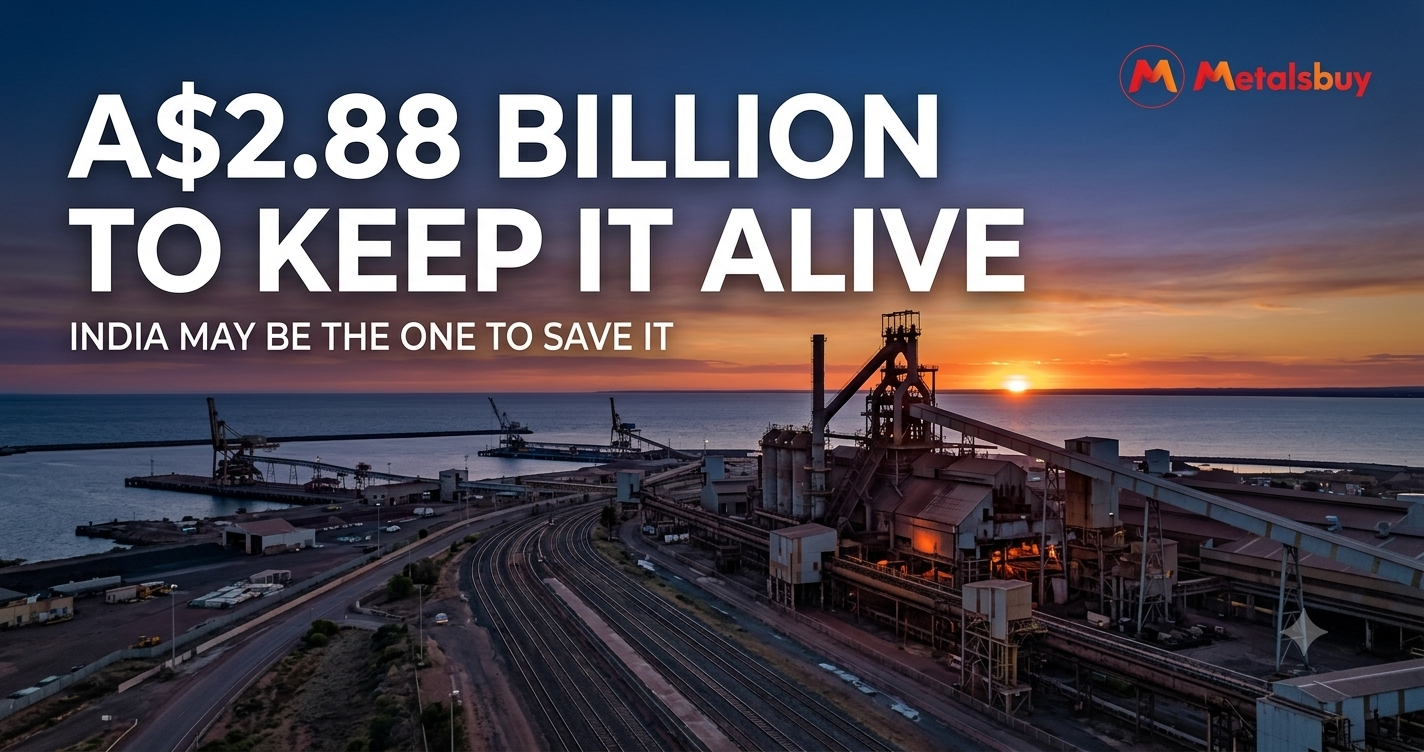
KEY NUMBERS
A$2.88 Billion : Total state and federal support committed to Whyalla Steelworks
A$319 Million : Additional funding announced in South Australia’s 2026-27 budget
1.2 MTPA : Steelmaking capacity at Whyalla Steelworks
May 27, 2026 : Final two bidders shortlisted
2 Final Bidders : M Resources and Jindal Steel
February 2025 : Whyalla entered administration
200 PJ : Gas supply agreement signed with Santos
2030 : Target year for DRI transition plans
Angul, Odisha : Home to one of the world’s most advanced DRI operations
Whyalla, South Australia : Location of the steelworks
MARKET ANALYSIS
Australia spent billions trying to save the plant.
India may end up owning it.
That is the remarkable reality emerging from one of the most closely watched steel transactions in the world today.
The race for Whyalla Steelworks has entered its final stage. After months of uncertainty, South Australia has narrowed the field to just two bidders. One is Australian mining company M Resources.
The other is India’s Jindal Steel.
The outcome will determine the future of Australia’s most strategically important steel asset. But the story is much bigger than a simple acquisition.
It is about where the future of steelmaking confidence now resides.
For decades, industrial assets in developing economies were acquired by companies from wealthier nations. Today, the direction of travel is beginning to reverse.
An Indian steel company is now one decision away from owning one of Australia’s most famous steel plants.
That would have been difficult to imagine twenty years ago.
Today, it feels entirely plausible.
WHYALLA’S LONG ROAD TO SURVIVAL
Whyalla is not a new steel plant.
It is one of Australia’s oldest and most important industrial assets.
The integrated operation includes mining infrastructure, rail connections, export facilities and steelmaking operations. It remains Australia’s only integrated long-products steelworks and continues producing critical products for construction and infrastructure markets.
Yet despite its strategic importance, the facility entered administration in February 2025.
Since then, governments have stepped in repeatedly to keep operations alive.
The numbers are extraordinary.
State and federal authorities have committed more than A$2.88 billion in support packages aimed at preserving the operation and securing its future. This week, South Australia added another A$319 million through its latest budget.
The message is clear.
Australia views Whyalla as too important to lose.
The challenge is finding the right owner to take it forward.
WHY JINDAL IS DIFFERENT
This is where the story becomes particularly interesting.
Most discussions about Whyalla focus on the steel plant itself.
Industry observers are increasingly focused on who is bidding.
Jindal Steel is not simply another steel producer.
The company operates one of the most advanced direct reduced iron facilities in the world at its Angul complex in Odisha. It has extensive experience in large-scale integrated steelmaking and has invested heavily in technologies that many believe will shape the next generation of lower-carbon steel production.
That expertise matters.
Whyalla’s long-term future increasingly revolves around its planned transition toward DRI-based steelmaking. A 200 petajoule gas agreement signed with Santos is intended to support that transition from around 2030 onward.
In other words, the future owner will need more than financial resources.
They will need technical capability.
That is one reason industry analysts are paying close attention to Jindal’s involvement.
WHAT IT MEANS FOR INDIA
If successful, the acquisition would represent far more than an overseas expansion.
It would signal a new phase in the evolution of India’s steel industry.
For years, Indian steelmakers focused on building domestic capacity.
Then they began acquiring mines.
Now they are increasingly looking at strategic international assets.
The shift reflects growing confidence.
India is now the world’s second-largest steel producer and one of the fastest-growing steel markets globally. Domestic producers have become larger, more sophisticated and more internationally ambitious.
The Whyalla bid is a reflection of that evolution.
The narrative has changed.
India is no longer simply competing in global steel markets.
It is beginning to shape them.
WHAT IT MEANS FOR FERRO ALLOYS
The immediate impact on ferro alloy demand is limited.
The strategic implications are much larger.
Every integrated steel operation consumes alloying materials. Whether located in Australia, Europe or India, steelmaking depends on ferrochrome, silico manganese and ferro manganese.
Ownership changes can influence sourcing strategies, supplier relationships and procurement networks.
More importantly, the transaction highlights the growing influence of Indian steel companies within the global industrial ecosystem.
As Indian producers expand internationally, their decisions increasingly affect commodity flows well beyond India’s borders.
That matters for everyone operating in the metals value chain.
INDUSTRY IMPACT
The Whyalla process highlights a broader trend that extends beyond Australia.
Many mature industrial economies are struggling with ageing steel assets, rising energy costs and increasingly complex environmental requirements.
At the same time, producers in India continue expanding capacity, investing in technology and pursuing growth opportunities.
The contrast is becoming difficult to ignore.
One side is trying to preserve existing capacity.
The other is actively looking to acquire it.
That dynamic may become increasingly common over the next decade.
MARKET OUTLOOK
The final decision has not yet been made.
Another bidder remains in contention.
Jindal could still lose.
But even if that happens, the significance of this moment remains.
An Indian steel company has reached the final stage of a process that will determine the future of one of Australia’s most important industrial assets.
That alone says something about how the global steel industry is changing.
For decades, the developed world built steel plants and the developing world bought steel.
Today, the developing world is increasingly buying steel plants.
And nowhere is that story more visible than Whyalla.