KEY NUMBERS
1.88 Billion MT : Projected global steel demand by 2030
0.4% : Expected global steel demand growth in 2026
5 Years : Consecutive years of stagnant global steel demand
640 Million MT : Global steel excess capacity in 2025
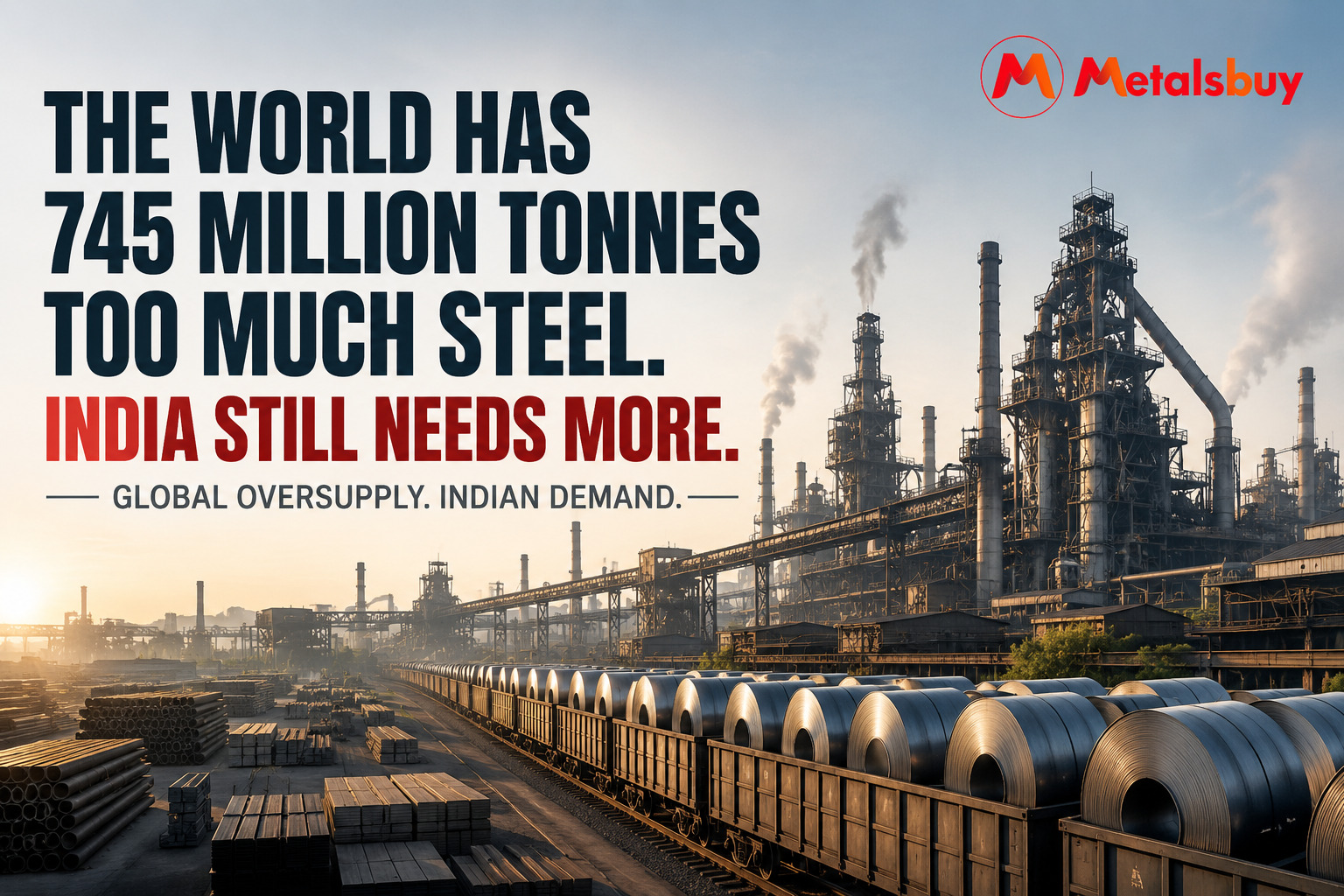
745 Million MT : Projected global steel excess capacity by 2028
139 Million MT : Additional steelmaking capacity expected by 2028
34 Million MT : Increase in global steel demand over the same period
6.9% : China’s steel demand decline in 2025
0.6% : Expected decline in China’s steel demand in 2026
6.7% : India’s projected steel demand growth in 2026
3.5% : ASEAN steel demand growth forecast
MARKET ANALYSIS
The global steel industry has a problem.
India has the opposite problem.
While much of the world struggles with weak demand, excess production and slowing industrial activity, India continues searching for more steel.
That contrast may be the most important steel story of 2026.
Global steel demand is expected to grow by just 0.4 percent this year. On paper, demand is still increasing. In reality, the market has been moving sideways for half a decade. Growth is barely keeping pace with new production capacity, creating a widening imbalance between what the world can produce and what it actually consumes.
The result is staggering.
Global excess steelmaking capacity already exceeded 640 million tonnes last year. Within three years, that figure is projected to approach 745 million tonnes.
To put that into perspective, excess capacity alone would be more than four times India’s entire annual steel production.
The world is building steelmaking capacity faster than it is creating steel demand.
That is usually a recipe for lower prices, weaker margins and intense competition.
Yet India sits at the center of a completely different story.
THE CHINA STORY IS CHANGING
For two decades, global steel demand was largely driven by China.
When China built cities, railways, factories and infrastructure, the steel industry grew alongside it. Steelmakers around the world expanded capacity to serve what became the largest industrial boom in modern history.
That era is changing.
Chinese steel demand has been declining as the country’s property sector slows and economic growth becomes less construction-intensive. The result is a structural shift in the global steel market.
The industry spent years preparing for more China.
Instead, it is adapting to less.
That adjustment is creating challenges across the steel value chain.
Countries that expanded production expecting endless growth are now competing for a smaller pool of demand.
That explains why excess capacity continues rising despite sluggish consumption growth.
INDIA IS THE EXCEPTION
While much of the world faces stagnation, India’s steel story remains remarkably different.
Demand is projected to grow by approximately 6.7 percent this year, making India one of the fastest-growing major steel markets globally.
The reasons are visible everywhere.
New highways.
Railway corridors.
Industrial parks.
Data centers.
Renewable energy projects.
Urban housing.
Manufacturing expansion.
Each requires steel.
Lots of it.
Unlike mature economies where infrastructure is largely complete, India is still building. The country’s industrialization story remains ongoing, creating sustained demand for steel products across multiple sectors.
That demand growth explains why steel producers continue announcing expansion projects despite a difficult global backdrop.
What looks excessive in one part of the world often looks insufficient in India.
WHY THIS MATTERS FOR FERRO ALLOYS
For the ferro alloy industry, this divergence is extremely important.
Steel demand drives alloy demand.
Every tonne of steel requires alloying materials such as ferro manganese, silico manganese and ferrochrome. When steel production rises, alloy consumption rises alongside it.
The rest of the world may be struggling with oversupply.
India is not.
As domestic steelmakers continue expanding capacity and increasing production, demand for ferro alloys remains supported by underlying industrial growth.
In many ways, India’s steel industry has become one of the most important demand anchors for the global ferro alloy market.
That role is likely to become even more significant over the next decade.
THE BIGGER GLOBAL IMBALANCE
The most striking aspect of the current market is the growing disconnect between capacity and demand.
Over the next few years, global steelmaking capacity is expected to increase by approximately 139 million tonnes.
Demand, meanwhile, is expected to grow by only around 34 million tonnes.
That gap explains why concerns about oversupply continue dominating industry discussions.
More mills.
More production capability.
Not enough customers.
Historically, periods like this create pressure on profitability and encourage consolidation, trade disputes and protectionist measures.
Many of those trends are already visible across global steel markets.
The industry is entering a period where efficiency and competitiveness matter more than ever.
MARKET OUTLOOK
The global steel industry is becoming a tale of two markets.
One is struggling with excess capacity, slowing demand and increasing competition.
The other is still building.
India’s growth does not eliminate global oversupply.
But it does provide something increasingly rare.
Demand.
Real demand.
While producers in many regions compete for a stagnant market, India’s steel industry continues expanding into one of the largest infrastructure and industrial growth stories in the world.
That makes the country more important to the global steel industry than ever before.
The world may have 745 million tonnes too much steel.
India still needs more.