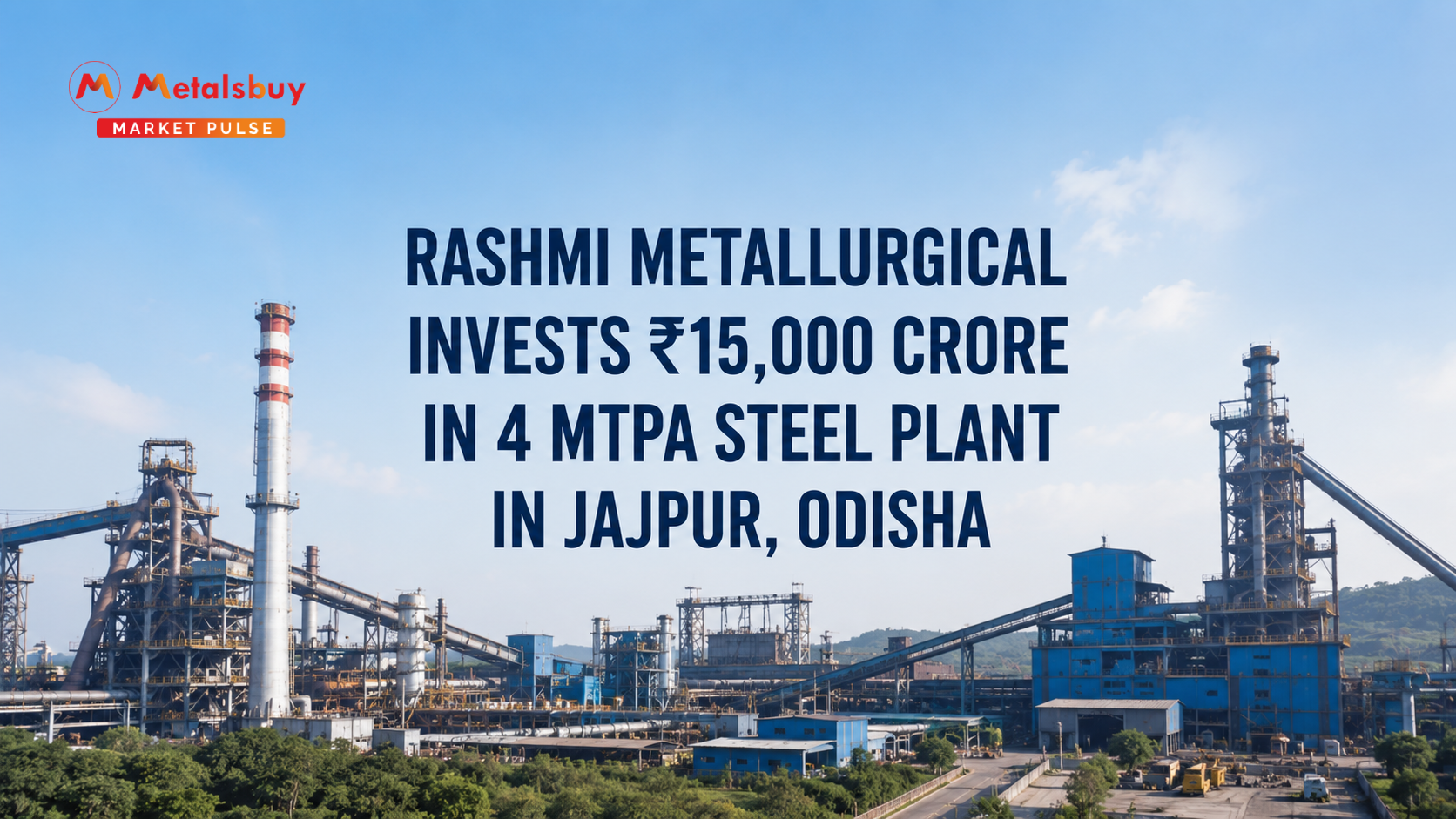
Key Numbers
• Total Investment: ₹15,000 Crore
• Proposed Steel Capacity: 4 Million Tonnes Per Annum (MTPA)
• Location: Jajpur, Odisha
• Employment Potential: 11,000 Jobs
• Project Type: Integrated Steel Plant
• State: Odisha
Market Analysis
1. Another Mega Steel Investment Heads to Odisha
Rashmi Metallurgical & Industries has announced plans to invest ₹15,000 crore in a 4 MTPA integrated steel plant in Jajpur, Odisha. The project is expected to create around 11,000 direct and indirect employment opportunities and further strengthen Odisha's position as India's leading steel investment destination.
The announcement comes at a time when steelmakers across the country are accelerating expansion plans to capitalize on India's long-term infrastructure and manufacturing growth story. Eastern India, particularly Odisha, continues to attract a significant share of these investments because of its abundant raw material availability and well-developed industrial ecosystem.
2. Why Jajpur Continues to Attract Steel Investments
Jajpur has emerged as one of India's most important steel and metal manufacturing hubs. The district offers proximity to iron ore mines, ferro alloy clusters, logistics infrastructure and major ports on the eastern coast. For integrated steel producers, access to raw materials remains one of the most important competitive advantages. Odisha accounts for a substantial share of India's iron ore reserves and has successfully positioned itself as the preferred destination for large-scale steel projects over the past decade.
3. Capacity Expansion Reflects Confidence in India's Steel Demand
A 4 MTPA integrated steel plant represents a significant addition to India's steelmaking capacity. The investment signals confidence in the country's long-term steel consumption outlook, which continues to be supported by infrastructure spending, urbanization, manufacturing growth and government-led capital expenditure programs. India remains one of the fastest-growing steel markets globally, and producers are increasingly positioning themselves to serve future demand from sectors such as construction, renewable energy, railways, automotive and engineering.
4. Employment and Regional Economic Impact
Beyond steel production, projects of this scale create a multiplier effect across the local economy. Mining, transportation, logistics, fabrication, engineering services and downstream manufacturing industries all stand to benefit from the development. The estimated 11,000 jobs associated with the project highlight the broader economic significance of large steel investments. Similar projects in eastern India have historically contributed to industrialization, infrastructure development and growth of ancillary industries.
5. Eastern India Emerging as the Steel Growth Engine
The latest proposal adds to a growing pipeline of steel investments being announced across eastern India. Producers are increasingly focusing on Odisha, Jharkhand, Chhattisgarh and West Bengal because of their raw material advantages and improving industrial infrastructure. This trend is expected to play a crucial role in India's ambition to significantly increase steelmaking capacity over the coming decade. New integrated facilities are likely to become the backbone of future production growth while improving regional industrial development.
6. Implications for Raw Material Markets
Every major steel capacity addition creates additional demand for iron ore, pellets, coal, ferro alloys, limestone, dolomite and logistics services. As more projects move from announcement to execution, the impact is expected to be felt across the entire steel value chain. For suppliers of steelmaking raw materials, the expansion pipeline provides visibility on future demand growth and supports investment in mining, processing and infrastructure capacities.
Industry Impact
The proposed ₹15,000 crore investment reinforces the strong investment cycle currently underway in India's steel sector. It demonstrates continued confidence among producers in the country's long-term steel demand fundamentals and highlights Odisha's growing importance as a steel manufacturing hub. For the industry, projects of this scale not only expand production capacity but also strengthen the broader ecosystem of mining, logistics, engineering and downstream manufacturing.
Outlook
As India continues its infrastructure-led growth journey, large integrated steel projects are expected to remain a defining feature of the industry's expansion strategy. The success of such investments will depend on execution timelines, raw material security, logistics efficiency and future steel demand growth. If implemented as planned, the Jajpur project could become another important milestone in India's journey toward becoming one of the world's largest and most competitive steel-producing nations.