Operational Leverage: The Core Profit Driver
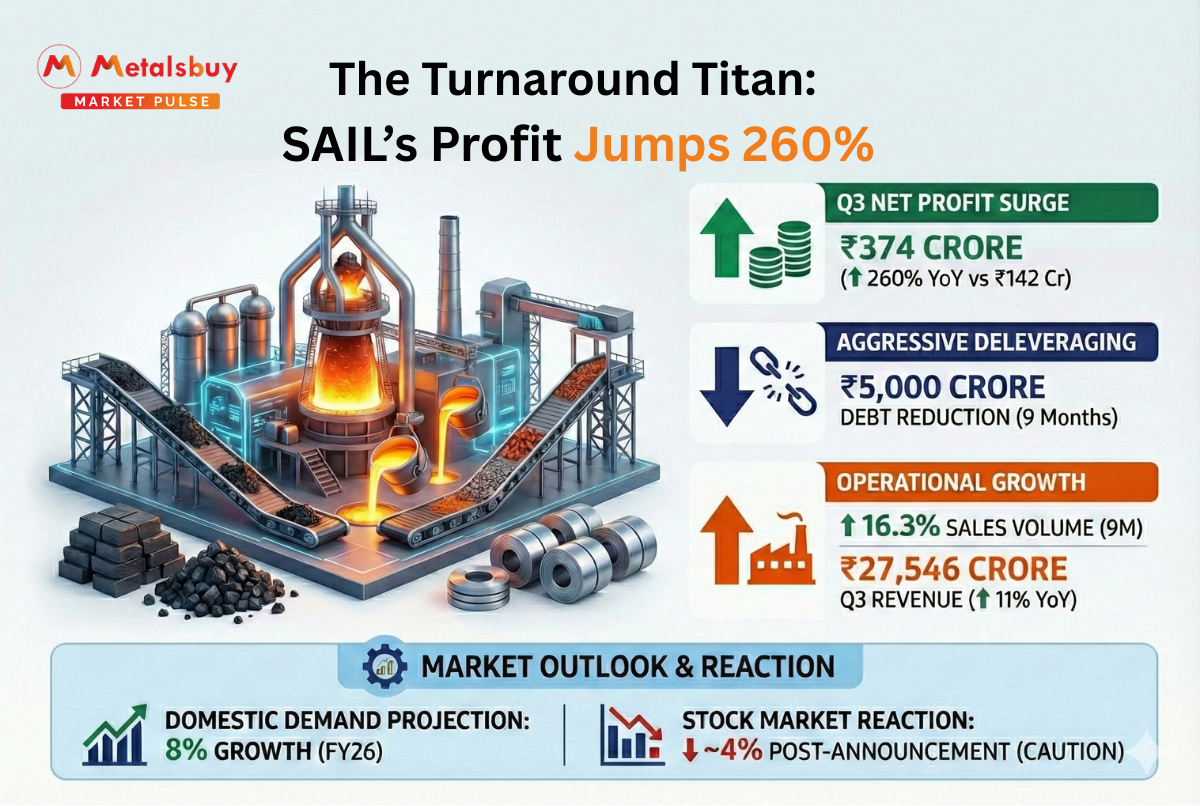
The headline growth was fuelled primarily by a double-digit expansion in topline revenue. SAIL’s total income for the quarter climbed by over 11% year-on-year (YoY) to ₹27,545.93 crore, up from ₹24,723.43 crore in the corresponding quarter of the previous fiscal.
For the nine-month period ending December 2025 (9M FY26), the sales traction was particularly visible. Sales volumes expanded by 16.3%, outpacing the company's crude steel production growth of 2% (totaling 14.35 million tonnes). This disparity suggests SAIL has been aggressive in liquidating inventory to capture market share, capitalizing on robust domestic infrastructure demand.
Financial Health: Debt Reduction and EBITDA Resilience
Beyond the Profit and Loss statement, SAIL’s balance sheet reflects a concerted effort to deleverage. A standout metric from the earnings release is the reduction of approximately ₹5,000 crore in debt during the first nine months of the fiscal year. This aggressive deleveraging creates headroom for future capital expenditure and reduces interest burdens, further aiding net profitability.
Profitability & Margins: Despite industry-wide margin pressure, EBITDA climbed 13% to ₹2,294 crore, with margins expanding marginally to 8.4% (vs 8.3% YoY). The 9M profit after tax improved sharply to ₹1,537.33 crore, up from ₹1,120.82 crore in the corresponding period last fiscal.
Debt Reduction: A critical takeaway was the aggressive deleveraging, with SAIL reducing net debt by approximately ₹5,000 crore during the first nine months of the fiscal year. This financial discipline has lowered interest burdens, directly bolstering the bottom line.
Market Context and Future Outlook
The results arrive at a pivotal moment for the Indian steel sector. Domestic demand remains a bright spot globally, with projections estimating an 8% growth in steel demand for FY26, driven largely by the government's infrastructure push and a resurgence in the construction sector.
Comparatively, SAIL’s 9M profit after tax stood at ₹1,537.33 crore, a stark improvement from ₹1,120.82 crore in the previous year. This trajectory positions the Maharatna PSU favorably against private sector peers who are also ramping up capacity to meet India's 2030 steel production targets.
However, the capital markets reacted with characteristic caution. Despite beating the previous year's low base, SAIL's stock faced selling pressure, closing down nearly 4% at ₹151.05 on the BSE post-announcement. Market veterans suggest this could be a classic "sell on news" reaction, or perhaps investor concern regarding the sustainability of volume-led growth if global steel prices soften further.
Conclusion
With domestic steel demand projected to grow 8% in FY26, SAIL’s strategy of maximizing volumes and slashing debt places it on a stable footing. The Q3 numbers confirm that scale and efficiency are currently the company's most effective shields against sector volatility.