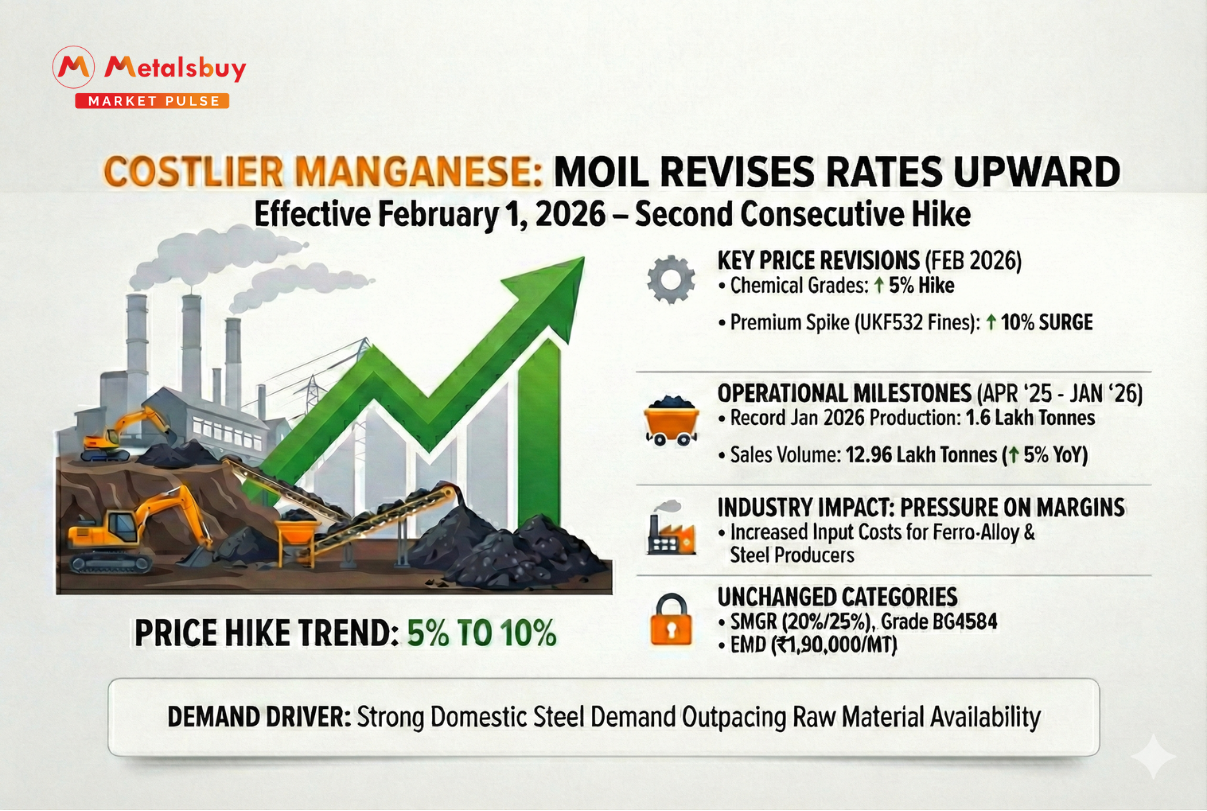
In a decisive move reflecting tightening supply dynamics and robust demand in the steel sector, state-owned manganese ore giant MOIL Limited has announced a comprehensive price revision effective February 1, 2026. The public sector undertaking (PSU) has hiked prices for the majority of its manganese ore grades by 5%, with select premium grades witnessing a steeper 10% surge.
This revision marks the second consecutive monthly increase in 2026, signaling a bullish trend in raw material costs for India’s steel manufacturing industry.
Key Price Revisions: A Segmented Approach
MOIL’s latest notification highlights a calibrated pricing strategy aimed at capitalizing on high-demand segments while maintaining stability in lower-grade markets.
- Ferro Grades: Prices for all Ferro grades (both above and below 44% manganese content) have increased by 5%.
- Exception: Grade BG4584 remains unchanged.
- SMGR & Fines: Silico Manganese Grade (SMGR) ores with 30% manganese content and all Fines grades are up by 5%.
- Chemical Grades: Prices hiked by 5%.
- Premium Spike: The UKF532 grade of Metal Mandi Fines witnessed a sharp 10% increase, indicating acute supply constraints for this premium category.
Unchanged Categories: To balance market sentiment, MOIL has kept prices stable for:
- SMGR grades with 25% and 20% manganese content.
- Metal Mandi Fines grades DBF575 and MSF592.
- Electrolytic Manganese Dioxide (EMD): The base price remains steady at ₹1,90,000 per metric tonne.
Production Surge Meets Market Strategy
The hike aligns with record operational performance. January 2026 saw MOIL’s best-ever January production of 1.6 lakh tonnes.
- Cumulative Growth: For April 2025 – January 2026, production reached 14.9 lakh tonnes, a 4% increase over the previous year.
- Sales Volume: Sales for the ten-month period hit 12.96 lakh tonnes, up 5% year-on-year.
Market Analysis & USP: The Unique Selling Proposition (USP) of this move is MOIL's ability to command higher prices despite increasing supply. Consecutive hikes suggest domestic steel demand is outpacing raw material availability. The aggressive 10% hike on UKF532 fines differentiates this from a standard inflation adjustment, pointing to a specific squeeze in high-grade alloying inputs.
Financial Implications and Stock Reaction
Despite strong operational numbers and price hikes, which typically boost revenues, market sentiment appeared cautious. MOIL shares witnessed volatility, correcting ~8.8% to trade near ₹345.40, likely due to profit-booking.
Industry Impact: Pressure on Steel Margins
For the secondary steel sector and ferro-alloy producers, this hike translates directly to increased input costs. Manganese is a critical component in steelmaking, used to remove oxygen and sulfur and to increase the alloy's strength.
- Cost Push: With Ferro Manganese and Silico Manganese prices likely to firm up in response to MOIL’s move, induction furnace operators and integrated steel plants may face a slight compression in margins for Q4 FY26.
- Inventory Valuation: Companies holding lower-cost inventory from December 2025 will gain a temporary competitive advantage.
Future Outlook
Steel makers and the market watchers will be closely monitoring the absorption of these prices. If the infrastructure push from the recent Union Budget 2026 continues to drive steel consumption, MOIL is well-positioned to sustain these higher price levels. However, the stability in lower-grade ore prices (SMGR 20%/25%) suggests the company is keen to avoid demand destruction in the cost-sensitive segments of the market.