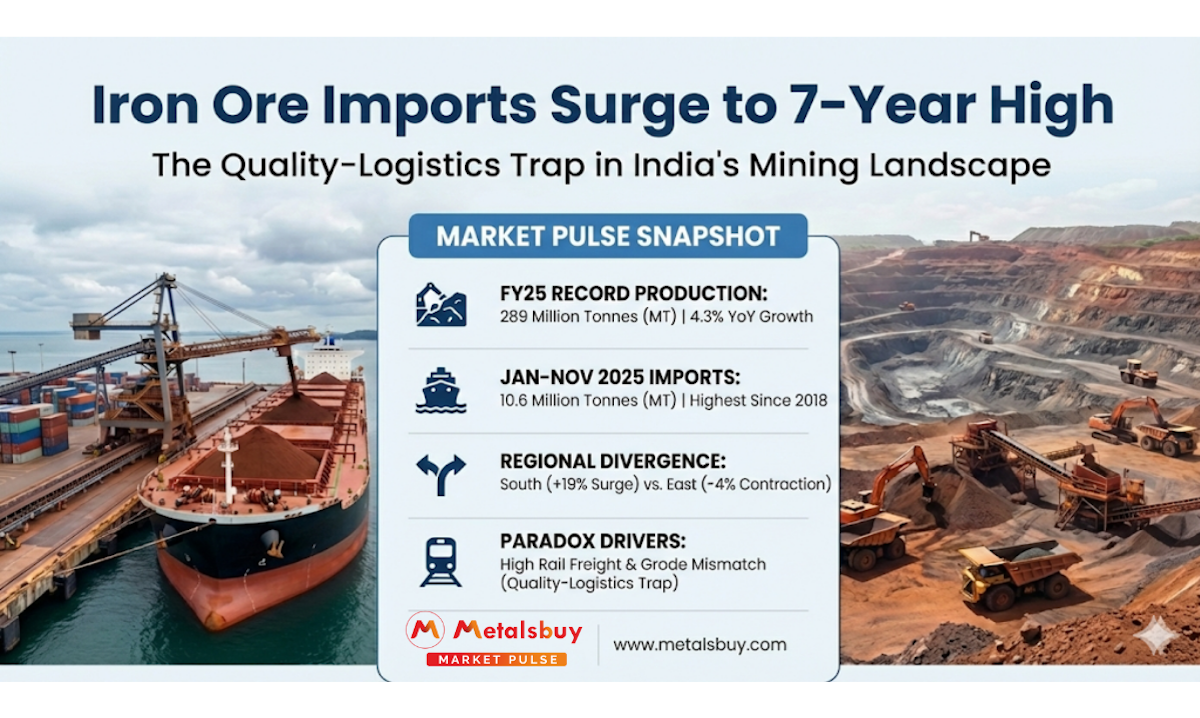
The Indian mining landscape is currently navigating a period of significant structural transition. According to recent market intelligence and federal mining data, India’s iron ore production for the financial year 2024-25 (FY25) reached a historic milestone of 289 million tonnes (MT). While this represents a record high—surpassing the 277 MT achieved in the previous fiscal year—the year-on-year growth rate has moderated to a modest 4.3%.
This deceleration in growth comes at a critical juncture for the domestic steel industry. Despite the record-breaking output, a deeper analysis reveals a widening gap between the quantity of ore mined and the quality of material required by modern blast furnaces, resulting in a surprising seven-year high in iron ore imports.
The Regional Divergence: Eastern Struggles and Southern Surges
A granular look at the state-level data indicates that the national growth figure of 4% masks significant regional imbalances. The eastern region, traditionally the powerhouse of Indian mining, witnessed a surprising 4% contraction in production during the first half of the calendar year 2025. Major state-run mining entities in the region recorded a 15% year-on-year drop, producing approximately 20 MT compared to 23.5 MT in the previous period.
Market analysts attribute this regional slowdown to high opening inventories and a lukewarm response to auctions in the early months of the fiscal year. Conversely, southern states have emerged as a bright spot, posting a robust 19% increase in output. This surge was primarily driven by the operational scaling of smaller miners and enhanced output from private players who have optimized their mining leases.
The role of the public sector remains pivotal. The country's largest iron ore producer maintained its lead by producing 25 MT in the first half of CY2025, marking a 6% growth. The state-owned major has set an aggressive target of 55.4 MT for FY26, signalling its intent to bridge the domestic supply gap.
The USP: The "Quality-Logistics" Trap
The Unique Selling Proposition (USP) of the current news cycle is the paradox of record production coexisting with record imports. India’s iron ore imports crossed 10.6 million tonnes between January and November 2025—the highest level since 2018.
This trend is not driven by a lack of raw ore, but by two primary structural hurdles:
- The Grade Mismatch: Leading domestic steelmakers are increasingly favouring high-grade overseas ore. Domestic ore often suffers from high levels of impurities like Alumina and Silica. For every 1% drop in iron content, steel production costs rise by nearly 2-2.5% due to increased fuel requirements and energy consumption.
- The Logistics Arbitrage: For port-based steel plants in Western and Southern India, importing high-grade material is often more cost-effective than transporting low-grade domestic ore from landlocked central states. Prohibitively high inland rail freights have effectively "outpriced" domestic ore against international benchmarks for coastal refineries.
Crude Steel Demand and the Infrastructure Push
The underlying demand for iron ore remains resilient, tied closely to the 7% year-on-year growth in India's crude steel production, which reached roughly 66.5 MT in the first five months of 2025. The national policy framework aims for a 300 MT capacity by 2030, which will necessitate an annual iron ore output exceeding 430 MT.
While production of Direct Reduced Iron (DRI) rose by 10% to 29 MT, the merchant mining sector is feeling the heat of high auction premiums. Of the 152 iron ore mines auctioned over the last decade, the average premium stands at a staggering 124%, making commercial viability a tightrope walk for many new operators.
Outlook and Policy Intervention
Looking ahead to FY26, market projections indicate a recovery in production growth, with output expected to climb toward the 325-330 MT range. This optimism is hinged on several "greenfield" blocks finally entering the production phase. Out of 138 mines auctioned under amended regulations, only about 37 have commenced operations. Accelerating statutory clearances, which currently take 2 to 4 years, will be essential to translate "allocated resources" into "market supply."
Furthermore, the industry is calling for a fiscal push to incentivize beneficiation—the process of upgrading low-grade ore into high-grade pellets. Without significant investment in last-mile logistics and beneficiation technology, the sector risks becoming increasingly dependent on overseas high-grade ore, despite sitting on massive mineral reserves.