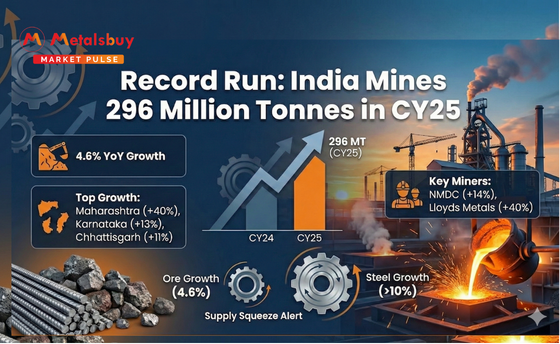
India's iron ore mining sector witnessed a year of paradoxical performance in Calendar Year 2025 (CY25). While total production climbed to a historic high of 296 million tonnes (MT), the growth rate decelerated to just 4.6% year-on-year, creating a widening chasm between raw material availability and the voracious appetite of domestic steelmakers.
According to preliminary data accessed from mining agencies and trade sources, production rose from approximately 283 MT in CY24, but the single-digit growth has raised alarms across the ferrous value chain. The sluggish pace of extraction contrasts sharply with India's crude steel production, which surged by over 10% in the same period, signaling a potential raw material squeeze as the country chases its ambitious infrastructure targets.
The Great Disconnect: Steel vs. Ore
The defining trend of CY25 has been the decoupling of steel and iron ore growth rates. For years, domestic ore output comfortably outpaced or matched steel capacity expansion. However, CY25 marked a reversal. With steel output growing at double the rate of iron ore mining, domestic mills were forced to scramble for feedstock, leading to a multi-year high in imports.
Market data indicates that iron ore and pellet imports crossed the 10.6 MT mark in the first 11 months of CY25 alone, the highest level since 2018. This surge in inbound shipments was primarily driven by coastal steel plants attempting to offset the tightening domestic supply and elevated logistics costs associated with moving ore from the hinterlands.
Odisha: The Engine That Stalled
The primary drag on national growth came from Odisha, the country's iron ore heartland. Historically accounting for over half of India's total output, Odisha saw its production contract by approximately 3.3% in CY25, dropping to roughly 152 MT.
Analysts attribute this rare decline to a confluence of factors:
- Operational Delays: Several merchant mines auctioned in previous cycles struggled with regulatory clearances and operational ramp-ups.
- State Miner Performance: The Odisha Mining Corporation (OMC), a pivotal player in the state's ecosystem, recorded a production dip of around 4.5%, largely due to inventory adjustments and weaker offtake in domestic auctions during the monsoon quarters.
The Rescuers: Chhattisgarh and Karnataka
While Odisha faltered, other mineral-rich states prevented a national output contraction.
- Chhattisgarh: The state emerged as a standout performer, recording a robust 11% growth to reach 50 MT.
- Karnataka: Continuing its recovery trajectory, Karnataka saw output rise by 13% to touch 48 MT.
- Maharashtra: Though a smaller base, Maharashtra posted a massive 40% surge, contributing 14.9 MT to the national basket, driven by rapid capacity expansion by local miners.
Major Miners: NMDC Leads the Pack
In the corporate arena, state-owned giant NMDC reinforced its dominance. The miner achieved a 14% year-on-year growth, surpassing the 50 MT production milestone in CY25. This performance is critical for the domestic market, as NMDC remains the largest supplier to non-captive steel producers.
Among private merchant miners, Lloyds Metals continued its aggressive expansion, lifting output by nearly 40% to 14.3 MT. The data reveals that the share of merchant miners in India’s total output has cemented itself at approximately 59-60%, underscoring the steel industry's continued reliance on non-captive sources.
Structural Challenges and the Road Ahead
The sluggish growth in CY25 exposes a structural vulnerability in India's "300 MT Steel by 2030" roadmap. The inability to quickly operationalize auctioned mines remains a bottleneck. Reports suggest that less than one-third of the mines auctioned since the 2015 MMDR Act amendments have commenced full-scale operations.
Recognizing this hurdle, the Ministry of Mines introduced the Mineral (Auction) Second Amendment Rules, 2025, aimed at enforcing stricter timelines and performance security to prevent miners from sitting on leases.
Key Takeaways for Stakeholders:
- Supply Tightness: Expect domestic iron ore prices to remain supported by the demand-supply mismatch in the short term.
- Import Dependency: Coastal mills may continue to rely on imports of high-grade fines and pellets unless domestic evacuation infrastructure improves.
- Policy Focus: The pressure is now on state governments to fast-track forest and environmental clearances to unlock the "stuck" capacity in Odisha and Jharkhand.
As India steps into CY26, the mining sector faces a clear mandate: accelerate extraction rates to bridge the 6% gap between ore and steel growth, or risk becoming a net importer in a market where it traditionally held a surplus.