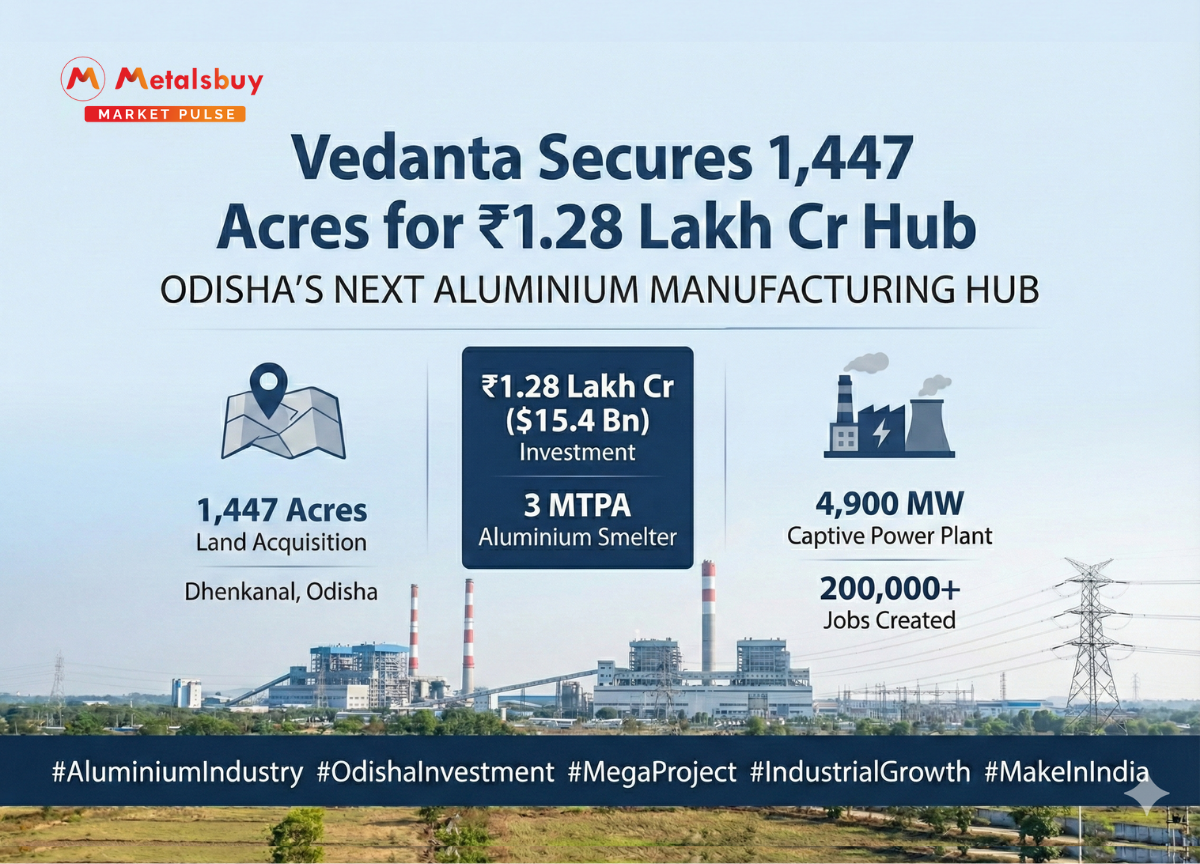
Vedanta Aluminium has cleared the final major hurdle for its historic expansion, formally securing 1,447 acres of land in Odisha’s Dhenkanal district today. The allotment letter, handed over by Chief Minister Mohan Charan Majhi to Vedanta officials, greenlights the mining conglomerate’s massive ₹1.28 lakh crore ($15.4 billion) investment to construct a 3 milliontonnes Per Annum (MTPA) aluminium smelter.
This isn’t just another factory; it is a strategic asset designed to cut India's import dependence and feed the hungry production lines of the electric vehicle (EV), aerospace, and defence sectors.
The Scale: A Global Heavyweight in Dhenkanal
The centerpiece of this expansion is the scale. While most global smelters operate in the 0.5 to 1 MTPA range, Vedanta’s Dhenkanal facility is designed for 3 MTPA, paired with a colossal 4,900 MW captive power plant.
This capacity addition is not merely about volume; it is about the Unique Selling Proposition (USP) of integrated efficiency. By locating the smelter near its existing coal blocks and bauxite supply chains in Odisha, Vedanta is effectively insulating itself from global volatility in raw material prices. The project is expected to generate over 200,000 direct and indirect employment opportunities, creating a multiplier effect that economic analysts predict could boost the region's GDP by 150-200 basis points over the next decade.
Powering the Giant: Energy Efficiency & Generation Strategy
In the aluminium industry, metal is often described as "solidified electricity," with energy accounting for nearly 40% of production costs. Vedanta’s strategy at Dhenkanal tackles this cost-driver head-on through a dual approach of self-sufficiency and technological optimization, detailed below.
|
Strategy Component |
Key Feature / Metric |
Strategic Impact & Advantage |
|
Captive Power Sovereignty |
4,900 MW independent plant vs. State Grid reliance |
Projected 15-20% reduction in energy costs; complete immunity to industrial tariff hikes and grid fluctuations. |
|
Load Factor Optimization |
85-90% Plant Load Factor (PLF) (National Grid Avg: 70-75%) |
Maximizes asset utilization; significantly lowers carbon intensity per unit of energy produced. |
|
The Green Transition |
Flex-fuel capability& Heat Recovery Systems |
Lowers specific energy consumption to 13,000–13,500 kWh/t, matching global efficiency leaders in China and the Middle East. |
|
Technological Integration |
Smart Grid & Digital Twin integration |
Real-time monitoring ensures 24/7 stable amperage required for sensitive electrolysis pots. |
Strategic Timing: Riding the 'Viksit Bharat' Wave
The timing of this capital infusion aligns perfectly with India's "Viksit Bharat" (Developed India) 2047 goals. Domestic demand for aluminium is projected to double by 2030, driven by the green energy transition.
"The state government’s timely land allotment has given the clarity and momentum required at this stage," stated Vedanta Aluminium CEO Rajiv Kumar, terming the move a "transformative step" for India's industrial journey. "We are fully prepared to move into the next phase of development with renewed focus and speed."
Financial Muscle: Record Q3 Numbers Fuel Ambition
Critics often question how conglomerates fund such mega-projects without over-leveraging. However, Vedanta’s recent financial scorecard provides a robust answer. The company’s Q3 FY26 results, announced just days ago, show a balance sheet in prime health, capable of sustaining aggressive Capex.
For the quarter ending December 31, 2025, Vedanta Limited reported a 60% surge in Net Profit, hitting ₹7,807 crore. The company’s revenue grew by 19% to ₹45,899 crore, driven by higher commodity prices and operational efficiencies.
Most crucially for investors, the EBITDA margin expanded to 41%, a clear signal that the company is converting revenue into cash flow efficiently. This liquidity is the engine that will drive the Dhenkanal execution without straining the debt-to-equity ratios significantly.
Data Snapshot: The Growth Trajectory
The following table breaks down the year-on-year financial performance, highlighting the capital strength backing the Odisha project.
|
Financial Metric |
Q3 FY26 (Current) |
Q3 FY25 (Previous) |
Year-on-Year Growth |
|
Revenue from Operations |
₹45,899 Crore |
₹38,526 Crore |
+19% |
|
EBITDA |
₹15,171 Crore |
₹11,284 Crore |
+34% |
|
Net Profit (PAT) |
₹7,807 Crore |
₹4,876 Crore |
+60.1% |
|
EBITDA Margin |
41% |
~35% |
+600 bps |
|
Alumina Production |
794 kt |
505 kt |
+57% |
|
Aluminium Production |
620 kt |
614 kt |
+1% |
The Road Ahead: 2026 and Beyond
As the Dhenkanal project enters the construction phase, the focus shifts to execution. The state government of Odisha views this as the anchor for a new industrial corridor, reinforcing its position as the 'Aluminium Capital of India'.
For the global market, this signals that India is no longer satisfied with exporting bauxite or alumina. It wants to capture the entire value chain—from dirt to finished metal. With aluminium prices forecast to remain firm through 2026 due to supply constraints in China and Europe, Vedanta’s gamble on capacity expansion looks increasingly like a calculated masterstroke.