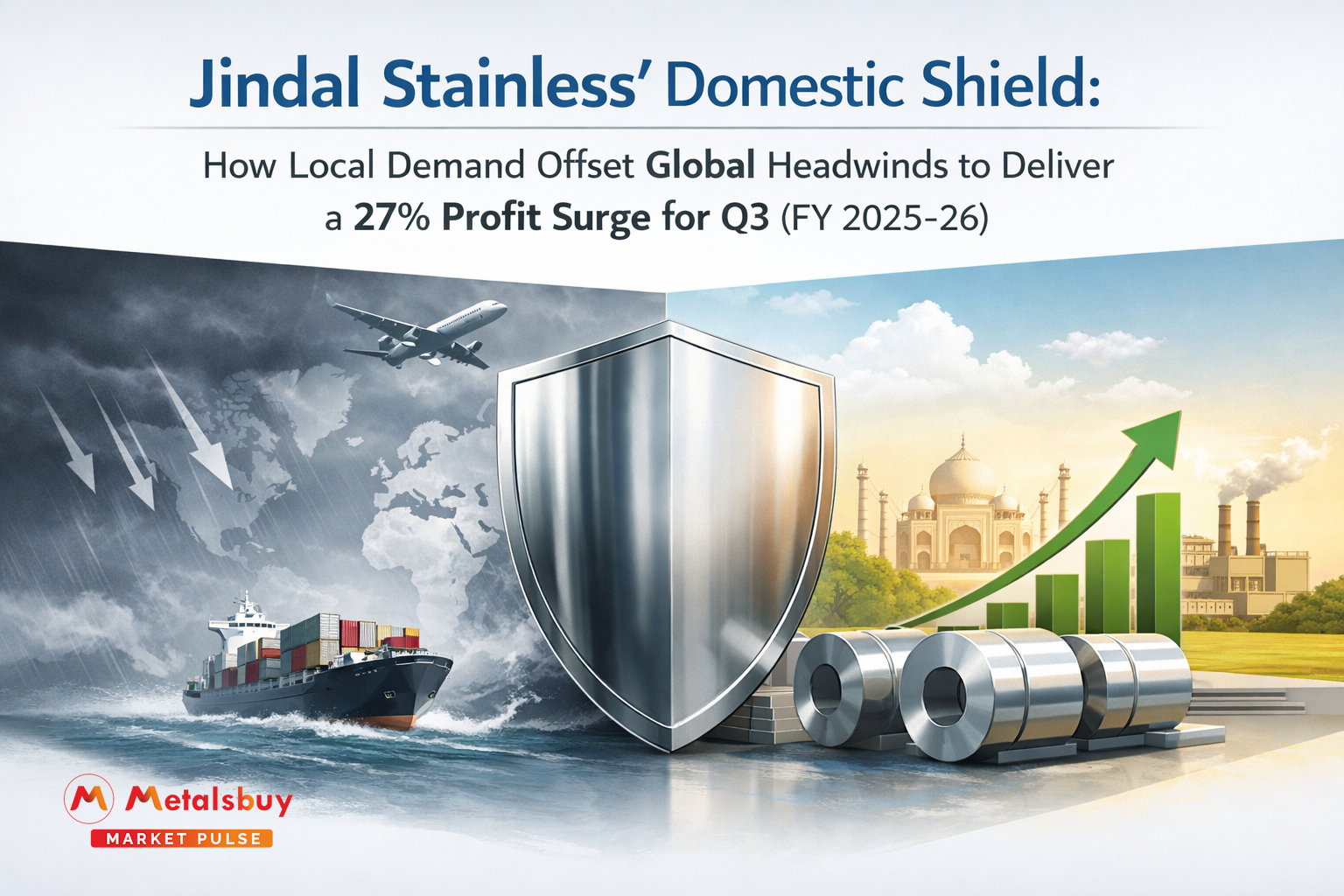
Amidst significant global volatility and logistical disruptions in the Red Sea, Jindal Stainless Limited (JSL) successfully decoupled its performance from Western markets to achieve an impressive 26.6% growth in net profit. Facing "policy fog" in the US and carbon taxes in Europe, the company strategically pivoted to the robust Indian domestic market to offset these external headwinds.
While Q3 of FY 2025-26 saw most commodity exporters in a defensive posture due to regulatory and logistical paralysis, JSL reported a consolidated net profit of INR 828 crore. By using the strong local economy as a shield, JSL demonstrated how swiftly adjusting sales channels can sustain high profitability even when export markets remain tight.
The "India Hedge": A Structural Shift in Sales
The most defining metric of Q3 wasn't the profit figure but the dramatic change in market mix. Traditionally, exports have served as a crucial revenue valve for JSL. In a climate of "extreme policy ambiguity" in the West, though, the export share for the company shrunk to a mere 5.4 percent of total sales, from 8.5 percent a year earlier.
In almost any other context, such a collapse in foreign orders would spell disaster. Instead, JSL posted a 10.6% growth in sales volume, reaching 649,857 tonnes. The savior was the Indian domestic market, which now commands a near-monopoly share of roughly 95% of the company’s business.
This was no passive change. JSL actively aligned production with India's capex cycle. The demand had many facets:
- The Indian Railways Renaissance: Modernisation has led to a huge requirement for stainless steel. From the Vande Bharat sleeper train sets to the expanding metros, the move away from carbon steel into the wagon industry with the switch to stainless steel is providing a strong base.
- Automotive Premiumization: While the markets witnessed a lot of fluctuation, the automotive segment itself, along with the pre-festive demand, contributed favorably towards the demand for special grade steels.
- Infrastructure Spine: Government spending on bridges, flyovers, etc., continued to translate order books into revenues.
Financials: Efficiency Over Inflation
Further, a study of the Balance Sheet reveals that JSL’s growth has been qualitative in nature, not merely quantitative, as its revenue grew by 6.2 percent to INR 10,518 crore, which may be considered a very modest compared to its profits.
This means the company’s earnings prior to interest, taxes, depreciation, and amortization (EBITDA) climbed ahead of revenue growth of 15 percent to INR 1,408 crore as the company increased its earnings per ton sold by 16.6 percent. This means the company improved its profitability per ton sold.
In addition, the company has shown good financial discipline in its growth journey so far. At present, the company has a comfortable net debt to equity level at 0.18x with a consolidated net debt level at INR 3,451 crore, and hence, it has successfully kept its debt levels at comfortable levels to retain further investment potential. Hence, in view of such good financial discipline, the company announced payment of an interim dividend at INR 1 per share to shareholders in aggregate.
The Export Freeze: Waiting for the Fog to Lift
What caused the exports to grind to a halt? The management attributed this to a "wait and watch" policy of the buyers from the West.
- CBAM Jitters: The European Union’s Carbon Border Adjustment Mechanism is moving from a policy discussion to a pecuniary one. European clients are experiencing jitters before investing in long-term deals until they recognize the implications of the carbon tax included in it.
- Tariff Turbulence: Within the United States, current trade policies have caused importers to avoid committing their orders because they fear that those same orders could arrive on their shores with unexpectedly increased tariffs.
JSL’s stance on this is also practical, as the company hasn’t withdrawn from these markets, just pushed the pause button. The company is “geared up" to commence its heavy exports again, but only when certain about regulations and is unwilling to compromise on margins to achieve high exports.
Future-Proofing: Green Steel and Capex
While it is navigating the present quarter, it is also laying down strong foundations to secure a place in a low-carbon economy. Notwithstanding that fact, it said that “56% of the power used in its key facilities in Jajpur and Hisar are now coming from renewable sources." This is an important asset for them. When European markets are reopened under the CBAM structure, its low carbon footprint would probably serve as an entry ticket to differentiate it from other competitors that have a higher carbon footprint.
On the expansion part, the major work seems to have been done. The company has already spent INR 2,200 crore out of INR 2,700 crore budgeted for capital expenditure in FY26, which constitutes 81% of the total capital expenditure planned for the current fiscal. This shows that the large outlays required for capacity additions have already been done.
The Looming Threat: Unfair Imports
While the positive numbers were being hailed in the quarterly report, there was a sense of caution attached with regard to the domestic ecosystem. Here, the company’s management pointed to the rising waves of “predatory imports” that were being carried out in the form of “sub-standard, subsidized Stainless Steel products being imported from China and Vietnam via the Free Trade Agreements.”
The dumping is a direct threat to India's own MSME sector, as they cannot compete with FDI through government subsidy. JSL has further intensified its demand for strict adherence of Quality Control Orders (QCOs). It states that without a level playing field, even India's own government initiative of Make In India can be jeopardized through unfair trading practices.
Outlook
As JSL enters the fourth quarter of FY26, as they like to call it, the roadmap for them is quite evident – Defend Home Turf & Prepare for Global Reopening. With the indigenous demand base running their machine quite efficiently and the capex cycle winding off their operations, any improvement in global trade will be fully leveraged by this company. Till then, the Indian market will definitely be enough to keep their furnaces glowing brightly.