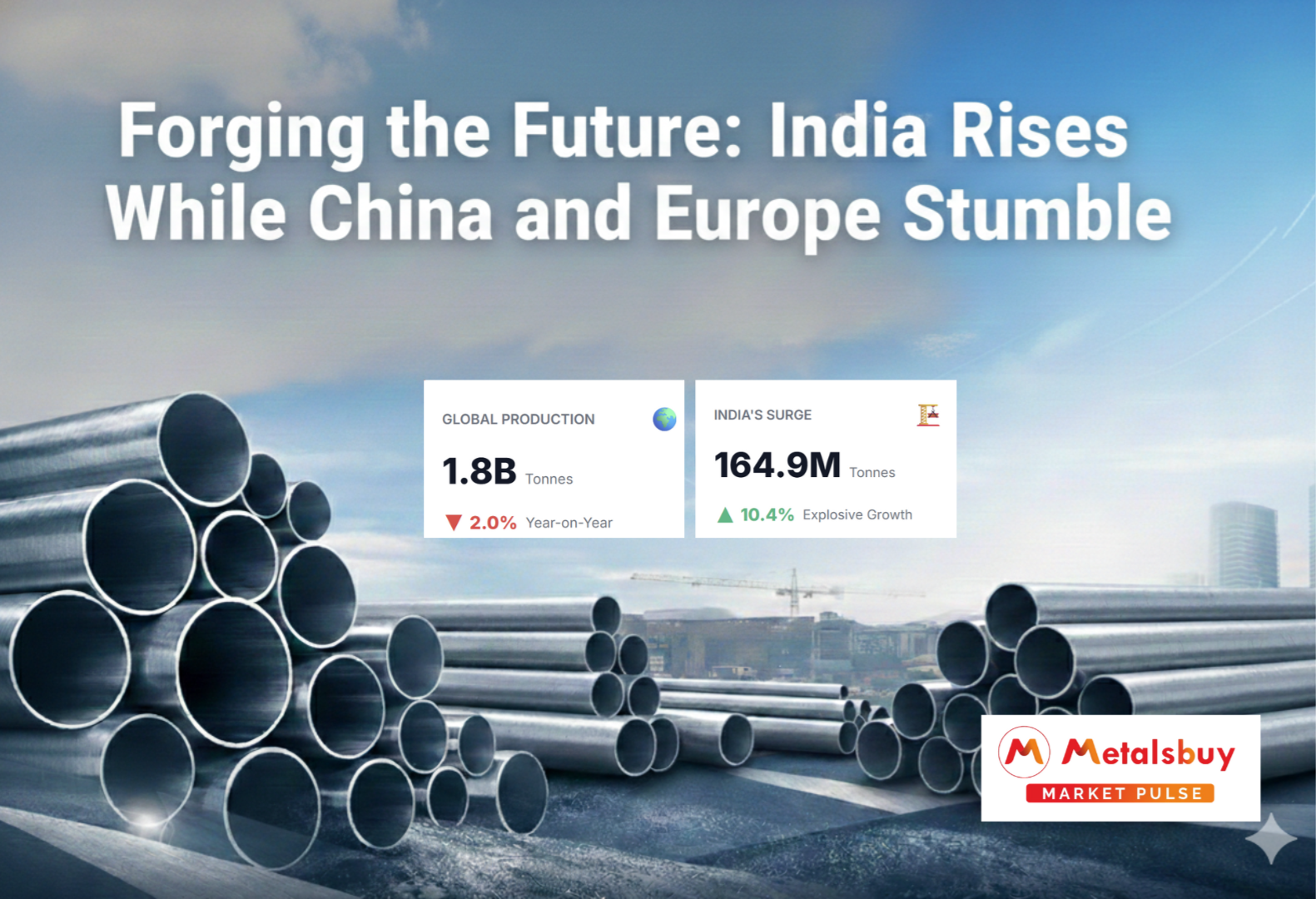
A tectonic change shook the global steel industry in 2025. This year signaled both the end of an era and an unstable beginning to a new one. The obvious fact is that there has been a contraction, with global production of crude steel down 2 percent year on year to 1.8 billion tonnes. However, what is less obvious is that the real story is about two distinct elements. The year 2025 was not merely about reduced production. This was the year that marked a definite change and shifted the center of gravity to the South.
Indeed, data released in the latter part of January seems to affirm the prognostications posited in the paragraphs above: while other erstwhile traditional category nations such as China and Germany struggled with crises in terms of structure as well as costs in terms of energy, India continued to consolidate itself as the only driver in the world in terms of heavy industrial growth.
The Contraction: A Structural Reset, Not Just a Cycle
However, a general 2% contraction on a global scale does not capture the magnitude of contraction in various regions. For example, there was a steep 3.7% contraction in December 2025 alone, driving down monthly production to 139.6 million tonnes. The exacerbation in cooling in the closing months of the year suggests that these drivers are not only seasonal but structural.
Meanwhile, in China, the giant which has set world steel trends in recent centuries – or at least during recent decades – produced 960.8Mt in 2025, substantially down by 4.4%. The "insatiable dragon" has at last started to diet in plain sight! And it has started to do so because of Beijing's twin strategies of curbing emissions and tackling an inescapable property sector crisis. The era of simply going through tonnage growth in China is gone; now it is all about profitability and high flat products seeking manufacturing rather than construction-type long products volumes being consumed in China.
The Indian Exception: An Infrastructure-Led Boom
Unlike everywhere else in this world of red seas and falling production rates, India stood as a statistical outlier: its production grew at a large rate of 10.4% and reached a figure of 164.9 million tonnes. This is not a statistical fluke but is a result of a concerted effort at providing infrastructure.
While Chinese mills kept blast furnaces inactive, Indian mills ignited brand-new furnaces to serve an appetite for highways, metro projects, and railroads. "India Story" for the steel sector looks to be the story of greatest concern to the raw material exporting nations. While the government’s protectionist walls kept local mills shut out from cheap global imports, the local players seem to be leveraging the robust demand at home. This 10.4 percent increase indicates that India appears to be bucking the global industrial slowdown by its spend-cycles that show no signs of flagging.
Europe’s Industrial Hollowness and the American Surprise
Historically, Europe has faced a weakening outlook, but now it seems to have reached a calamitous stage. When we talk about Europe, we think about industry, and when we think about industry, we think about Europe's industrial powerhouse, namely Germany. Its industry output dropped drastically by 8.6% to 34.1 million tonnes, continuing a multi-year decline driven by a lack of competitiveness in energy prices, making primary steel production in the Rhineland increasingly uneconomic.
On the other hand, the United States provided an unexpected bonus, as its output increased by 3.1 percent to 82 million tonnes. This can only be accounted for "through front-loading" ahead of anticipated regimes and the constant "churn" from localized projects. It would seem that the steel market in America is successfully "insulatin[g] itself behind a wall of trade defenses," evidenced through the creation of "a split market. where US steel markets function on an entirely different basis to the rest of the world".
The "Why" Behind the Numbers
To fully grasp what is happening in 2025, we need to go beyond the blast furnace and into the boardrooms and the parliamentary debate. What has been happening in production is the result of three distinct forces:
1.The Property Decoupling: China’s property sector, once the consumer of 40% of China’s steel output, is undergoing a painful deleveraging. China’s declining output reflects the housing projects that were brought to a halt.
2.The Energy Arbitrage: European producers are subsidizing an "green premium" and high costs for energy, costs that their Asian and US counterparts do not pay, and losing market share, which trade barriers (like the new mechanism on CBAM) have yet to reverse.
3.The Capex Pivot: India’s growth is driven by government expenditures: This is a significant growth model differing from the West’s “consumer-driven” model in that India’s “steel boom” is built literally from foundations of concrete and reinforcing rods, similar to China’s model from the early 2000s.
Future Outlook: 2026 and the Green Transition
Projecting to 2026, it can be asserted that the market is still in a risky state. In fact, forecasts by the World Steel Association as well as other prominent experts predict a marginal improvement in the global steel industry by approximately 1.3%, subject to many "moving parts."
Another decline of 1-3% is expected in China in the future, albeit at a slower rate, as this country seeks to stabilize its property sector. The wild card in this crisis will be the exported volumes from China. It is this aspect that may again lead to a new round of the trade war in the near future.
India is likely to continue its momentum and sustain its growth rate to an increase of 8 to 9%, which can generate another capacity increase of 10 to 15 million tonnes. To raw material suppliers such as coking coal and iron ore, India has now become the buyer of last resort.
The Green Factor: Transitioning to "Green Steel" will go from the PowerPoint stage to the pilot plant stage in 2026. Again, as the experience in Germany demonstrates, the transition is indeed tenuous. Thus, the issue is decarbonization becoming synonymous with deindustrialization.
Conclusion
"That 2025 data represents a death knell – a death certificate. The supercycle of global growth synchronies is null and dead. A multipolar world of steel and fire has emerged. One camp comprises a shrinking China focused on efficiency and a troubled Europe. The other camp comprises a soaring India in need of infrastructure and a sheltered, yet resilient, United States. Thus, what investors and participants need in their 2026 strategy is as complex and multi-faceted as the market itself – short on global commodity exposure in aggregate but long on regions where furnaces continue to glow."