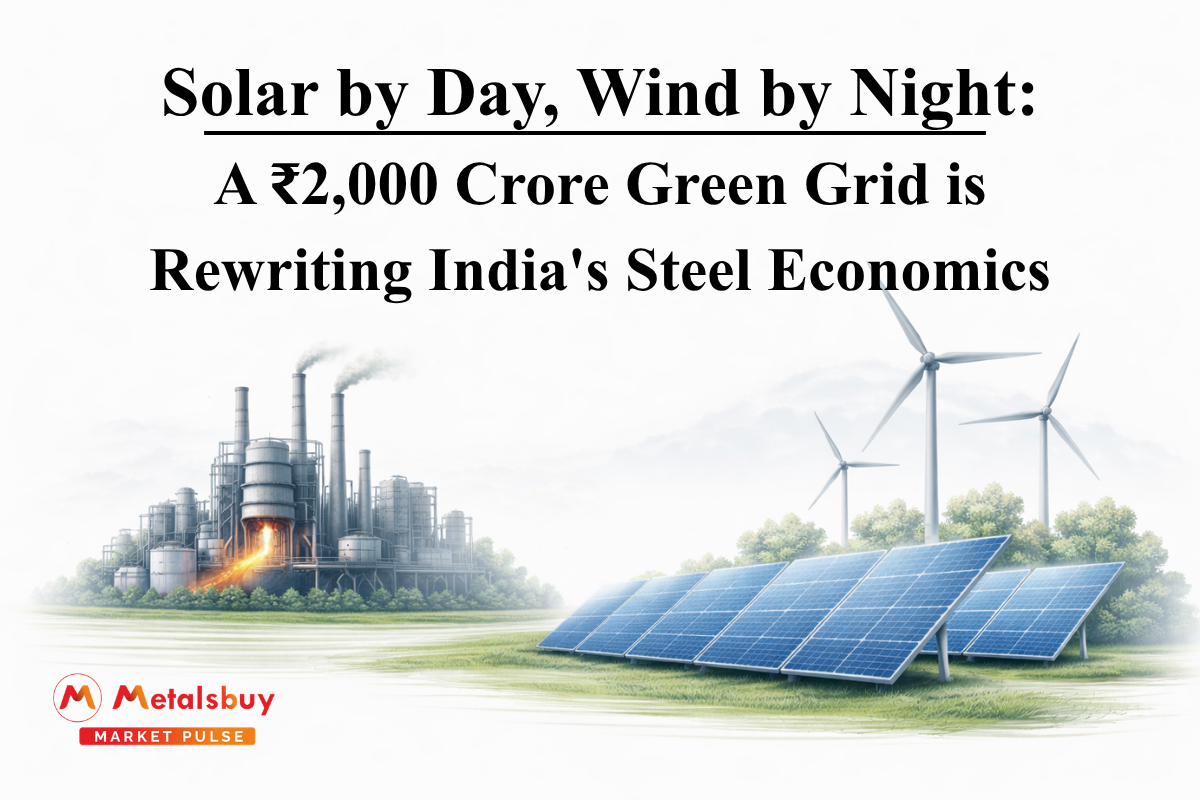
India's transition toward a sustainable industrial economy has just recorded a massive logistical milestone. In a definitive move to decarbonize heavy metallurgy, Jindal Stainless Limited—the country’s largest manufacturer of stainless steel—has officially commenced the phased rollout of a 315.6-megawatt hybrid solar and wind energy project. Developed in close partnership with independent power producer Oyster Renewable Energy, this utility-scale venture sets a new standard for how energy-intensive industries secure their operational future.
The sheer scale of the capital deployed underscores the serious nature of this transition. The total project involves a sprawling infrastructure investment exceeding ₹2,000 crore. To secure a dedicated, long-term pipeline of clean electricity, Jindal Stainless directly committed ₹132 crore in equity to the venture. This is a highly calculated financial maneuver designed to insulate the steelmaker from the volatile pricing of traditional fossil-fuel utility grids while simultaneously fortifying the global competitiveness of its supply chain.
Engineering a Balanced Power Output Across States
The most compelling aspect of this green energy initiative is its advanced technical and geographical architecture. Renewable energy is historically plagued by intermittency, a fatal flaw for round-the-clock steelmaking furnaces that demand a flawless, uninterrupted power supply. To solve this, Oyster Renewable engineered a highly integrated hybrid model that co-locates two distinct power sources to flatten the generation curve.
The facility integrates high-efficiency bifacial solar modules, which capture sunlight from both their front and rear surfaces using intelligent sun-tracking systems. These arrays are deployed directly alongside advanced 3.15-megawatt wind turbines manufactured by Suzlon. Because solar generation naturally peaks during the mid-day hours and wind energy production frequently hits its maximum output during the late evening and nighttime, pairing the two resources creates a remarkably stable daily power profile.
Geographically, the 315.6-megawatt capacity is divided to leverage optimal weather corridors. The partners have successfully initiated the partial commissioning of the first 216 megawatts located in the Agar-Malwa district of Madhya Pradesh. Under the current power purchase agreement, this initial phase will begin routing approximately 450 million units of clean electricity annually directly to Jindal Stainless’s primary manufacturing facilities in Jajpur, Odisha, and Hisar, Haryana. The remaining 99 megawatts are currently undergoing final site integration in the high-wind coastal zones of Gujarat. Once fully online by mid-year, the Gujarat phase will inject an additional 250 million units of green power into the company’s operations, bringing the project's total annual generation to over 700 million units.
Quantifying the Massive Environmental Impact
To grasp why a ₹2,000 crore hybrid facility is critical to the broader economy, one must look at the hard data surrounding India's steel decarbonization efforts. The domestic steel sector is historically one of the hardest industries to abate, responsible for a massive portion of the nation’s total greenhouse gas emissions.
Once the entire 315.6-megawatt hybrid capacity is actively feeding the grid, it is projected to facilitate a carbon emissions reduction of exactly 6.5 lakh metric tonnes every single year for Jindal Stainless. This is not just a future projection; it builds upon aggressive momentum the company has already established. Over the previous fiscal year, Jindal Stainless successfully drove down its year-over-year CO2 emissions by 14 percent, successfully avoiding over 318,248 metric tonnes of carbon. Furthermore, by late last year, the company had successfully pushed the share of renewable energy to over 50 percent of its total imported power consumption.
Bringing this massive new hybrid project online acts as an accelerant for these environmental targets. It serves as a cornerstone of the manufacturer's broader sustainability mandate, which includes a hard public commitment to slash its overall carbon footprint by 50 percent by the year 2035 and achieve a definitive net-zero operational status by 2050.
The Long-Term Economics of Green Steel
Looking ahead, the successful deployment of the Agar-Malwa and Gujarat sites provides a highly replicable, data-driven blueprint for the future of industrial power consumption. Reaching India's ambitious national target of 500 gigawatts of non-fossil fuel electricity by 2030 requires heavy manufacturers to pivot from being passive consumers to becoming active investors in renewable generation assets.
Furthermore, the shift toward sustainable energy carries immediate commercial weight on the international stage. Major Western markets, particularly the European Union, are finalizing strict import frameworks like the Carbon Border Adjustment Mechanism. These policies will soon penalize high-carbon industrial imports with steep financial tariffs. By proactively decarbonizing its energy inputs to the tune of 700 million green units annually, Jindal Stainless is effectively future-proofing its export business. This ensures its premium product lines retain frictionless access to environmentally conscious global markets without the heavy burden of cross-border carbon taxes.
The collaboration between Oyster Renewable and Jindal Stainless proves that heavy manufacturing and environmental stewardship are no longer mutually exclusive concepts. By leveraging cutting-edge Suzlon turbines, bifacial solar tracking, and strategic corporate capital, this initiative highlights how precise, data-backed engineering can fundamentally reshape the carbon economics of the steel world. Ultimately, it transforms green energy from a standard regulatory checklist item into a core driver of long-term industrial profitability.