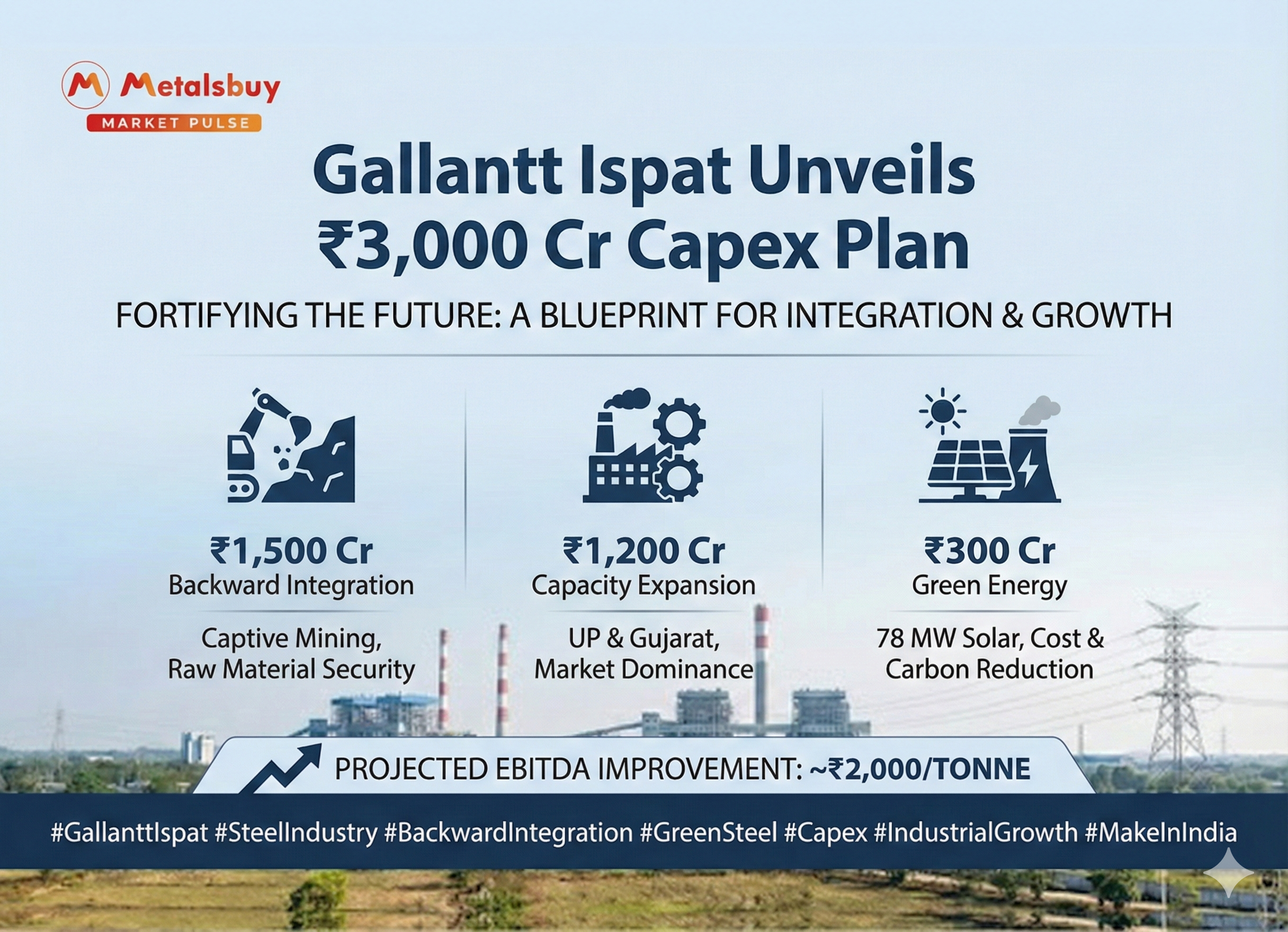
The mid-tier steel sector is shifting from volume-driven races to margin protection through deep backward integration. In a definitive move underscoring this shift, Gallantt Ispat Limited is executing a massive ₹3,000 crore capital expenditure program. This multi-tiered investment is a calculated architectural overhaul designed to insulate the company from supply chain volatility and cement its dominance as a national heavyweight.
Tracing the Capital Allocation: The Blueprint for Scale
Gallantt Ispat is consciously avoiding a single-objective expansion, choosing instead to deploy capital strategically across manufacturing, mining, and renewable energy. Over the next 24 to 36 months, the company will execute this capital rollout to fortify its operational base.
Strategic Capital Expenditure Breakdown
|
Investment Pillar |
Capital Allocated (₹ Crore) |
Core Objectives & Initiatives |
|
Backward Integration |
1,500 |
Securing captive raw materials; Developing Sonbhadra & Todpura mines; New Pellet Plant |
|
Capacity Expansion |
1,200 |
Phased manufacturing upgrades across Gorakhpur (UP) and Kutch (Gujarat) nodes |
|
Green Energy |
300 |
Setting up a 78 MW solar power plant to hedge against energy inflation |
|
Total Planned Outlay |
3,000 |
Comprehensive structural and operational transformation |
Driving Volume: The Manufacturing Targets
The ₹1,200 crore earmarked for capacity expansion is designed to lock down logistical advantages and deepen market penetration across the infrastructure-heavy corridors of Northern and Western India. This aggressive scaling fortifies Gallantt's commanding 25% market share in Uttar Pradesh’s rebar sector.
Projected Operational Capacities
|
Production Node |
Target Capacity (Lakh MTPA) |
Strategic Impact |
|
Total Steelmaking |
12.30 |
Positions the company as a high-volume national supplier |
|
Pellet Plant |
7.92 |
Crucial for in-house raw material processing |
|
MS Billet |
6.53 |
Ensures steady supply for rebar and rolled product manufacturing |
|
Sponge Iron |
5.94 |
Reduces reliance on external scrap and volatile spot markets |
The Margin Play: Decoding the Raw Material Strategy
While capacity generates topline growth, true financial engineering lies in the supply chain. To counter the cyclical nature of open-market commodity prices, half of the total outlay (₹1,500 crore) is dedicated to captive mining.
Transitioning from a buyer to an integrated miner fundamentally alters the cost structure. Industry analysts project that this level of backward integration will unlock an EBITDA improvement of roughly ₹2,000 per tonne. The financial translation of this efficiency is already visible; for the first nine months of FY26, the company reported a robust 27.1% surge in net profits to ₹361.44 crore on a revenue base of ₹3,214 crore.
The Decarbonization Imperative
The most forward-looking aspect of this outlay is the ₹300 crore allocated for a 78 MW solar power plant. Heavy industries face severe margin compression from grid power fluctuations and rising coal prices. By establishing dedicated renewable infrastructure, Gallantt actively hedges against long-term energy inflation. This solar initiative significantly drives down per-unit conversion costs over the plant's lifecycle while actively aligning with critical "green steel" mandates.
Market Implications and the Road Ahead
With a market capitalization hovering near ₹13,900 crore, Gallantt Ispat is signaling its transition to a structurally resilient, integrated player. The strategy is airtight: control the inputs, scale the output, and green the energy. By executing this blueprint, Gallantt Ispat is uniquely positioned to capitalize on booming domestic infrastructure spending while remaining insulated from the raw material price squeezes that routinely cripple its unintegrated peers.