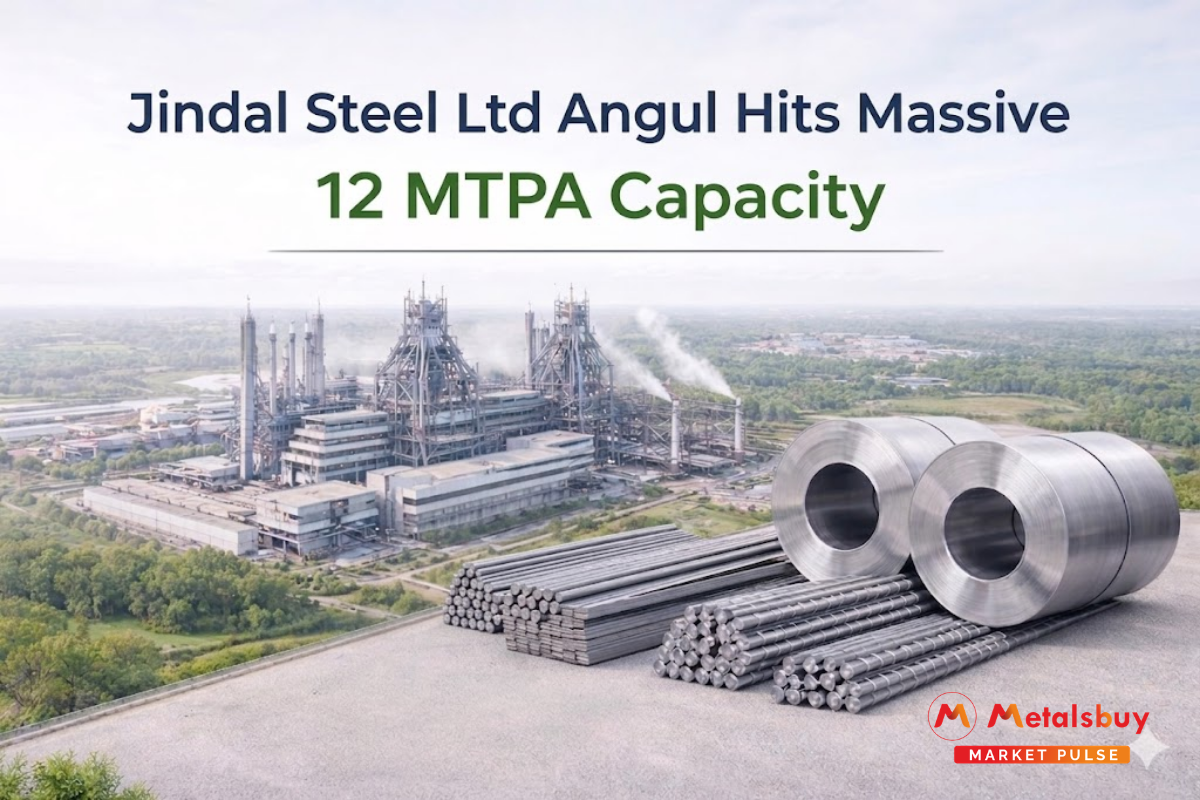
The Indian steel sector reached a historic milestone this week as Jindal Steel Ltd. officially commissioned the final phase of its capacity doubling project at the Angul Integrated Steel Complex. This development isn't just a corporate win; it is a fundamental shift in India's ability to meet its soaring infrastructure demands. With the operationalization of the third Basic Oxygen Furnace (BOF-3), the Angul facility has surged to a production capacity of 12 million tonnes per annum (MTPA), effectively becoming one of the largest single-location steel plants in the country and a cornerstone of the "Atmanirbhar Bharat" vision.
The Numbers Behind the Surge: A 15.6 MTPA Global Contender
The scale of Jindal Steel Ltd.’s recent growth is best understood through its verified production data. As of March 2026, the company’s total crude steel capacity has jumped to 15.6 MTPA, a significant leap from the 9.6 MTPA recorded at the end of fiscal year 2024. This total includes the 12 MTPA powerhouse at Angul and the 3.6 MTPA facility at Raigarh.
To achieve this, the company has executed an aggressive capital expenditure (Capex) program. While initial estimates placed the cycle at ₹25,000 crore, recent filings indicate that as of December 31, 2025, Jindal Steel Ltd. had already deployed ₹32,925 crore toward its expansion goals. This investment is part of a larger ₹47,043 crore roadmap that aims to take the group’s total capacity toward 25 MTPA by 2030. The immediate results are tangible: the newly commissioned 6 MTPA Hot Strip Mill at Angul is already allowing the company to target a 50-50 mix of "long" and "flat" products, moving away from simple construction steel toward high-margin automotive and consumer durable grades.
Why It Matters: Solving the Energy and Cost Equation
The strategic rationale for this expansion rests on two pillars: raw material security and energy innovation. India has historically grappled with the high cost of imported coking coal. Jindal Steel Ltd. has countered this by pioneering the world’s only Coal Gasification-Direct Reduced Iron (DRI) facility at Angul. By converting domestic high-ash thermal coal into synthesis gas (syngas) for steel production, the company has insulated itself from global price swings.
The data confirms the success of this strategy. Jindal Steel Ltd. is on track to achieve near 100% thermal coal security by the end of 2026, largely through the operationalization of the Utkal C and Meral coal blocks. From a financial perspective, this efficiency is reflected in the company’s balance sheet. Despite the heavy Capex, Jindal Steel Ltd. has maintained a Net Debt to EBITDA ratio below 1.1x, a level that analysts consider exceptionally healthy for a capital-intensive industry. In the 2023-24 fiscal year, the company reported a Net Profit After Tax (PAT) of ₹5,943 crore, a robust performance that provided the internal accruals necessary to fund these multi-billion dollar expansions.
Green Steel and the Global Competitive Edge
As the European Union prepares to implement the Carbon Border Adjustment Mechanism (CBAM) in 2026, the carbon intensity of steel has become a critical financial metric. Jindal Steel Ltd. is positioning its Angul expansion as a "Green Steel" hub. The DRI-syngas route is inherently cleaner than traditional blast furnaces, and the company has committed to reducing its CO2 emissions by 30% by 2030 (relative to 2005 levels).
Technology is the primary driver here. The company is currently establishing one of India’s largest green hydrogen projects, aiming to generate 4,500 tons per annum by late 2025. This will be supported by a massive 2,800 MW renewable energy capacity addition scheduled for completion by 2027. By integrating carbon capture and waste heat recovery units—which already contribute significantly to the plant’s 1,634 MW captive power capacity—Jindal Steel Ltd. is lowering its per-ton energy intensity to global benchmarks.
Socio-Economic Multiplier: Beyond the Blast Furnace
The impact of the Angul expansion radiates far beyond the plant gates. In the Odisha industrial belt, Jindal Steel Ltd.’s growth has acted as a catalyst for local employment and SME development. The project has created over 9,400 direct roles, while indirect employment in logistics, maintenance, and service sectors is estimated to support tens of thousands more.
Furthermore, the company has integrated a sophisticated slurry pipeline system to transport iron ore from its 7.5 MTPA Kasia and 3.11 MTPA Tensa mines directly to the Angul plant. This doesn't just reduce logistics costs; it removes thousands of heavy trucks from the roads daily, significantly lowering the regional environmental impact.
Future Outlook: The Road to 25 MTPA and Beyond
Looking ahead, Jindal Steel Ltd.’s trajectory suggests a relentless pursuit of volume and value. With the Angul plant now fully operational at 12 MTPA, the focus shifts to the Keonjhar expansion and the goal of reaching a 25 MTPA capacity by the end of the decade. The company’s recent entry into specialized rail production—including high-speed and head-hardened rails—positions it as the primary supplier for India’s $1.4 trillion National Infrastructure Pipeline.
In a global market where India is now the second-largest producer of crude steel (producing roughly 149 MT in 2024), Jindal Steel Ltd. is no longer just a domestic player. It is a technological vanguard. By doubling its Angul capacity through a blend of financial discipline, energy innovation, and high-value product diversification, Jindal Steel and Power has set a new standard for industrial expansion in the 21st century