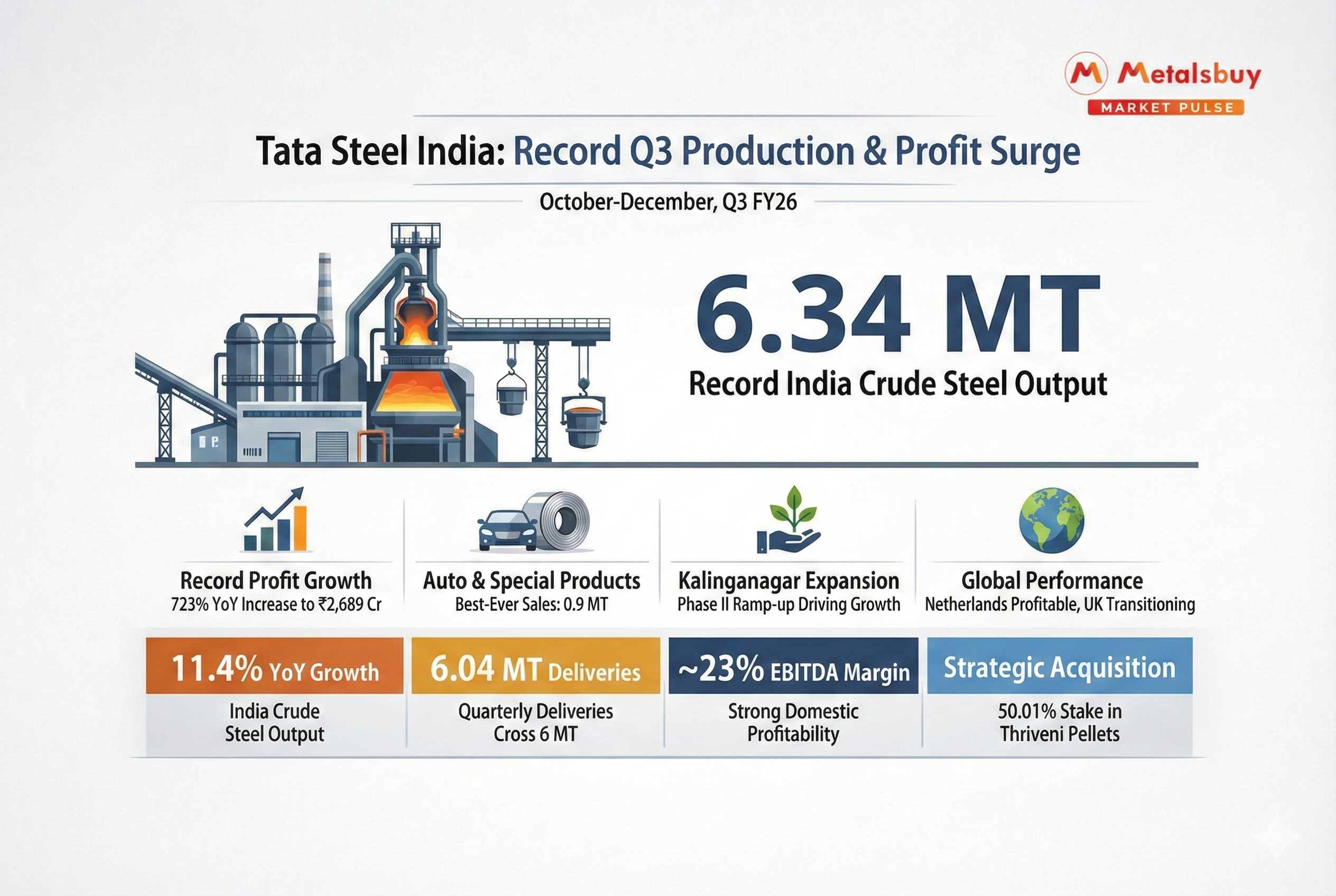
In a resounding validation of its domestic expansion strategy, Tata Steel has reported a stellar operational performance for the October-December quarter (Q3 FY26). Defying a global environment saturated by cheap exports and geopolitical volatility, the steel major achieved a record 11.4% year-on-year (y-o-y) increase in India crude steel production, touching 6.34 million tonnes (MT).
This performance stands as a critical differentiator in the current market, identifying Tata Steel’s Domestic-First Value Strategy as its core USP. While global peers struggle with margin compression, Tata Steel has successfully ring-fenced its Indian operations, delivering a massive 723% surge in consolidated net profit to ₹2,689 crore, up from just ₹327 crore in the same period last fiscal.
Operational Deep Dive: The 6 MT Milestone
The quarter marked a historic operational shift. For the first time, Tata Steel India’s quarterly deliveries crossed the 6 million tonne threshold, settling at 6.04 MT—a 14% y-o-y jump. This volume growth significantly outpaced the broader Indian market, driven largely by the ramp-up of the Phase II expansion at the Kalinganagar facility.
The production surge was not merely about volume; it was about efficiency. The India operations clocked an impressive EBITDA of ₹8,291 crore, translating to a robust margin of ~23%. This is particularly notable given that global steel markets were flooded with 119 million tonnes of Chinese exports in 2025, a level surpassing the 2015 peak.
Segmental Breakout: Auto and Retail Lead the Charge
A granular analysis of the order book reveals that Tata Steel’s growth is being powered by high-margin verticals rather than commodity-grade steel.
- Automotive & Special Products: This vertical recorded its best-ever quarterly sales of approximately 0.9 MT, registering a 20% growth y-o-y. The spike is attributed to accelerated OEM approvals for cold-rolled and high-tensile steel grades from the new Kalinganagar lines.
- Branded Products & Retail: Catering to the B2C segment, this division surpassed 2 MT in quarterly volumes, growing by 12%. Flagship brands like Tata Tiscon and Tata Steelium (up 20% q-o-q) continue to command pricing power, insulating the company from spot market volatility.
- Industrial Products: This segment contributed 1.9 MT, supported by a record performance in the Engineering sub-segment.
The European Context: A Mixed Bag
The "Two-Speed" narrative of Tata Steel’s portfolio continues, though with signs of stabilization in the Netherlands.
- Tata Steel Netherlands: The unit reported a turnaround with an EBITDA of €55 million (approx. ₹495 crore), recovering from a loss-making streak. Liquid steel production stood at 1.68 MT, while deliveries were at 1.40 MT.
- Tata Steel UK: The transition pain persists at Port Talbot as the company shifts to Electric Arc Furnace (EAF) technology. The unit reported an EBITDA loss of £63 million on deliveries of just 0.52 MT, weighed down by subdued demand and import pressures.
Strategic Capital: Future-Proofing Growth
Beyond the operational numbers, Q3 FY26 saw significant strategic consolidation. The company completed the acquisition of a 50.01% stake in Thriveni Pellets Private Limited, securing critical raw material linkages for its expanding blast furnaces. Additionally, it consolidated its stake in Tata Steel Colors, further integrating its downstream value chain.
Conclusion and Market Outlook
Tata Steel’s Q3 report serves as a bellwether for the Indian steel sector's resilience. With India revenues hitting ₹35,725 crore, the company has effectively decoupled its domestic fortune from the stagnant European market.
As CEO T.V. Narendran noted, despite the "elevated finished steel exports from China," the company’s focus on capacity expansion and value-added products has delivered a "strong performance." For investors, the takeaway is clear: Tata Steel’s pivot to a higher domestic volume mix is not just a safety net—it is a high-growth engine firing on all cylinders.
Tata Steel Q3 FY26 results, India crude steel production record 6.34 MT, Tata Steel net profit growth 723%, Kalinganagar expansion impact, steel industry global glut 2026, Thriveni Pellets acquisition.