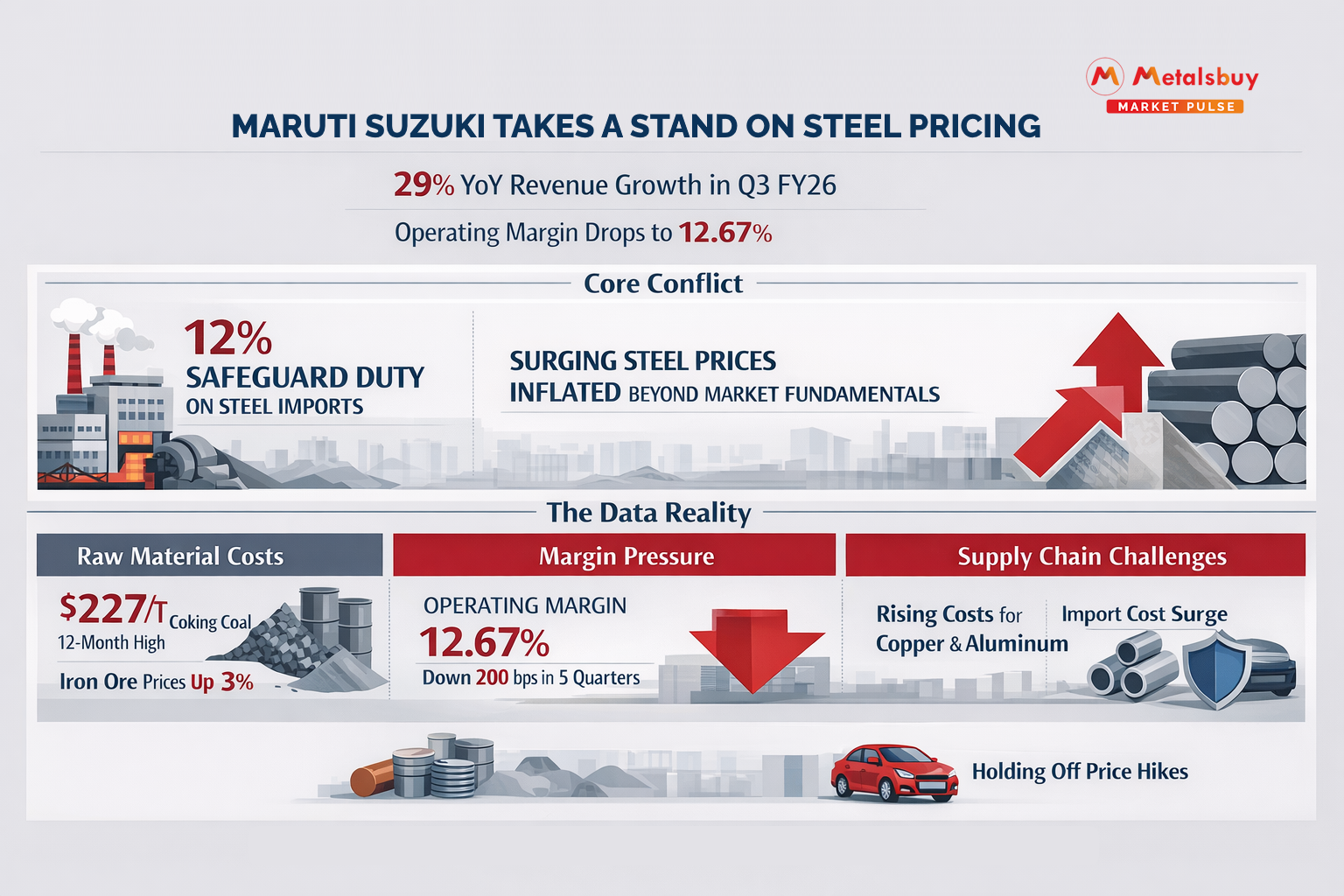
Maruti Suzuki India Ltd (MSIL) has initiated a decisive move to "engage" directly with domestic steel manufacturers, signaling a rare public friction between India’s automotive giant and its raw material suppliers. Despite posting a robust 29 percent year-on-year revenue surge in Q3 FY26, the carmaker is grappling with margin pressures, prompting a firm stance against what it views as unjustified commodity price hikes.
The Core Conflict: Safeguard Duties vs. Pricing Power
The friction stems from the recently imposed 12 percent safeguard duty on specific steel imports, a government measure designed to protect domestic mills from global dumping. However, Maruti Suzuki contends that steelmakers are leveraging this policy shield to artificially inflate prices beyond market fundamentals.
Rahul Bharti, the company’s Senior Executive Officer for Corporate Affairs, articulated the automaker's position clearly during the post-earnings call. He emphasized that while the government’s intent was to prevent injury to the domestic steel sector, the policy explicitly warned against profiteering. Maruti’s decision to formally negotiate suggests they believe steel companies are using the duty as a tool for margin expansion rather than mere protection, effectively passing inefficiencies down to the manufacturing value chain.
The Data Reality: Costs vs. Margins
The urgency of this negotiation is underpinned by hard data. While input costs have undeniably risen, the automaker argues the hike in steel prices is disproportionate.
- Raw Material Spikes: Coking coal, essential for steel production, has hit a 12-month high of roughly $227 per tonne, and iron ore prices have inched up by 3 percent.
- Supply Chain Stress: Beyond steel, the sector is managing inflated costs for non-ferrous metals like copper and aluminum, alongside a spike in import costs for rare earth sub-assemblies due to supply constraints.
These pressures have visibly impacted Maruti’s financial health. Operating margins have compressed to 12.67 percent—a drop of over 200 basis points in the last five quarters. This contraction indicates that the cost of production is outpacing the net realization per vehicle, a trend that could become unsustainable if steel prices remain unchecked.
Future Outlook: Protecting the Consumer Recovery
Maruti Suzuki’s aggressive negotiation stance is largely driven by a desire to protect the nascent demand recovery in the passenger vehicle market. Following the historic GST rate cut in September 2025, volumes—particularly in the small car segment—have rebounded significantly.
The company leadership views an immediate price hike as detrimental to this positive sentiment. Bharti noted that raising car prices so soon after a tax benefit would be "counter-intuitive" and an ethical breach of the trust placed in the sector by consumers. Consequently, for the remainder of FY26, Maruti appears willing to absorb some input cost shocks rather than pass them on.
However, this strategy relies heavily on the success of these talks. The automaker is banking on operational leverage from its upcoming Kharkhoda plant to offset costs in the long run. Ultimately, this engagement is a strategic maneuver: Maruti is drawing a line in the sand to ensure that "Make in India" remains competitive and that trade remedial measures do not morph into inflationary burdens for the end consumer.