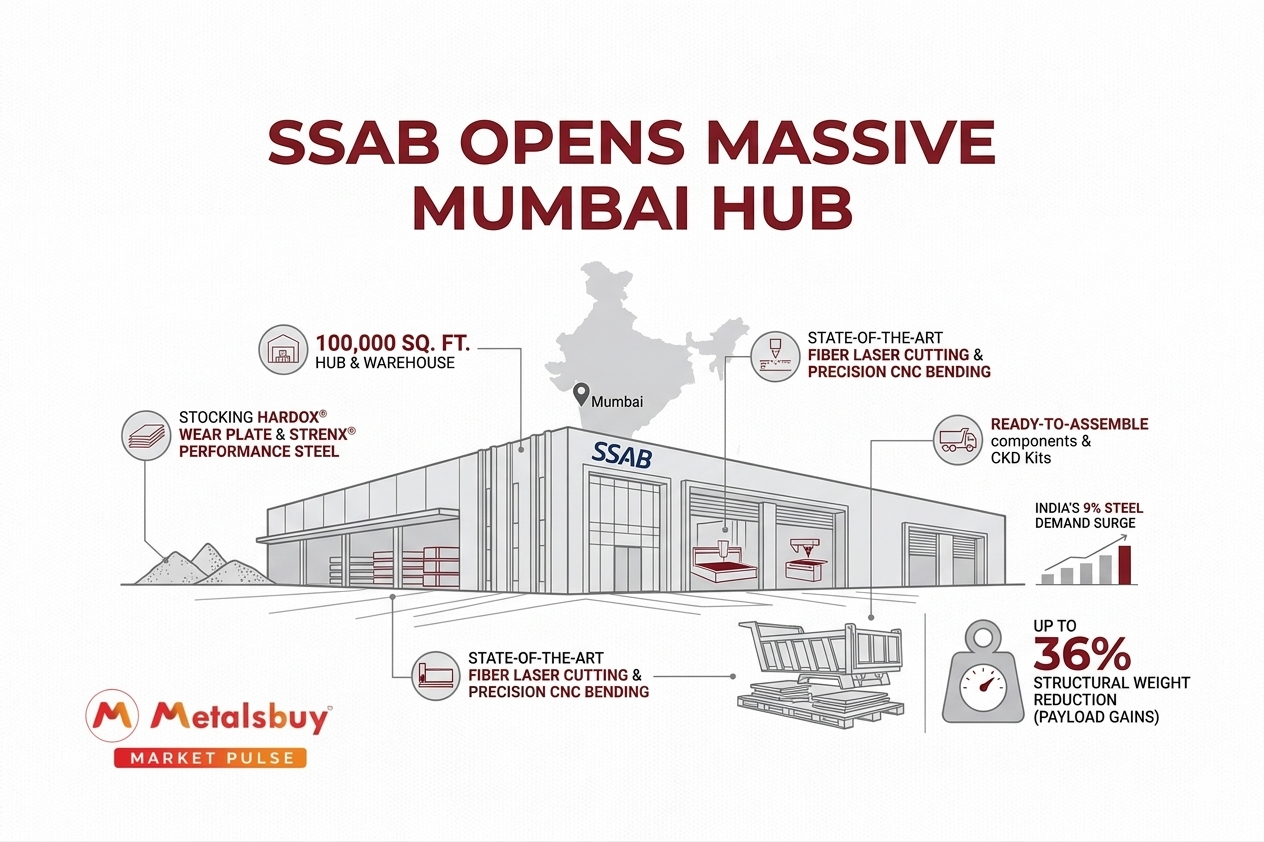
As the global steel sector grapples with stagnant growth, the Indian market is emerging as an undisputed bright spot. Driven by a colossal $1.4 trillion National Infrastructure Pipeline, domestic steel consumption is projected to grow by an industry-leading 8% to 9% through 2025 and 2026, with overall 2026 demand projected to be nearly 75 million tonnes higher than 2020 levels. To capture this momentum, Swedish specialty steel manufacturer SSAB has strategically expanded its operational footprint by inaugurating a state-of-the-art service center in Mumbai.
Moving away from the traditional, volume-heavy raw material distribution model, this new facility introduces a highly localized, value-added approach. By delivering completely knocked-down (CKD) kits and ready-to-assemble components directly to Indian heavy equipment manufacturers, SSAB is bridging the critical gap between premium European metallurgy and the fast-paced fabrication requirements of India's domestic industries.
The Core Development: Precision Processing at Scale
Strategically located within the ESR Taloja Industrial & Logistics Park, the new service center spans an expansive 100,000 square feet. This positioning offers seamless logistical access across Mumbai, Navi Mumbai, and Thane, ensuring uninterrupted supply chains for regional manufacturing hubs. The facility is anchored by a centralized warehouse built to maintain a robust standing inventory of over 10,000 tonnes of specialized steel plates, supporting shorter lead times and reliable just-in-time delivery models.
However, the facility’s true industrial significance lies in its advanced processing capabilities. It is fully equipped with state-of-the-art heavy-duty machinery entirely dedicated to fiber laser cutting and precision CNC bending. The center focuses exclusively on SSAB’s flagship materials: the highly abrasion-resistant Hardox wear plate and the high-yield Strenx performance steel. By handling these notoriously difficult-to-machine grades locally, SSAB can now supply precision-machined parts tailored to exact original equipment manufacturer (OEM) specifications, eliminating a major bottleneck for local factories.
Strategic Rationale: Fueling an Infrastructure Boom
The timing of this investment aligns perfectly with India's broader economic trajectory. With domestic crude steel capacity targeting a massive 300 million tonnes by 2030, the market is rapidly maturing from basic structural steel toward specialized, high-performance alloys. Manufacturers of heavy-duty rock body tippers, commercial tipping trailers, and crane booms are facing dual pressures: equipment must endure extreme physical wear in mining and construction, yet meet tightening domestic transport emission standards that demand lighter overall vehicle weights.
High-strength and wear-resistant steels require highly specialized cutting parameters and heavy-duty press brakes to manage physical phenomena like "spring-back" during bending. By establishing this local hub, SSAB removes the heavy capital expenditure burden of complex fabrication from the end-user. According to Subodh Shinde, Country Head for India at SSAB, the core objective is manufacturing simplification. By combining premium materials with in-house technical expertise, the Taloja facility empowers domestic builders to achieve superior equipment performance without needing to invest millions in proprietary heavy-duty processing infrastructure.
The Unique Value Proposition: Quantifiable Payload Gains
The primary unique selling proposition (USP) of this venture is the transition from a standard material supplier to an integrated manufacturing partner, backed by hard performance data. Instead of bearing the overhead costs of complex cutting and scrap management, Indian bodybuilders can now source pre-processed CKD kits that drastically alter their unit economics.
The operational data surrounding these materials is compelling. Field applications replacing standard mild steels (like ASTM A36) with advanced grades such as Hardox 500 Tuf or Strenx 700/900MC have consistently demonstrated structural weight reductions of up to 35% to 36%. For a commercial tipper manufacturer, shedding several tonnes of tare weight translates directly into a massive increase in legal payload capacity. In practical terms, this allows fleet operators to transport significantly more material per trip, accelerating the return on investment through increased haulage revenue and reduced per-tonne fuel consumption.
Future Outlook: Redefining Heavy Equipment Supply Chains
Looking ahead, the operational launch of the Mumbai facility signals a critical maturation in the heavy equipment supply chain across South Asia. As operational efficiency and carbon footprint reduction become critical metrics for fleet owners, the demand for lightweight, durable commercial vehicles will only accelerate. The shift toward thinner, stronger plates aligns perfectly with India's environmental goals, effectively fighting gravity to reduce diesel consumption in heavy transport.
Additionally, by keeping processing in-house and supplying strictly through authorized channels, SSAB is actively securing product authenticity in a sector occasionally plagued by counterfeit materials.
Over the coming years, this localized, data-driven processing model is expected to set a new benchmark for metallurgical firms operating in India. It shifts the competitive focus from simple raw material tonnage to embedded technical partnerships and quantifiable payload economics. Ultimately, SSAB’s new Taloja facility is not merely a logistical expansion; it is a calculated integration into a booming industrial ecosystem, equipping domestic manufacturers to build the stronger, lighter, and more efficient machinery required for India's next decade of growth.