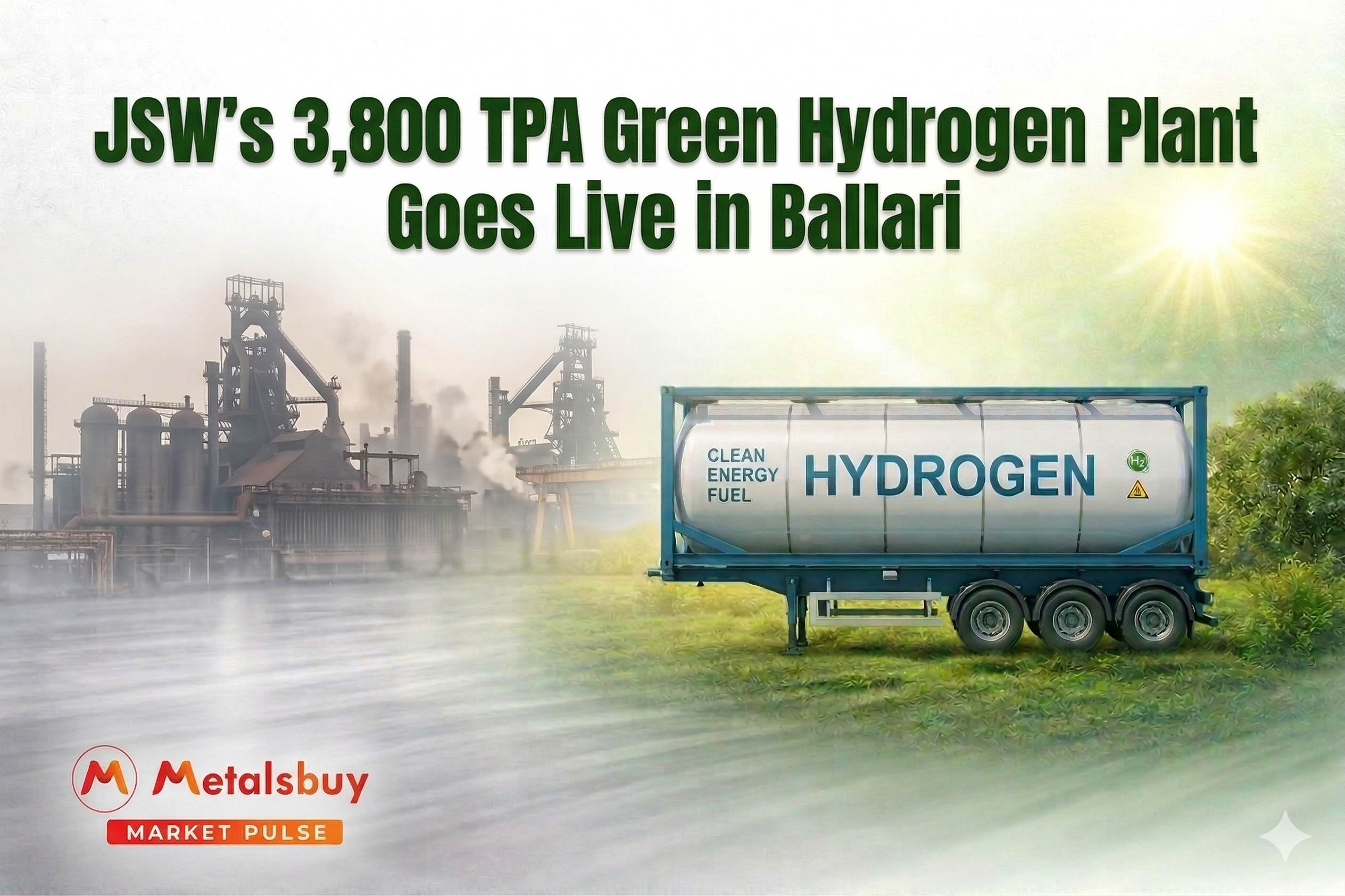
India’s transition toward an emission-free industrial framework reached a definitive milestone this week. The Solar Energy Corporation of India officially announced the commissioning of the country’s first green hydrogen production facility under the National Green Hydrogen Mission.
While the broader clean energy narrative heavily features electric vehicles and solar grids, the unique selling proposition of this new development lies in its direct integration into heavy steel manufacturing. By successfully deploying industrial-scale green hydrogen to replace fossil-heavy processes, the country is moving beyond theoretical climate commitments and executing tangible decarbonization in one of the world's most notoriously hard-to-abate sectors.
Operationalizing the Green Hydrogen Vision in Ballari
The newly commissioned facility, developed by JSW Energy, is strategically located at the JSW Vijayanagar Steel complex in Karnataka. Functioning under Phase I of the Production Linked Incentive scheme, the plant establishes a new baseline for industrial sustainability. Under a comprehensive seven-year offtake agreement, the facility will produce 3,800 tonnes per annum of green hydrogen.
The underlying mechanics of the project highlight a highly optimized approach to resource management. The plant relies on pressurized alkaline-based electrolyzers powered entirely by 25 to 27 megawatts of round-the-clock renewable energy, sourced seamlessly from a combination of captive wind and solar assets.
What makes this project fundamentally unique is its dual-utility model. The primary green hydrogen output is fed directly into the steel plant’s direct reduced iron process, a critical step that traditionally relies heavily on carbon-intensive natural gas or coal. Simultaneously, the electrolysis process generates 30,000 tonnes of pure green oxygen annually as a byproduct. Instead of venting this off, the oxygen is captured and repurposed for the plant’s blast furnace operations. This closed-loop utilization significantly elevates the overall operational efficiency of the steel complex, proving that ecological sustainability and heavy industrial profitability can coexist.
The Strategic Engine of Policy Push and Corporate Scaling
To understand the momentum behind this development, one must look at the aggressive policy architecture erected by the Indian government and the parallel scaling by private enterprises. The National Green Hydrogen Mission was launched with an initial financial outlay of ₹19,744 crore. Out of this budget, a massive ₹17,490 crore is specifically earmarked for the Strategic Interventions for Green Hydrogen Transition program to absorb the early-stage risks of clean energy adoption.
The strategy is clearly yielding numeric results. According to the Ministry of New and Renewable Energy, India’s cumulative commissioned green hydrogen capacity successfully reached 8,000 tonnes per annum by February 2026. Government financial backing has seen a sharp upward trajectory alongside this physical growth. Fund utilization for the mission skyrocketed from a mere ₹0.11 crore in the 2023-24 fiscal year to ₹203.75 crore by March 2026 against an allocated ₹300 crore budget for the year.
Corporate players are matching this ambition. JSW Energy has already signed a memorandum of understanding to progressively scale its supply to the steel plant, targeting between 85,000 and 90,000 tonnes of green hydrogen and 720,000 tonnes of green oxygen annually by 2030. This aligns with the company's broader infrastructure push, which currently boasts a locked-in power generation capacity of 30.5 gigawatts and an impressive 29.4 gigawatt-hours of energy storage, establishing a firm foundation to achieve corporate carbon neutrality by 2050.
Shifting Cost Economics and the Blueprint for 2030
The push toward commercial viability is largely driven by a rapidly shifting cost curve. According to World Bank estimates, renewable energy inputs dictate between 50% and 70% of the total cost of green hydrogen production, translating to roughly ₹235 per kilogram purely for power.
Through competitive bidding mechanisms, domestic supply costs are beginning to break historic barriers. While early contracts for major state-run refineries like Indian Oil and Bharat Petroleum discovered price points hovering between ₹387 and ₹397 per kilogram, the landscape changed dramatically in late March 2026. A joint venture between BPCL and Sembcorp Industries secured a landmark contract to supply 10,000 tonnes annually to the Numaligarh Refinery at a record-low tariff of just ₹279 per kilogram. This sub-$3 milestone puts the industry well within striking distance of the government's highly coveted $2 per kilogram target, a benchmark necessary to make green hydrogen globally competitive against conventional fossil fuels.
The commissioning of the Ballari project is the opening phase of a much larger industrial restructuring. The government has set a firm target to build a green hydrogen production capacity of 5 million metric tonnes annually by 2030. Achieving this will require an unprecedented infrastructure build-out, including the addition of 125 gigawatts of dedicated renewable energy capacity and the deployment of 60 to 100 gigawatts of electrolyzers.
The environmental and geopolitical dividends of reaching these numbers are immense. A mature domestic green hydrogen supply chain will allow India to avert nearly 50 million metric tonnes of annual greenhouse gas emissions. By substituting imported fossil fuels with domestically produced clean energy, the country stands to reduce its import bills by an estimated ₹1 lakh crore.
The successful operationalization of the SECI and JSW project serves as a crucial proof of concept. It demonstrates to global markets that the technological hurdles of heavy industrial decarbonization have been cleared. As clean fuel costs continue their downward trajectory, the narrative is shifting entirely. India is actively positioning itself to lead the global clean energy transition through concrete, data-backed execution.