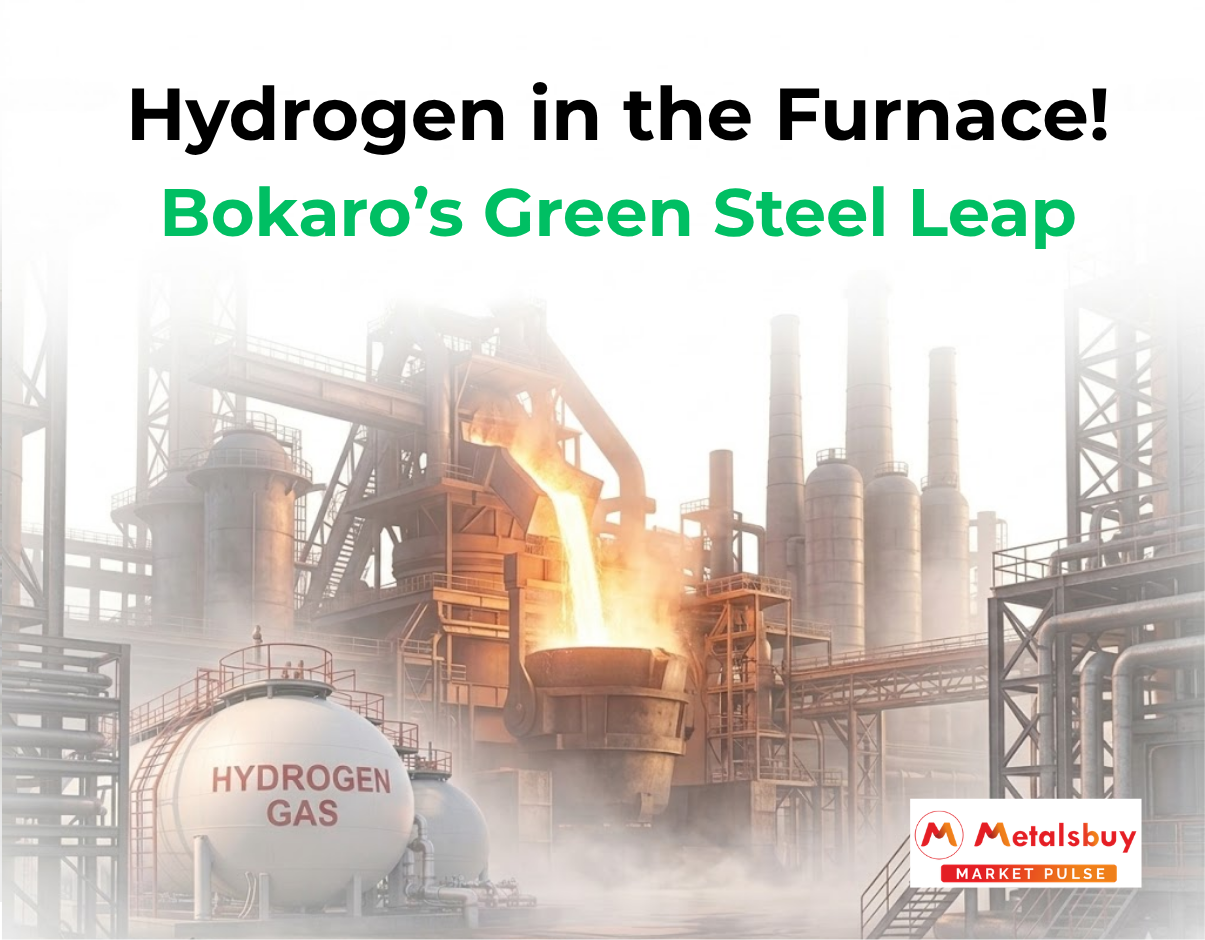
The global heavy manufacturing sector is navigating a delicate transition, balancing the urgent demand for infrastructure material against tightening global climate mandates. In a defining move for India’s industrial trajectory, the Steel Authority of India Limited (SAIL) has initiated a massive technological leap at its Bokaro Steel Plant. By introducing hydrogen gas injection into an active blast furnace, the state-run enterprise is actively stress-testing the commercial viability of low-carbon manufacturing in the world's second-largest steel-producing nation.
This development arrives at a pivotal juncture for the domestic market. According to recent fiscal data, India’s crude steel output surged by 10.7% year-on-year to hit a record 168.4 million tonnes in FY 2025-26. However, this impressive economic growth carries a heavy environmental footprint. The Indian steel industry currently accounts for roughly 12% of the country’s total greenhouse gas emissions, making decarbonization a matter of both national policy and long-term economic survival.
The Strategic Blueprint and Execution
On April 7, 2026, the Bokaro Steel Plant formally signed an execution contract with engineering firm Forbes Marshall Private Limited to implement hydrogen injection technology in Blast Furnace-1. Operating under the strategic umbrella of the Union Government’s National Green Hydrogen Mission, this pilot project is backed by technical expertise from UK-based Primetals Technologies and the Research and Development Centre for Iron and Steel (RDCIS).
The core operational shift involves partially replacing the highly carbon-intensive coke and pulverized coal traditionally used as reducing agents in the furnace. By injecting hydrogen at the tuyere level of the blast furnace, the chemical reaction extracts iron from ore while producing water vapor instead of carbon dioxide. Given the sheer scale of Bokaro's operations, this ranks among the largest industrial hydrogen injection initiatives attempted globally.
The unique selling proposition of the Forbes Marshall SAIL agreement lies in its pragmatic approach to capital expenditure. Currently, over 59% of India’s operating steel capacity is based on the legacy Blast Furnace-Basic Oxygen Furnace (BF-BOF) route, with plants designed to operate for decades. Instead of abandoning these multi-billion-dollar assets to build entirely new greenfield facilities, this retrofitting technology allows existing blast furnaces to significantly lower their carbon footprint. It bridges the gap between today’s carbon-heavy infrastructure and the eventual shift to fully renewable-powered networks.
Decoding the Data and Financial Drivers
The urgency behind this blast furnace decarbonization is strictly driven by hard data and shifting trade economics. The average emission intensity of crude steel production in India stands at roughly 2.36 to 2.55 tonnes of CO2 per tonne of crude steel (tCO2/tcs). This is noticeably higher than the global average of 1.85 tCO2/tcs, largely due to the reliance on domestic coal and high-ash iron ore. With India targeting an expanded production capacity of 300 million tonnes by 2030, maintaining the current emissions trajectory is unsustainable and would risk adding nearly 680 million tonnes of CO2 equivalent to the atmosphere.
Furthermore, international regulatory shifts are forcing Indian manufacturers to adapt. With the European Union enforcing the Carbon Border Adjustment Mechanism (CBAM), exporters of carbon-heavy steel face the imminent threat of steep tariffs that will erode their pricing competitiveness in Western markets. Green steel production in India is no longer an environmental luxury; it is a defensive trade strategy.
To cushion the immense financial risk associated with adopting nascent technologies, the government has provided a crucial safety net. The Ministry of New and Renewable Energy, through the National Green Hydrogen Mission, has allocated a dedicated budget of ₹455 crore extending up to FY 2029-30 specifically for pilot projects in the steel sector. This state-backed funding model allows companies like SAIL to absorb the currently high costs of hydrogen logistics and operational integration, socializing the financial risk of innovation.
Future Outlook and Sectoral Evolution
The Bokaro pilot acts as a vital barometer for the broader heavy-industries sector. If the integration successfully maintains optimal furnace permeability and operational yield while proving the safe, continuous handling of industrial-scale hydrogen, it will establish a replicable standard for integrated steel mills across the country.
Looking ahead, this technology offers a highly viable middle-path. While the ultimate objective for India net-zero steel 2070 is a complete transition to 100% green hydrogen direct reduced iron (DRI) paired with electric arc furnaces powered by renewable energy, that reality is decades away. In the interim, blending varying percentages of hydrogen into existing blast furnaces provides immediate emission cuts. As the cost of producing green hydrogen inevitably declines over the next decade due to scaling electrolyzer manufacturing and cheaper renewable power, the blending ratios in these furnaces can be steadily increased.
For global stakeholders monitoring India's economic ascent, the Bokaro initiative sends an overwhelmingly positive signal. It demonstrates that the nation’s heavy industries are actively deploying data-backed, scalable solutions to meet their climate obligations. SAIL is proving that record-breaking industrial output and aggressive decarbonization do not have to be mutually exclusive, laying a resilient foundation for the next generation of global infrastructure.