Renewed merger discussions between Rio Tinto and Glencore have brought large scale mining consolidation back into sharp focus, at a time when commodity markets are entering a more constructive phase of the cycle.
According to market reports, preliminary talks that collapsed in 2024 have resurfaced in early 2026, driven by stronger price signals in copper, improved medium term demand visibility, and renewed investor appetite for scale backed by cash generating assets. If consummated, the transaction would create the world’s largest diversified mining group by market capitalisation, with material influence across iron ore, copper, coal, and critical minerals.
For steel mills, commodity traders, institutional investors, and policymakers, the revival of these talks signals far more than a corporate transaction. It points to a potential structural shift in how raw material supply, pricing power, and capital allocation could evolve over the coming decade.
Valuation Reality and Balance Sheet Asymmetry
At the heart of the renewed discussions lies a complex valuation equation.
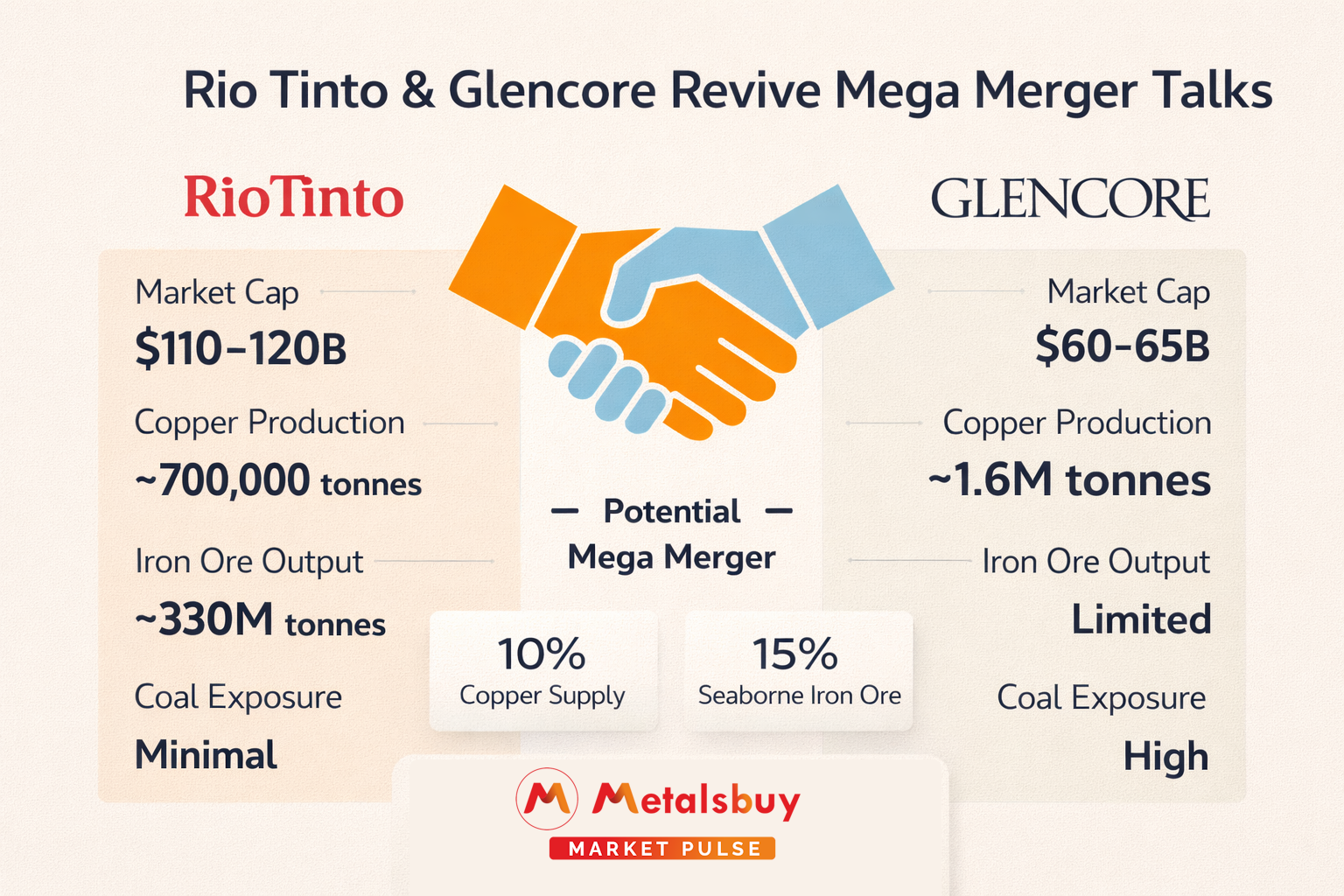
Rio Tinto currently commands a market capitalisation estimated at USD 110 to 120 billion, underpinned by its highly profitable iron ore franchise in Western Australia. Iron ore contributes close to 60 percent of Rio Tinto’s EBITDA, making it one of the most cash generative mining portfolios globally.
Glencore, in contrast, is valued at approximately USD 60 to 65 billion but operates on a fundamentally different earnings model. Its FY2025 revenues exceeded USD 210 billion, driven largely by its global commodity trading and marketing arm. While headline revenues are significantly higher, EBITDA margins are structurally thinner and more volatile.
This asymmetry explains why market participants expect any deal structure to be equity heavy rather than cash led, and why valuation alignment remains one of the most sensitive negotiation points.
Copper as the Strategic Anchor of the Deal
Copper is widely seen as the primary strategic driver behind the renewed talks.
Combined, Rio Tinto and Glencore could control copper production exceeding 2.5 million tonnes per annum, accounting for close to 10 percent of global mined copper supply. At a time when permitting challenges, declining ore grades, and capital intensity are constraining new supply, such consolidation materially alters the long term copper supply equation.
For policymakers and energy transition planners, this raises questions around supply concentration in a metal critical to electrification, renewable energy, electric vehicles, and grid infrastructure. For investors, it strengthens the long term optionality embedded in a combined balance sheet, particularly as copper demand growth is expected to outpace supply growth well into the 2030s.
Implications for Iron Ore and the Global Steel Industry
From a steel market perspective, the potential merger carries meaningful implications.
Rio Tinto currently produces over 330 million tonnes of iron ore annually and controls roughly 15 percent of global seaborne iron ore trade. Its pricing discipline and volume stability have historically acted as an anchor for benchmark iron ore markets.
While Glencore’s direct iron ore production is relatively modest, its strength lies in marketing, trading, and logistics. A combined entity could blend Rio Tinto’s supply dominance with Glencore’s commercial agility, potentially reshaping contract negotiations, spot market liquidity, and supply responsiveness.
For steel mills, especially in Asia, this raises the prospect of a more consolidated supplier base with enhanced pricing power, reinforcing the importance of long term procurement strategies and diversification of raw material sourcing.
Coal Exposure and the ESG Fault Line
One of the most contentious aspects of the discussions remains Glencore’s coal portfolio.
Glencore remains among the world’s largest exporters of thermal coal, with annual volumes exceeding 100 million tonnes. During strong pricing cycles, coal contributes more than 40 percent of its industrial EBITDA, making it a critical cash flow pillar.
Rio Tinto, by contrast, has largely exited thermal coal and committed to a net zero pathway by 2050. This divergence introduces both reputational and strategic tension, particularly among ESG focused investors.
Any merger scenario would almost certainly require asset rationalisation, spin offs, or phased divestments of coal assets to align with Rio Tinto’s decarbonisation narrative and regulatory expectations in key jurisdictions.
Regulatory, Antitrust, and Policy Considerations
Regulatory scrutiny is expected to be intense.
A merged entity could control over 20 percent of global copper concentrate trade, raising potential antitrust concerns in multiple jurisdictions. Regulatory approvals would likely be required across Australia, the UK, the European Union, China, the United States, and several resource rich developing economies.
For policymakers, the transaction raises broader questions around resource nationalism, strategic mineral security, and the balance between market efficiency and supply concentration.
Market Reaction and Investor Positioning
Equity market response has reflected cautious optimism.
Glencore shares reportedly gained between 7 and 9 percent following reports of revived talks, as investors priced in takeover optionality. Rio Tinto shares, however, traded flat to marginally lower, indicating shareholder concern around integration risk, capital discipline, and strategic fit.
This divergence underscores a key reality. While the market recognises the long term strategic logic, investors remain focused on execution risk and value accretion rather than scale alone.
Summary Comparison Table
| Metric | Rio Tinto | Glencore |
|---|---|---|
| Market Capitalisation | USD 110 to 120 billion | USD 60 to 65 billion |
| Annual Revenue | USD 55 to 60 billion | USD 210 billion plus |
| Copper Production | Around 700 thousand tonnes | Around 1.6 million tonnes |
| Iron Ore Output | Around 330 million tonnes | Limited |
| Coal Exposure | Minimal | High |
Institutional Takeaway
The revival of merger talks between Rio Tinto and Glencore is not merely a corporate development. It reflects a broader recalibration underway in global commodity markets, where scale, long life assets, and control over future facing metals are becoming increasingly strategic.
For steel mills, the implications lie in iron ore supply concentration and procurement leverage. For traders, it signals potential shifts in market liquidity and pricing dynamics. For investors, it presents a high stakes debate around value creation versus complexity. For policymakers, it raises fundamental questions about mineral security and market structure.
Whether or not the deal ultimately materialises, one conclusion is clear. Large scale consolidation is firmly back on the agenda, and the global mining sector is positioning itself for the next phase of the commodity supercycle.