KEY NUMBERS
25 MTPA : Planned steel production capacity at JSW’s proposed Gadchiroli project
₹1 Lakh Crore : Total planned investment into the integrated steel complex
7 To 8 Years : Expected development timeline for the project
9,100 Acres : Land being acquired by MIDC for the facility
14 Villages : Villages included in the acquisition process
May 23, 2026 : Date project confirmation was announced publicly
Gadchiroli, Maharashtra : Location selected for the integrated steel project
World Number 1 : Potential ranking as the world’s largest single steel manufacturing facility
Mining Operations : Resource extraction activity has already commenced in the region
Central India : Emerging as India’s fastest growing steel and raw materials corridor
⸻
MARKET ANALYSIS
For decades, Gadchiroli existed in industrial conversations as a warning.
Difficult terrain. Security risks. Naxalite activity. Untapped mineral reserves trapped behind political and logistical barriers. Companies discussed the region carefully and usually from a distance.
Now one of India’s largest industrial groups wants to build the world’s biggest steel plant there.
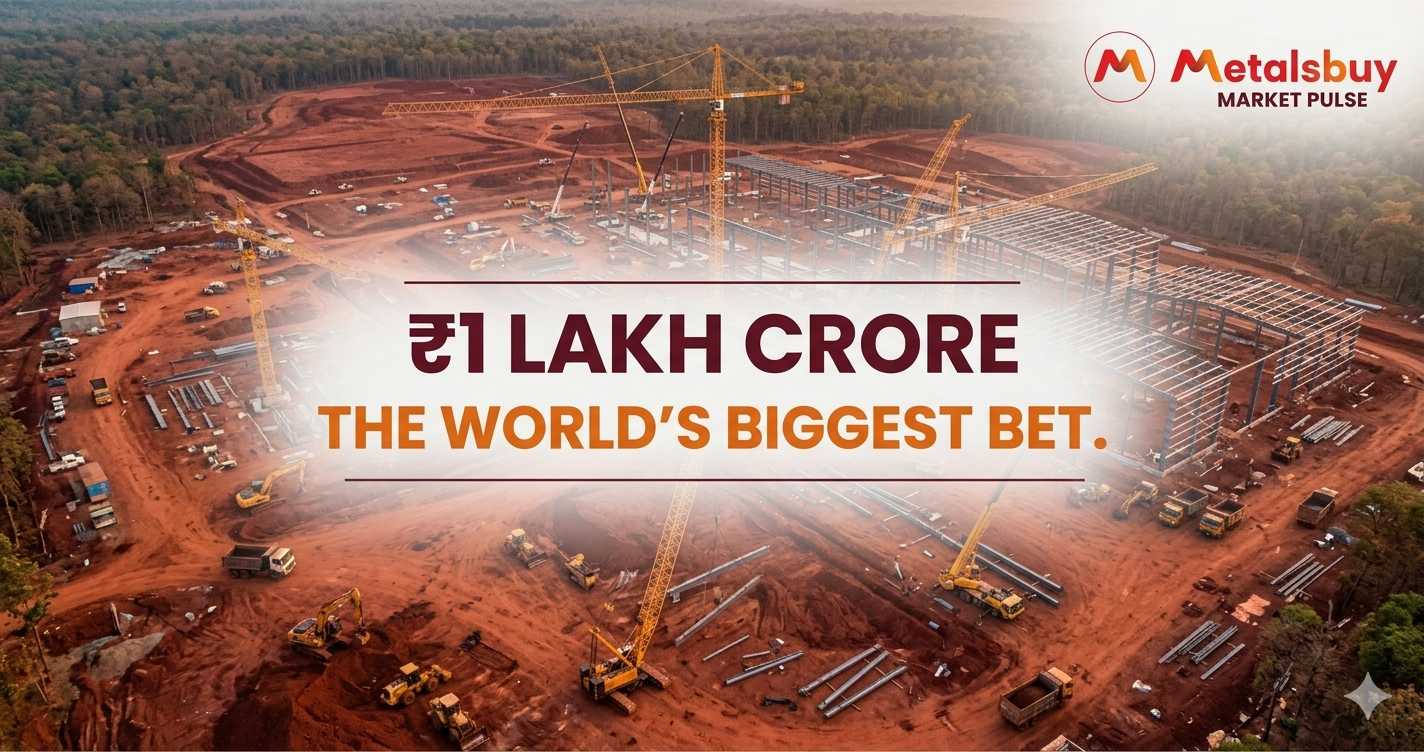
JSW Group Chairman Sajjan Jindal confirmed on May 23 that the company plans to develop a 25 MTPA integrated steel complex in Gadchiroli with investment estimated at roughly ₹1 lakh crore over seven to eight years. If completed at planned scale, the facility would become the largest single steel manufacturing site globally.
The scale alone is extraordinary.
India’s steel industry has announced many expansion projects over the past decade, but most remain incremental additions layered onto existing industrial corridors. Gadchiroli is different because this is not simply capacity expansion. It is industrial geography being rewritten in real time.
That matters far beyond steel output itself.
Integrated steel plants create entire industrial ecosystems around them once construction begins accelerating. Mines expand. Rail infrastructure develops. Power demand surges. Pellet capacity grows. Sponge iron production rises. Ferro alloy procurement intensifies. Logistics corridors that barely existed previously begin carrying continuous industrial movement every hour of the day.
The location is strategic for another reason.
Central India increasingly sits at the intersection of ore access, land availability and expanding manufacturing demand. Chhattisgarh, Odisha and parts of Maharashtra are gradually forming a connected industrial belt where mining, steelmaking and ferro alloy trade reinforce one another operationally. Gadchiroli may become one of the most important additions to that corridor if execution progresses at the scale currently envisioned.
Mining has already begun.
That detail matters because steel projects only become credible once raw material movement starts appearing physically on the ground. MIDC’s acquisition of 9,100 acres across fourteen villages signals that the project has already moved beyond conceptual discussion into early structural execution.
Yet the risks remain enormous.
Large integrated steel projects rarely proceed exactly according to original timelines. Land acquisition complexity, infrastructure development, financing cycles, environmental approvals and global steel demand conditions all influence whether giant industrial projects ultimately reach intended scale efficiently.
The market understands that.
But it also understands something else.
India’s steel industry is no longer planning cautiously.
⸻
INDUSTRY IMPACT
A 25 MTPA integrated steel project would reshape procurement patterns across multiple industrial sectors simultaneously.
Iron ore demand would rise sharply. Coking coal movement would intensify. Pellet producers would gain a massive new consumer base. Rail networks would require major expansion. Industrial power infrastructure would need scaling far beyond current regional capacity.
Ferro alloy markets would feel the impact directly.
Large integrated steel facilities consume enormous volumes of silico manganese, ferromanganese and other alloying materials continuously once blast furnaces and downstream rolling operations stabilise. Producers across Raipur, Odisha and eastern India will watch closely because projects of this scale eventually alter regional alloy demand structures for years.
The project also signals growing confidence inside India’s domestic steel consumption outlook.
No company commits ₹1 lakh crore over nearly a decade unless it believes long duration demand growth exists across infrastructure, manufacturing, automotive production, energy systems and industrial construction. India’s steel industry increasingly appears willing to build ahead of anticipated national demand rather than expand reactively after shortages emerge.
That changes competitive behaviour.
Smaller regional steel producers may eventually face pressure competing against giant integrated facilities capable of controlling mining, power, logistics and downstream production simultaneously. The market could gradually consolidate toward fewer but significantly larger industrial groups operating across entire supply chains.
The alloy industry already understands that pattern well.
⸻
WHAT TO WATCH NEXT
Land acquisition progress will be the first major signal.
Projects of this scale depend heavily on how quickly industrial land transfer, rehabilitation frameworks and infrastructure approvals move through administrative processes. Delays there often ripple across financing schedules and construction timelines later.
Watch railway and power infrastructure announcements carefully.
A 25 MTPA steel facility cannot operate without enormous supporting logistics and electricity systems. Future announcements around freight corridors, captive power generation and transmission infrastructure may reveal how aggressively JSW intends to accelerate development.
Steel market conditions will also matter.
India’s long term steel demand outlook remains strong, but global steel pricing cycles can still influence capital deployment pacing across large industrial expansions. Companies building projects over seven to eight years inevitably navigate multiple pricing environments during construction.
Ferro alloy producers should monitor procurement integration signals closely.
Projects of this size often eventually create long duration supplier relationships across silico manganese, ferro manganese and specialty alloy categories tied directly into integrated steel operations.
⸻
MARKET OUTLOOK
JSW’s Gadchiroli project is not simply another steel expansion announcement attached to a large number.
It is a statement about where India believes its industrial future is heading.
The country is increasingly moving toward giant integrated manufacturing corridors capable of supporting mining, steelmaking, alloy production and downstream fabrication within tightly connected regional systems. Gadchiroli may eventually become one of the clearest examples of that shift if execution proceeds successfully.
The opportunity is enormous.
So is the complexity.
Projects at this scale reshape economies, logistics networks and industrial power structures over decades rather than quarters. Markets will debate execution risks heavily because they are real. But the broader signal is already difficult to ignore.
India’s steel industry is beginning to think on a global scale.
JSW’s ₹1 Lakh Crore Gadchiroli Bet. India Is Preparing To Build The World’s Largest Steel Plant In A Region Once Cut Off By Conflict.