KEY NUMBERS
₹1,610 Crore : Revenue reported by Godawari Power and Ispat during Q4 FY26
41% : Sequential rise in quarterly revenue
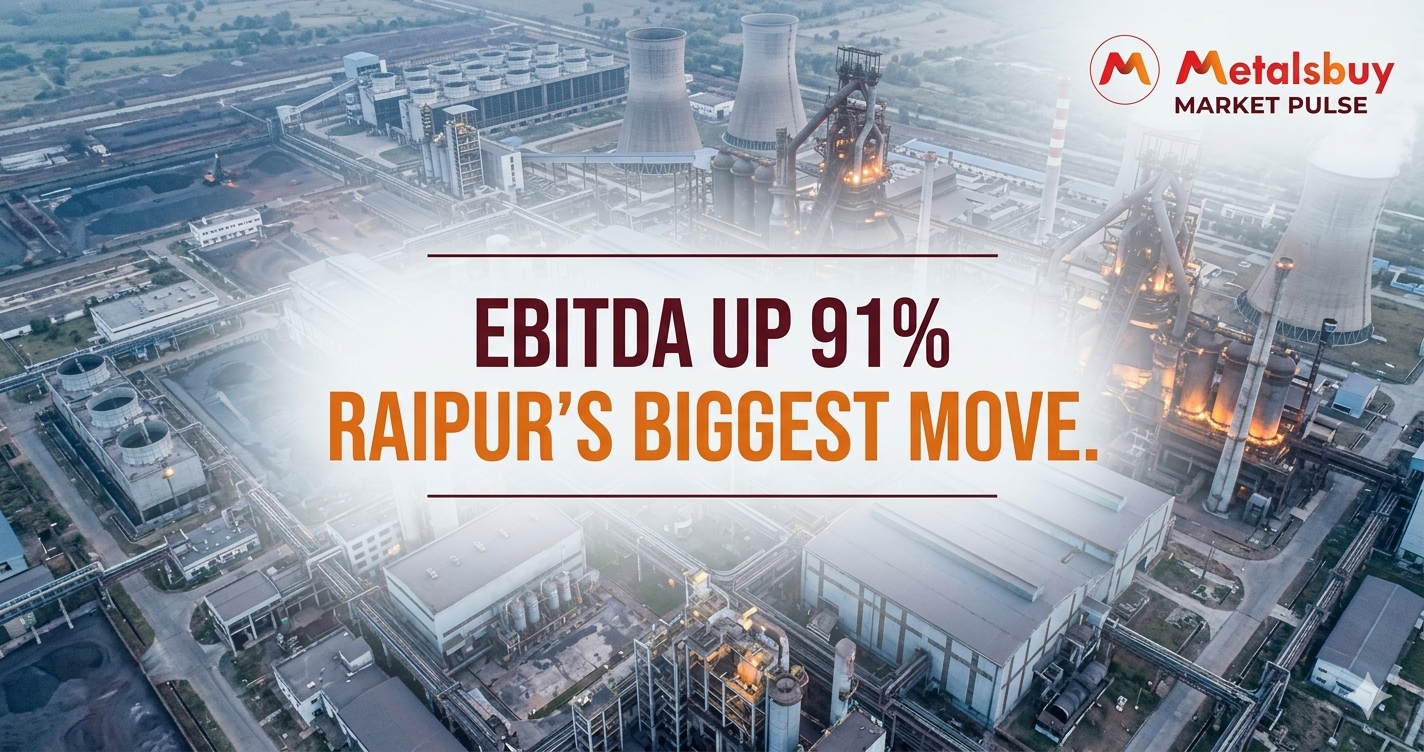
₹439 Crore : EBITDA reported during the quarter
91% : Sequential growth in EBITDA
27% : EBITDA margin achieved during Q4 FY26
₹30,000 Crore : Revenue target outlined under Vision 2031 roadmap
5x Growth : Targeted revenue expansion by 2031
₹7,000 Crore : Planned investment into integrated steel plant at Sarora Raipur
July 2026 : Planned start of cold rolling mill construction
20 GWh : Planned battery storage project capacity
Raipur, Chhattisgarh : Location of company’s expansion strategy
⸻
MARKET ANALYSIS
The roads around Raipur already feel different after dark.
More trucks. Longer industrial queues. More sponge iron movement heading toward mills that are running harder than they were a year ago. The city’s metals economy has been expanding quietly for several quarters. Godawari Power and Ispat’s latest results suggest that expansion may now be accelerating into something much larger.
The company reported its strongest quarter of FY26 with revenue rising 41% sequentially to ₹1,610 crore while EBITDA surged 91% to ₹439 crore. Margins expanded sharply to 27%. At the same time, the company unveiled its Vision 2031 roadmap targeting ₹30,000 crore in revenue supported by a ₹7,000 crore integrated steel project in Sarora, a new cold rolling mill and a 20 GWh battery storage initiative.
The combination matters more than the quarterly numbers alone.
Strong quarters happen regularly across cyclical commodity industries. What markets watch more carefully is what companies decide to do immediately after strong quarters arrive. Godawari is choosing expansion aggressively. That suggests management believes India’s steel demand cycle still has several years of structural growth ahead rather than merely a short term recovery phase.
Raipur sits directly inside that thesis.
Chhattisgarh has gradually evolved into one of India’s most interconnected metals manufacturing corridors where sponge iron, billets, pellets, ferro alloys and finished steel all operate within tightly linked industrial networks. Integrated projects in the region tend to create ripple effects quickly because procurement chains are already deeply concentrated geographically.
That becomes particularly important for ferro alloys.
Every expansion in integrated steelmaking eventually increases demand intensity for silico manganese, ferro manganese and other refining alloys feeding long products, flat steel and downstream manufacturing. Large integrated plants consume alloys continuously once utilisation stabilises, which means procurement behaviour often changes years before full production capacity arrives online.
The battery storage announcement deserves separate attention.
Indian steel producers are increasingly treating electricity security as a strategic variable rather than simply an operating expense. Rising industrial power costs globally, combined with tighter environmental expectations across manufacturing supply chains, are pushing large producers toward integrated energy strategies alongside steel expansion itself.
That trend is becoming difficult to ignore across central India.
⸻
INDUSTRY IMPACT
Godawari’s expansion roadmap reinforces a broader shift underway across India’s steel industry.
The sector is moving from incremental capacity additions toward larger integrated industrial positioning strategies where companies attempt to control multiple parts of the manufacturing chain simultaneously: steelmaking, power infrastructure, downstream rolling capacity and logistics integration.
That creates pressure across surrounding supply chains.
Raw material movement increases sharply once large integrated projects begin construction. Pellet demand rises. Sponge iron utilisation strengthens. Rail and freight networks tighten. Ferro alloy procurement becomes more active because mills prefer securing long duration supplier relationships well before utilisation reaches peak levels.
Raipur benefits directly from that concentration.
The city already functions as one of India’s most important commercial hubs for secondary steelmaking and ferro alloy trade. Additional integrated steel capacity strengthens the wider industrial network around it, potentially increasing throughput across surrounding mining, alloy and logistics operations over the next decade.
The cold rolling mill also signals something important about product positioning.
Indian steel producers increasingly want greater downstream integration rather than relying only on commodity grade steel output. Cold rolled products typically feed higher value manufacturing sectors including appliances, automotive supply chains and engineering applications where margins can remain more resilient than bulk construction steel during weaker cycles.
That strategy changes procurement patterns throughout the industrial chain.
⸻
WHAT TO WATCH NEXT
Execution discipline now matters more than expansion headlines.
Large industrial projects often face delays tied to land approvals, environmental clearances, financing cycles and infrastructure development. Markets will watch carefully whether construction timelines around the Sarora project and cold rolling mill progress according to current schedules.
Power integration deserves close attention too.
Battery storage remains relatively new inside large scale Indian steel manufacturing strategies. The economics and operating reliability of industrial energy storage systems will influence whether more producers across Chhattisgarh and Odisha pursue similar models over the next several years.
Watch ferro alloy demand indicators carefully.
Silico manganese and ferro manganese procurement activity across central India often strengthens quietly before major steel utilisation increases become obvious in finished steel data. Traders around Raipur will likely monitor early procurement signals closely as expansion activity accelerates.
⸻
MARKET OUTLOOK
Godawari Power’s latest quarter matters because it combines two signals markets rarely ignore when they appear together.
Strong profitability and aggressive expansion confidence.
The company is not behaving like a producer preparing defensively for weaker steel conditions ahead. It is positioning for larger industrial scale over the next decade through integrated steelmaking, downstream rolling capacity and power infrastructure investment.
That does not remove the risks.
Steel remains cyclical. Raw material costs remain volatile. Large projects always face execution challenges. But the broader direction inside central India’s metals economy is becoming increasingly visible.
The region is no longer expanding cautiously.
It is building for scale.
Godawari Power Delivers Record Quarter. Raipur’s Industrial Expansion Is Starting To Accelerate Faster Than Expected.