KEY NUMBERS
₹7,000 Crore : Planned investment into integrated steel facility at Sarora near Raipur
₹30,000 Crore : Revenue target under Vision 2031 roadmap
5x Growth : Targeted revenue expansion outlined by the company
41% : Sequential rise in quarterly revenue reported in latest FY26 results
27% : EBITDA margin reported during the quarter
20 GWh : Planned battery storage capacity under company expansion roadmap
3x : Planned increase in captive solar generation capacity
Sarora, Raipur : Location selected for the new integrated steel project
FY26 : Period during which company reported strongest quarterly performance
Chhattisgarh : One of India’s fastest growing steel and ferro alloy production regions
⸻
MARKET ANALYSIS
The trucks already move through Raipur before sunrise.
Iron ore. Sponge iron. Pellets. Coal. Ferro alloys. Finished steel. Every road feeding the industrial belt around Raipur carries the same message: central India’s metals economy is expanding again.
Godawari Power and Ispat’s latest announcement suggests that expansion may now be entering a different scale entirely.
The company reported its strongest quarter of FY26 with revenue rising 41% sequentially and EBITDA margins expanding to 27%. At the same time, it unveiled a Vision 2031 roadmap targeting ₹30,000 crore in revenue alongside plans for a ₹7,000 crore integrated steel facility in Sarora near Raipur. The proposal also includes battery storage capacity and a major increase in captive solar generation.
The timing matters because Indian steel producers are beginning to shift from cautious capacity additions toward much larger industrial positioning bets.
That shift carries consequences well beyond steel output alone.
An integrated steel facility changes raw material flows across an entire region. Iron ore demand rises. Pellet consumption increases. Sponge iron production expands. Logistics corridors tighten. Power requirements climb sharply. Ferro alloy procurement grows alongside every additional tonne of steelmaking capacity that comes online.
That last point matters particularly in Chhattisgarh.
The state already sits at the centre of India’s silico manganese and ferro alloy trade network. Raipur is not simply a steel city anymore. It has become one of the country’s most important commercial hubs for alloy movement, secondary steelmaking and industrial raw material distribution. A project of this scale adds another layer to that concentration.
The company’s battery storage and renewable power ambitions are equally revealing.
Steel producers are no longer thinking about electricity as a background operating expense. Power stability is becoming a strategic variable across Indian metals manufacturing, particularly after global energy volatility reshaped industrial economics over the last several years. Companies expanding steel capacity today are increasingly trying to secure power visibility at the same time.
That approach looks less optional every quarter.
⸻
INDUSTRY IMPACT
A ₹7,000 crore integrated steel project does not remain confined within one company’s balance sheet.
It pulls activity across the wider industrial chain.
Mining contractors see higher movement volumes. Pellet producers gain another large consumer base. Rail and trucking networks tighten. Industrial land values rise. Oxygen suppliers expand. Furnace equipment demand increases. Ferro alloy procurement becomes more active as blast furnaces and secondary steel units ramp output.
Silico manganese demand may ultimately become one of the more important downstream effects.
India’s steel expansion cycle continues increasing manganese alloy consumption steadily, particularly across long products and construction steel. Large integrated facilities consume alloys continuously once utilisation stabilises. Producers across Raipur and neighbouring industrial belts will watch closely for future procurement structures tied to the project.
There is also a regional power dynamic forming underneath these investments.
For years, western and coastal India dominated discussions around steel capacity expansion. Central and eastern India are now increasingly becoming the centre of gravity because that is where ore access, land availability and industrial infrastructure still allow large integrated projects to scale efficiently.
Raipur sits directly inside that shift.
⸻
WHAT TO WATCH NEXT
Execution timelines will matter more than headline investment numbers.
Integrated steel projects often move slower than initial announcements suggest because land acquisition, environmental approvals, railway linkage and utility infrastructure all determine how quickly construction can actually accelerate. Markets will watch closely for commissioning schedules, production configuration and raw material integration details.
The financing structure is another key variable.
Large industrial expansions during periods of uneven global steel pricing always carry balance sheet risks. Strong margins during one quarter do not automatically guarantee equally strong conditions three years later when new capacity begins commissioning. Procurement managers and traders will watch carefully for signs of disciplined execution rather than aggressive overexpansion.
The battery storage component deserves attention separately.
Most steel expansion announcements still focus almost entirely on furnace capacity. Godawari’s inclusion of energy storage and renewable scaling suggests producers increasingly expect electricity economics to become a defining part of industrial competitiveness over the next decade.
⸻
MARKET OUTLOOK
Godawari Power’s Sarora project is not simply another steel expansion announcement.
It is a statement about where India’s industrial centre of gravity is moving.
The country’s next phase of metals growth increasingly appears concentrated around integrated regional manufacturing clusters where mining, pellets, steelmaking, power generation and ferro alloy trade all reinforce one another inside the same geography.
That creates opportunity. It also creates pressure.
Raw material competition intensifies when multiple producers expand simultaneously. Freight corridors tighten. Power demand climbs. Alloy markets become more sensitive to utilisation changes across a smaller number of very large industrial projects.
Yet the broader direction remains difficult to miss.
India’s steel industry is no longer expanding cautiously. Companies are beginning to build for the next decade.
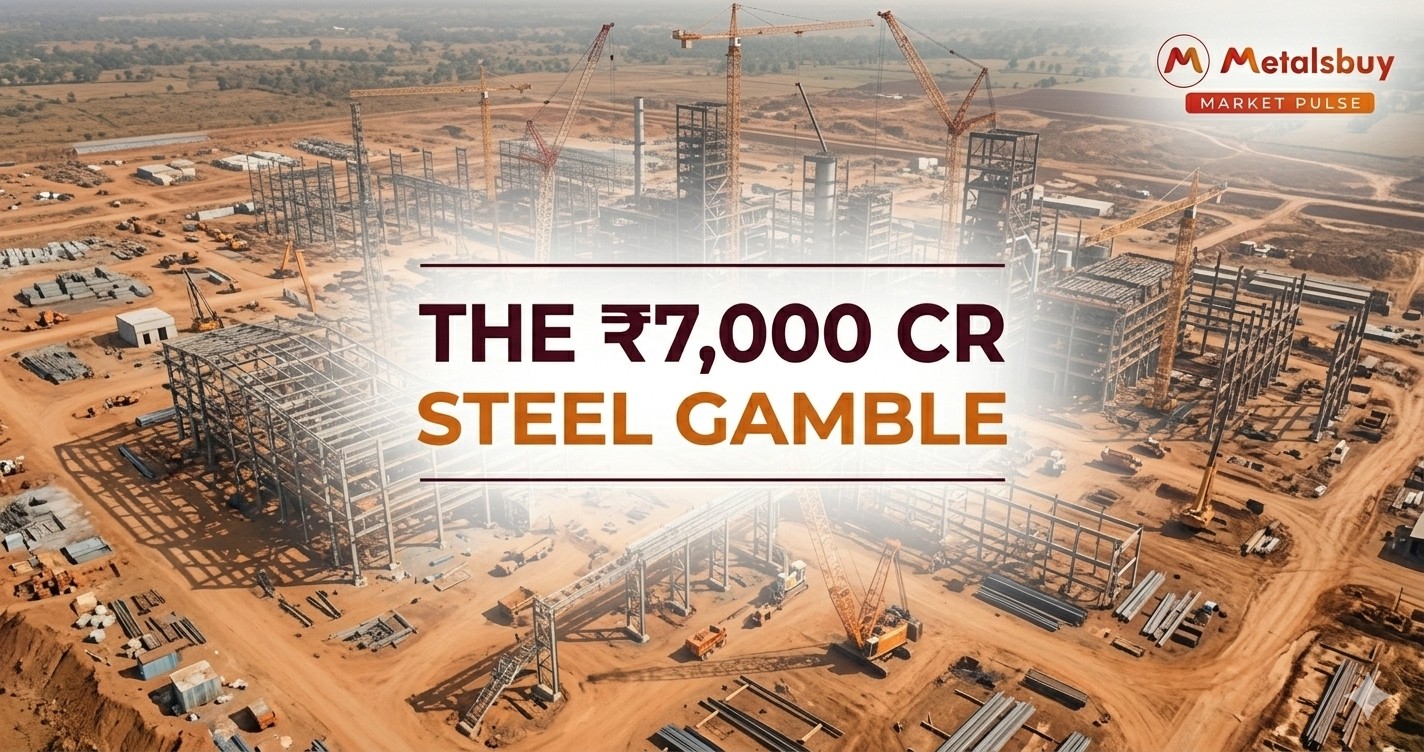
Godawari Power’s ₹7,000 Crore Steel Gamble. Raipur Is Preparing For An Industrial Expansion Wave.