KEY NUMBERS
$66.11 Billion : Global ferro alloy market value in 2026
$136.63 Billion : Projected market value by 2034
9.5% CAGR : Forecast annual growth rate through 2034
2034 : Target year for projected market value
India : One of the fastest growing ferro alloy consumption markets globally
Southeast Asia : Emerging growth engine for steel and alloy demand
Electric Arc Furnaces : Increasingly important driver of alloy consumption
Automotive Sector : Major source of future alloy demand
Renewable Energy Infrastructure : Expanding end use market for specialty steels
Steel Industry : Primary consumer of global ferro alloy production
⸻
MARKET ANALYSIS
Walk through any ferro alloy market in Raipur today and the mood feels different from five years ago.
The trucks are heavier. The enquiries are larger. The buyers are travelling farther. Conversations that once revolved around monthly orders now increasingly revolve around capacity expansion, long term supply contracts and future production plans.
The numbers are finally catching up with what the market has been feeling on the ground.
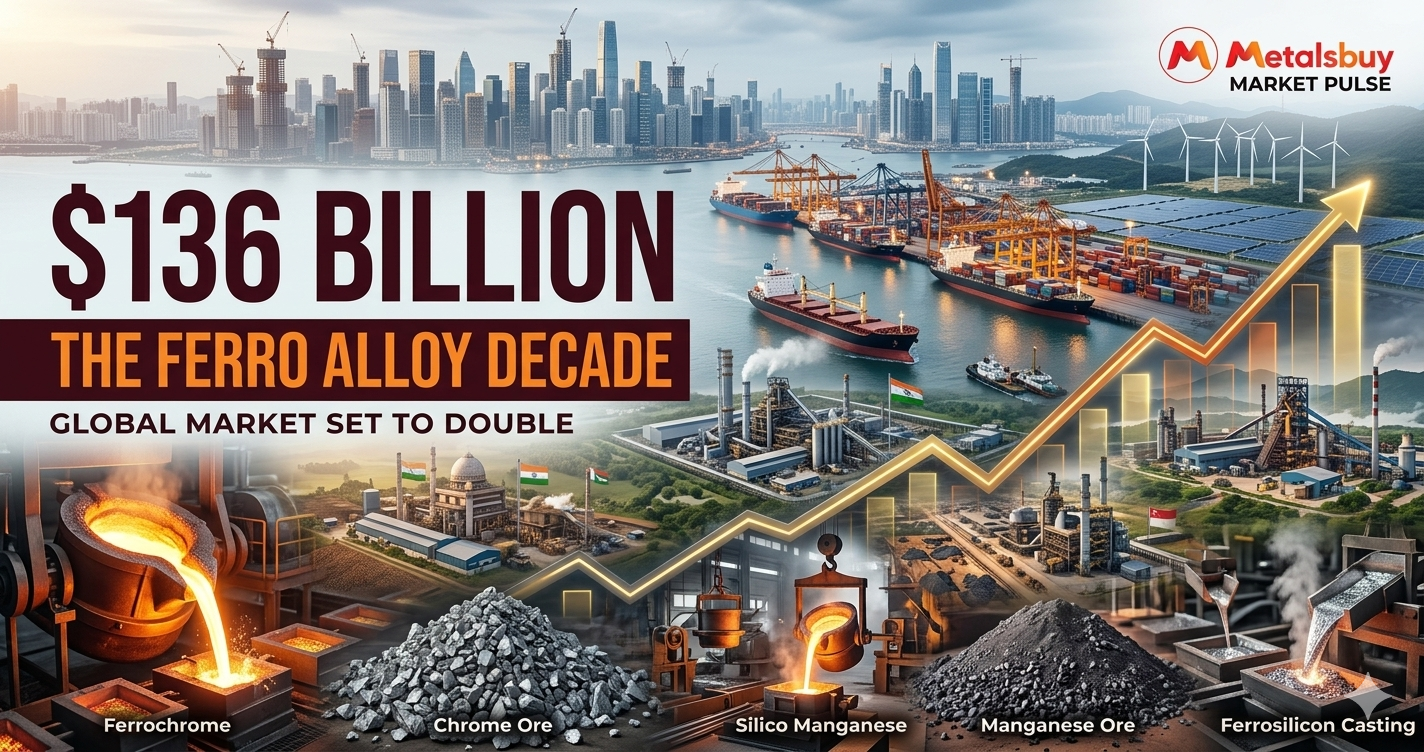
New market research places the global ferro alloy market at $66.11 billion in 2026, with projections suggesting it could reach $136.63 billion by 2034. That implies annual growth of roughly 9.5 percent over the period. For most industries, those would be impressive figures. For ferro alloys, they represent something more important.
Validation.
For years, ferro alloys operated in the shadow of the steel industry. Steel captured the headlines. Steel attracted the investment. Steel dominated policy discussions. Ferro alloys remained the essential but often overlooked materials that made modern steel possible.
That is beginning to change.
The growth story is no longer being driven by China alone. In many ways, the centre of gravity is shifting. India and Southeast Asia are emerging as the most important demand engines for the next decade as industrialisation, infrastructure spending and manufacturing investment accelerate across the region.
Steel production sits at the heart of the trend.
Every additional tonne of steel requires alloying materials to achieve specific strength, hardness, corrosion resistance and performance characteristics. Whether the end product is a railway bridge, an electric vehicle, a wind turbine or a transmission tower, ferro alloys remain essential inputs.
The rise of electric arc furnace steelmaking is adding another layer to the story.
Unlike traditional blast furnace routes, electric arc furnaces often rely heavily on precise alloy additions during steel refining. As more steelmakers transition toward secondary steelmaking routes, demand for alloys such as ferrosilicon, silico manganese and ferro manganese grows alongside them.
The renewable energy sector is creating a second source of demand.
Wind turbines require large quantities of specialty steel. Solar infrastructure consumes steel throughout mounting systems and support structures. Transmission networks require steel intensive construction. Every renewable project ultimately feeds back into alloy consumption through the steel value chain.
That connection is becoming increasingly visible.
The market is no longer growing because one country is building more apartments.
It is growing because multiple industries across multiple regions are consuming more advanced steel simultaneously.
⸻
INDUSTRY IMPACT
The implications extend well beyond market size projections.
A doubling of market value over less than a decade would fundamentally reshape investment decisions across mining, alloy production, logistics and steelmaking.
Producers are already responding.
Capacity expansions are accelerating across India. New furnace investments continue appearing in Odisha, Chhattisgarh and eastern India. Integrated steelmakers are securing long term alloy supply arrangements as future demand visibility improves.
India occupies a particularly interesting position.
The country is simultaneously one of the world’s fastest growing steel markets and one of its most important ferro alloy production centres. Raipur remains the commercial heart of that ecosystem, connecting producers, traders and steelmakers across the country.
That positioning matters.
As global demand expands, regions with established production infrastructure, logistics networks and raw material access will likely capture a disproportionate share of future growth.
The competitive landscape is changing as well.
Chinese dominance remains significant, but growth increasingly comes from elsewhere. India and Southeast Asia are becoming demand centres in their own right rather than simply export destinations.
That shift may define the next decade of the ferro alloy business.
⸻
WHAT TO WATCH NEXT
Electric arc furnace adoption deserves close attention.
The faster steelmakers move toward secondary steelmaking routes, the stronger the outlook becomes for several ferro alloy categories. Alloy consumption patterns often evolve alongside steelmaking technology.
Watch India’s steel expansion plans carefully as well.
Projects announced across Odisha, Maharashtra and Chhattisgarh will ultimately determine how much additional alloy demand emerges domestically over the next decade. Every new integrated steel facility creates long term consumption visibility for alloy producers.
The renewable energy sector is another variable worth monitoring.
Global investment into wind, solar and grid infrastructure continues accelerating. Those projects require enormous quantities of steel and, by extension, the alloys that make that steel possible.
The market’s next phase of growth may come from industries that historically had little direct connection to ferro alloys at all.
⸻
MARKET OUTLOOK
The projection of a $136 billion ferro alloy market by 2034 is not merely a research statistic.
It is a reflection of broader industrial change.
Steel demand is expanding. Manufacturing is becoming more sophisticated. Infrastructure is growing larger. Energy systems are being rebuilt. Transportation is being electrified.
Ferro alloys sit underneath all of it.
The market will face challenges. Raw material volatility, energy costs and environmental pressures are unlikely to disappear. Yet the long term direction appears increasingly clear.
The world needs more steel.
Modern steel needs more alloys.
And that makes the coming decade potentially one of the most important periods the ferro alloy industry has ever experienced.
The Ferro Alloy Market Is Worth $66 Billion Today. By 2034, It Could Be Twice That Size.