May 2026 | Metalsbuy Market Pulse
KEY NUMBERS
4.49 Million Tonnes : Forecast Indian green steel demand by FY30
24 Million Tonnes : Forecast green steel demand by FY35
73 Million Tonnes : Forecast green steel demand by FY40
179 Million Tonnes : Forecast green steel demand by FY50
10% to 12% : Share of national greenhouse gas emissions attributed to the steel sector
₹1,19,407 Crore : FDI attracted by metallurgical industries between April 2000 and December 2025
FY30 : First major green steel demand milestone
FY50 : Long term demand forecast horizon
EAF Steelmaking : Expected to play a larger role in green steel production
India : One of the world’s fastest growing steel markets
⸻
MARKET ANALYSIS
The conversation around steel is changing.
For decades, the industry’s success was measured in tonnes produced, furnaces commissioned and capacity added. The next chapter will still be measured in tonnes. But the question will be different.
How much of that steel is green?
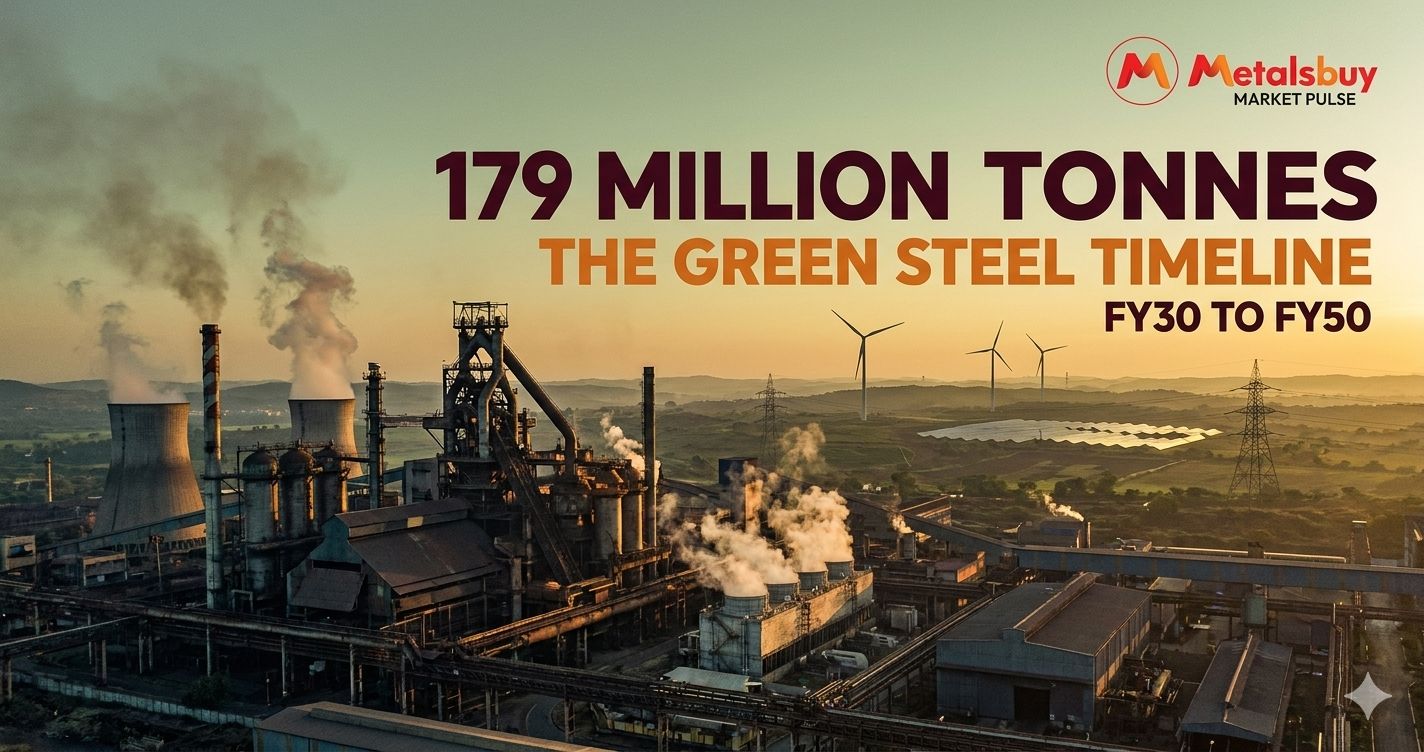
Government forecasts now suggest India’s green steel demand could reach 4.49 million tonnes by FY30, before accelerating to 24 million tonnes by FY35, 73 million tonnes by FY40 and an extraordinary 179 million tonnes by FY50. Those numbers are not merely environmental targets. They represent one of the largest industrial transitions the country has ever attempted.
The scale becomes clearer when viewed against the industry’s emissions profile. Steel production currently contributes between 10 and 12 percent of India’s greenhouse gas emissions. As steel demand continues growing through infrastructure, manufacturing, railways and urbanisation, pressure to reduce the carbon intensity of production will only increase.
Yet there is a misconception that continues to appear in discussions around green steel.
Many assume lower carbon steel somehow reduces the need for ferro alloys.
The opposite may prove true.
Electric arc furnaces are expected to become increasingly important in green steel production. These furnaces still require alloying elements to achieve desired grades and performance characteristics. Stainless steel still needs ferrochrome. Structural steels still require ferro manganese and silico manganese. Speciality steels continue relying on a range of alloy additions.
The production route changes.
The metallurgy does not.
That distinction matters because it fundamentally changes how ferro alloy producers should view the energy transition. Green steel is not a threat to alloy demand. It is a different demand pathway for the same industrial inputs.
Investment flows are beginning to reflect that reality.
Indian metallurgical industries attracted more than ₹1,19,407 crore in foreign direct investment between April 2000 and December 2025. Investors are not simply betting on steel production. They are positioning for the transformation of how that steel is produced.
The market is already thinking decades ahead.
⸻
INDUSTRY IMPACT
The implications for ferro alloys are substantial.
Every forecast tonne of green steel still requires metallurgical inputs. In many cases, higher value steel grades associated with advanced manufacturing and renewable energy applications require more sophisticated alloying rather than less.
That creates an unusual dynamic.
Many industrial transitions produce winners and losers. The green steel transition may create winners across multiple parts of the supply chain simultaneously. Renewable energy developers benefit. Equipment suppliers benefit. Technology providers benefit. Ferro alloy producers continue serving an industry that remains dependent on their products regardless of how power is generated.
The transition also introduces new procurement priorities.
Steelmakers are increasingly evaluating not only the carbon footprint of steel production but also the sustainability credentials of raw material suppliers. Producers capable of demonstrating lower carbon operations may gain a competitive advantage over time.
That conversation is already beginning.
⸻
WHAT TO WATCH NEXT
Hydrogen pilot projects deserve close attention.
Several steelmakers are evaluating hydrogen based production technologies, and their success will influence the pace of green steel adoption over the next decade.
Watch electric arc furnace investments as well.
The scale and speed of EAF adoption will shape future ferro alloy consumption patterns and determine how quickly green steel production expands.
Government policy remains critical.
Incentives, procurement standards and carbon related regulations will influence how rapidly forecast demand becomes reality.
The next five years will provide the first meaningful signals.
⸻
MARKET OUTLOOK
The forecast of 179 million tonnes by FY50 may sound distant.
In industrial terms, it is not.
Steel plants built today will still be operating when that demand materialises. Investment decisions being made now will shape competitiveness decades into the future.
The green steel transition is often framed as an environmental story.
It is also a raw material story.
A supply chain story.
An investment story.
And for ferro alloy producers, it may become one of the largest demand opportunities of the century.
Because every tonne of green steel still needs to be steel.
And steel still needs alloys.