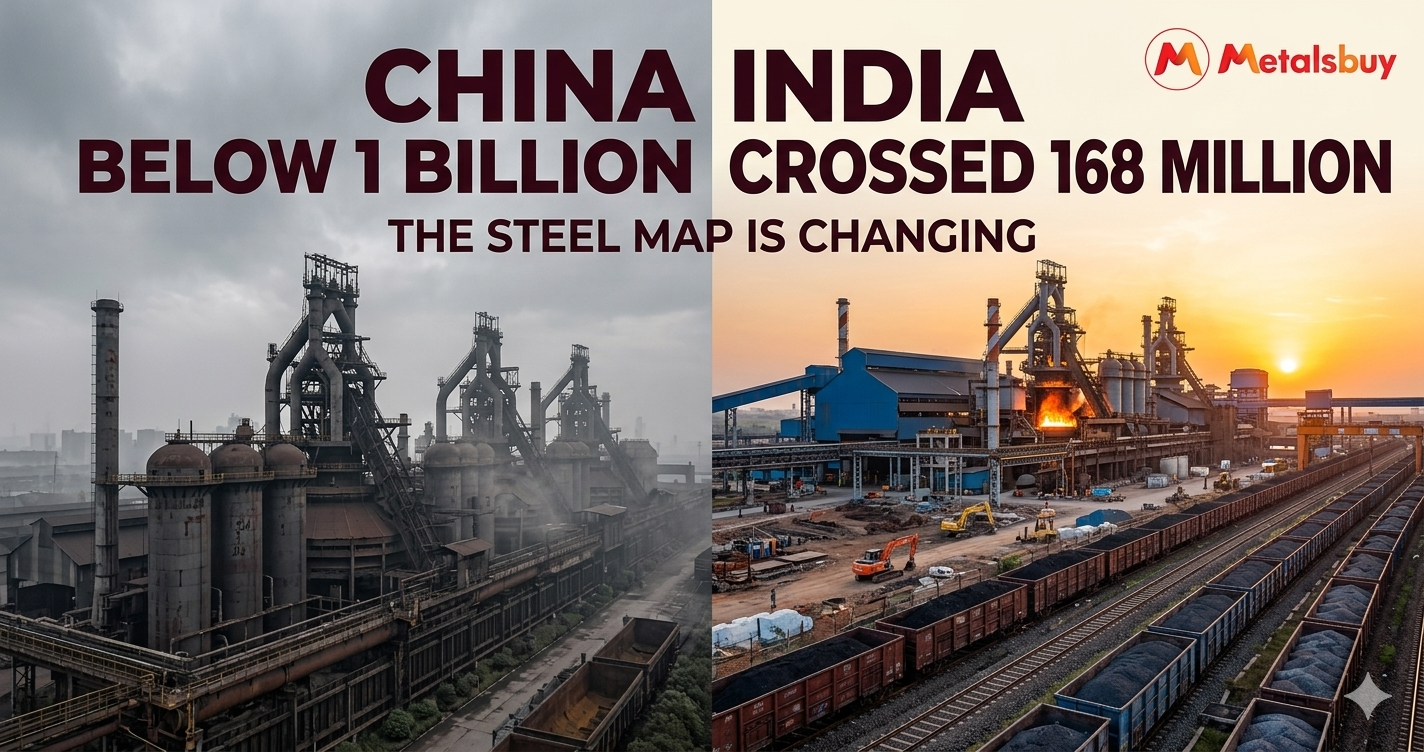
KEY NUMBERS
960.81 Million Tonnes : China’s crude steel production in 2025
4.4% : Decline in Chinese steel output during 2025
First Time Since 2018 : China produced less than 1 billion tonnes of steel
4.6% : Year on year decline in Chinese steel output during Q1 2026
168.4 Million Tonnes : India’s crude steel production in FY26
10.7% : Growth in Indian steel production during FY26
29.1% : Growth in Indian steel exports during March 2026
1 Billion Tonnes : Production threshold China fell below
2018 : Last time Chinese output remained below 1 billion tonnes
India : World’s second largest steel producer
⸻
MARKET ANALYSIS
For most of the past two decades, there was one steel number that mattered more than all the others combined.
One billion tonnes.
China crossed that threshold years ago and built an industrial machine so large that every major commodity market eventually began taking its cues from Chinese demand. Iron ore miners expanded because of China. Ferrochrome producers expanded because of China. Manganese alloy producers expanded because of China. Entire industries were built around the assumption that Chinese steel production would keep growing.
That assumption is now being challenged.
China’s steel production fell to 960.81 million tonnes in 2025, down 4.4 percent from the previous year and below the one billion tonne mark for the first time since 2018. The weakness has carried into 2026. First quarter output declined another 4.6 percent as mills continued reducing production in response to weak demand from the country’s prolonged property downturn.
The significance is not simply that China is producing less steel.
It is why.
The country’s housing sector has not recovered. Developers remain under pressure. Construction activity is weaker than it was during the boom years. Beijing has reinforced the shift by announcing that it will strictly curb new steel capacity additions rather than encouraging another round of expansion.
For ferro alloy markets, the implications are immediate.
Less steel production means less alloy consumption. Every tonne of stainless steel requires ferrochrome. Every tonne of structural steel requires manganese alloys. When Chinese steel mills produce fewer tonnes, alloy demand falls alongside them.
The material does not disappear.
It looks for another market.
That is where India enters the story.
While China’s steel industry is contracting, India’s is expanding at remarkable speed. Crude steel production reached a record 168.4 million tonnes in FY26. Steel exports rose sharply. JSW Steel reported record annual production. Tata Steel delivered its highest ever India output. New steel plants are being built across Odisha, Maharashtra and Chhattisgarh.
One market is focused on discipline.
The other is focused on growth.
Commodity producers notice these shifts early because their business depends on identifying tomorrow’s demand rather than yesterday’s.
For years, that demand came overwhelmingly from China.
Increasingly, it is coming from India.
⸻
INDUSTRY IMPACT
The ferro alloy market may be one of the first places where this shift becomes visible.
Producers in South Africa, Malaysia, Kazakhstan and the Middle East have traditionally viewed China as the primary destination for incremental alloy supply. As Chinese consumption slows, those suppliers are paying closer attention to India and Southeast Asia.
The transition creates opportunities.
Indian steel producers benefit from a larger pool of globally available alloy material. Procurement teams gain greater flexibility. Suppliers gain access to one of the fastest growing steel markets in the world.
The adjustment will not happen overnight.
China remains the dominant force in global steelmaking. A country producing nearly one billion tonnes of steel still shapes commodity pricing and trade flows.
But markets rarely focus on absolute size.
They focus on growth.
And growth is increasingly shifting south.
⸻
WHAT TO WATCH NEXT
Chinese steel production data through the second half of 2026 will be critical.
If output continues declining, alloy exporters may accelerate efforts to build stronger relationships in India and Southeast Asia. If Beijing introduces significant economic stimulus and construction activity improves, some of the pressure could ease.
Watch Chinese property indicators closely.
The steel market’s direction remains closely tied to housing and infrastructure activity.
At the same time, keep an eye on India’s capacity expansion pipeline.
Every new steel project announced in Odisha, Maharashtra and Chhattisgarh strengthens the country’s position as the industry’s next major growth engine.
The competition for future demand is already underway.
⸻
MARKET OUTLOOK
China’s steel industry is not collapsing.
That is not the story.
The story is that global steel demand growth is becoming less concentrated than it once was.
China is entering a period defined by consolidation, efficiency and production discipline. India is entering a period defined by expansion, investment and rising consumption.
For ferro alloy suppliers, that distinction matters.
A market producing fewer tonnes consumes fewer alloys. A market producing record volumes consumes more.
The result is a gradual rebalancing of global trade flows.
Not a sudden shift.
Not a dramatic reversal.
A steady change in where future growth is expected to come from.
And increasingly, that answer is India.
Written by Metalsbuy Editorial Desk
May 2026
CHINA’S STEEL OUTPUT FELL BELOW 1 BILLION TONNES. INDIA IS BECOMING THE GROWTH STORY.