May 2026 | Metalsbuy Market Pulse
KEY NUMBERS
960.81 Million Tonnes : China’s crude steel production in 2025
4.4% : Decline in Chinese steel output during 2025
First Time Since 2018 : China produced less than 1 billion tonnes of steel
4.6% : Year on year decline in Chinese steel output during Q1 2026
168.4 Million Tonnes : India’s crude steel production in FY26
10.7% : Growth in Indian steel production during FY26
29.1% : Growth in Indian steel exports during March 2026
1 Billion Tonnes : Production threshold China fell below
2018 : Last time Chinese output remained below 1 billion tonnes
India : World’s second largest steel producer
⸻
MARKET ANALYSIS
For most of the past twenty years, there was only one steel market that mattered.
China.
If Chinese mills were buying ferrochrome, prices moved. If Chinese stainless steel production accelerated, alloy suppliers expanded capacity. If Chinese construction slowed, commodity markets from iron ore to manganese reacted immediately.
The world’s steel industry became accustomed to looking in one direction.
That habit is becoming harder to justify.
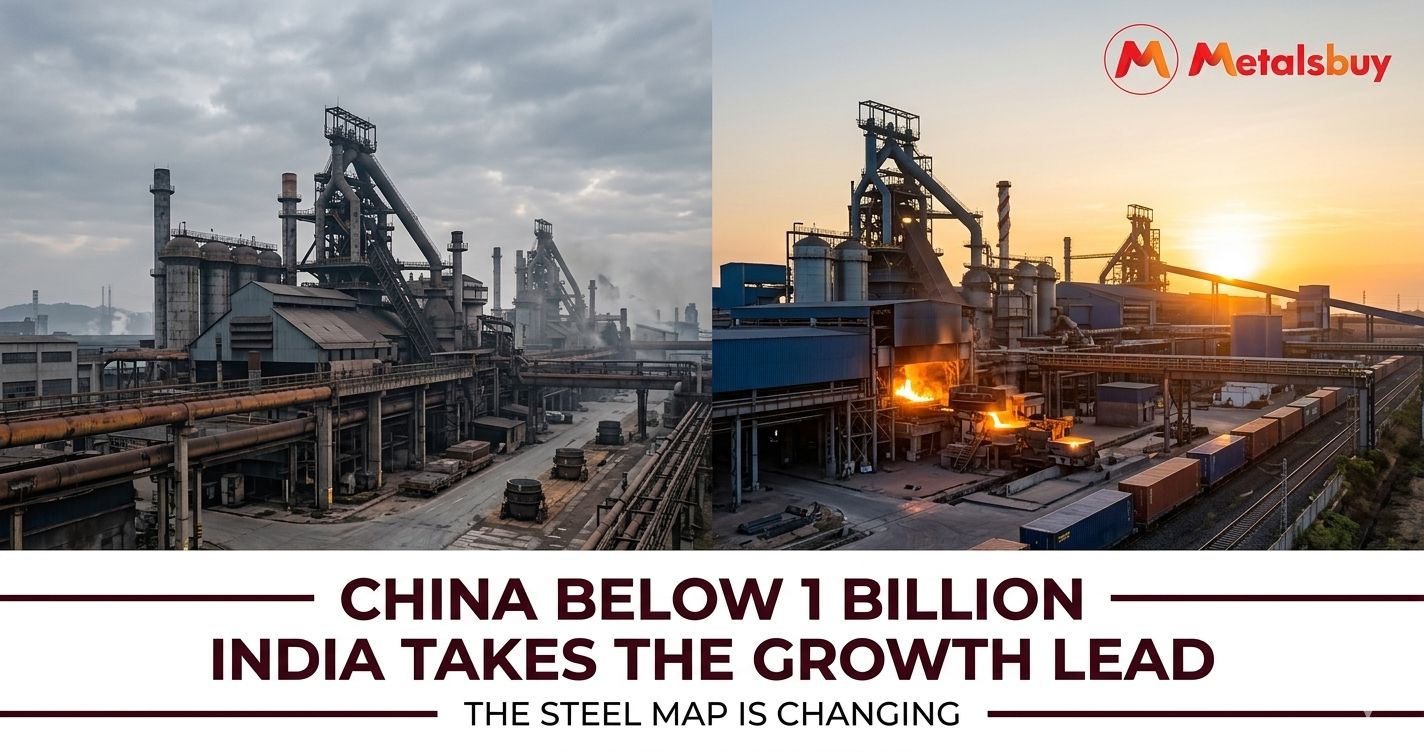
China’s steel production fell to 960.81 million tonnes in 2025, the first time the country has produced less than one billion tonnes since 2018. The decline was not an accident. It was policy. It was economics. And increasingly it is becoming structural.
The property sector remains weak. Apartment construction has slowed. Local governments are carrying heavy debt burdens. Mills are producing less steel because there is less steel to consume. Beijing has reinforced the message by stating it will strictly control new steel capacity additions rather than allowing another expansion cycle to emerge.
The immediate consequence is obvious.
Less steel means less ferro alloy consumption.
China remains the world’s largest consumer of ferrochrome, silico manganese and ferro manganese. When blast furnaces and electric furnaces produce fewer tonnes, alloy demand falls alongside them. Material that would normally move into Chinese supply chains begins looking for a new home.
That home increasingly looks like India.
While China fell below one billion tonnes, India reached a record 168.4 million tonnes of steel production. Steel exports surged. Consumption continued growing. JSW Steel reported record output. Tata Steel reported record India production. Jindal Steel delivered record production. Across Odisha, Maharashtra and Chhattisgarh, new steel projects continue moving from announcement to construction.
The contrast could hardly be sharper.
One country is managing excess capacity.
The other is building it.
That distinction matters because commodity markets do not care where demand comes from. They follow growth. For two decades that growth came from China. Today an increasing share is coming from India.
The shift is still in its early stages.
China remains almost six times larger than India’s steel industry.
But markets pay close attention to direction.
And the direction is changing.
⸻
INDUSTRY IMPACT
Ferro alloy producers around the world are already adjusting.
South African ferrochrome exporters. Malaysian smelters. Manganese alloy producers. Chrome ore suppliers. Every participant in the alloy chain understands that the fastest growing steel market deserves attention.
India’s steel expansion creates an alternative demand centre.
That does not mean China becomes irrelevant. Far from it.
A market producing 960 million tonnes of steel still dominates global commodity flows. What changes is the marginal tonne. The next increment of demand is increasingly likely to come from India rather than China.
For Indian alloy producers, that creates a favourable backdrop.
Growing domestic steel production provides a larger customer base. Export opportunities remain available. Procurement conversations become less dependent on Chinese buying cycles than they once were.
The centre of gravity begins to move.
Slowly at first.
Then all at once.
⸻
WHAT TO WATCH NEXT
The most important number is not China’s current production.
It is China’s next production number.
If output continues falling through the rest of 2026, alloy suppliers will increasingly redirect their attention toward India and Southeast Asia. If Beijing introduces stimulus that revives construction activity, the adjustment could slow.
Watch Indian capacity additions as closely as Chinese production cuts.
Every new steel project in Odisha, Chhattisgarh and Maharashtra reinforces the same trend. More steel production creates more alloy demand.
The competition for future growth is already underway.
⸻
MARKET OUTLOOK
China’s steel industry is not collapsing.
That is not the story.
A country producing nearly one billion tonnes of steel remains the dominant force in global metals markets.
The story is that growth is no longer concentrated in one place.
China is becoming a market defined by efficiency, consolidation and production discipline.
India is becoming a market defined by expansion.
For ferro alloy suppliers, traders and steelmakers, that distinction may prove more important than any quarterly price movement.
Because the steel industry’s future will not be decided by who is biggest today.
It will be shaped by who is growing tomorrow.
And increasingly, that answer is India.
Written by Metalsbuy Editorial Desk
May 2026