KEY NUMBERS
13.2 MTPA : Steelmaking capacity planned at JSW’s Paradip complex
₹1.25 Lakh Crore : Total investment commitment across JSW’s Odisha projects
May 27, 2026 : Date construction officially commenced at Paradip
5 Components : Planned structure of the integrated industrial complex
2 Pellet Plants : Pellet facilities included in the project
2 Steel Units : Steelmaking units planned within the complex
1 Port Jetty : Dedicated jetty infrastructure included in development
₹1,310 : JSW Steel share price after rising 1.27% following the announcement
20 Years : Approximate period during which the earlier POSCO project remained stalled
Paradip, Odisha : Location of the integrated steel project
⸻
MARKET ANALYSIS
The land carried a reputation long before the first construction equipment arrived.
For nearly two decades, Paradip symbolised one of the most ambitious industrial projects India could not complete. Governments changed. Policies shifted. Negotiations dragged across years. POSCO’s proposed steel project became less an investment story and more a case study in how difficult large industrial execution inside India could become once land, politics and local resistance collided simultaneously.
Yesterday, the story changed.
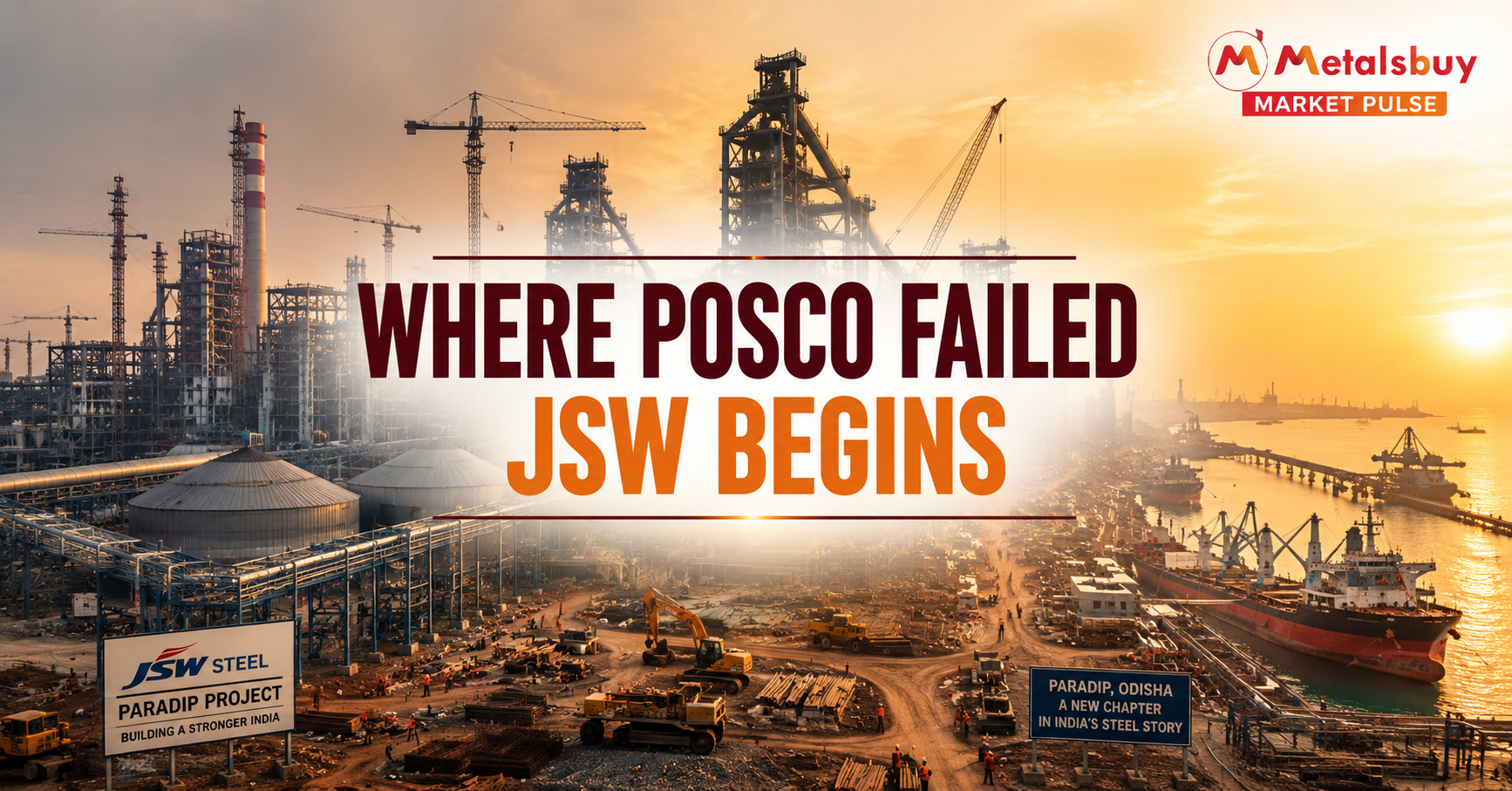
JSW Steel officially commenced construction on a 13.2 MTPA integrated steel complex at Paradip in Odisha with Chief Minister Mohan Charan Majhi and JSW Group Chairman Sajjan Jindal attending the ceremony. The symbolism is impossible to ignore. The same geography that once represented industrial paralysis is now being positioned as one of India’s largest steelmaking centres.
The scale extends far beyond one plant.
JSW’s broader Odisha investment commitment now stands at ₹1.25 lakh crore, with the Paradip project designed around two pellet plants, two steelmaking units and dedicated port infrastructure. That structure matters because integrated coastal steelmaking changes procurement economics fundamentally. Pellet supply stabilises. Imported raw material access improves. Export flexibility strengthens. Freight costs become more controllable.
Odisha sits directly at the centre of that logic.
The state already anchors India’s ferrochrome economy while simultaneously holding some of the country’s most important iron ore reserves and steelmaking infrastructure. Every additional integrated steel project deepens the concentration of mining, pellets, ferro alloys and downstream manufacturing inside the region. Paradip potentially accelerates that process sharply because coastal integration allows large scale industrial movement both inward and outward simultaneously.
The market responded quickly.
JSW Steel shares rose after the announcement, reflecting investor confidence not only in the project itself but also in the broader demand assumptions underneath it. Companies do not commit ₹1.25 lakh crore into long duration steel infrastructure unless they believe India’s industrial demand story remains structurally intact for many years ahead.
That assumption now increasingly shapes the entire metals chain.
Silico manganese, ferro manganese and other alloy markets ultimately move alongside integrated steel capacity because every additional tonne of steel output requires corresponding growth in refining inputs, logistics throughput and raw material integration. Paradip may become one of the defining demand anchors for eastern India’s metallurgical economy once construction accelerates fully.
The industry understands what makes this story different.
This is not merely another plant announcement.
It is a project returning from industrial history.
⸻
INDUSTRY IMPACT
Paradip strengthens a broader shift already reshaping India’s steel geography.
The country’s next phase of industrial expansion increasingly favours large integrated coastal and mineral linked clusters capable of combining mining access, pelletisation, steelmaking, alloy procurement and export logistics inside unified operating corridors. Odisha now sits at the centre of that transformation more clearly than any other Indian state.
That creates enormous downstream implications.
Pellet demand will rise sharply as integrated capacity scales. Port movement intensifies. Rail connectivity strengthens. Ferro alloy procurement grows alongside higher steel utilisation. Industrial power demand expands continuously once multiple steelmaking units begin operating simultaneously.
Ferrochrome and silico manganese markets will feel the impact indirectly but meaningfully.
Large integrated steel facilities create long duration alloy demand visibility because procurement becomes tied to continuous industrial throughput rather than spot market volatility alone. Producers across Odisha, Raipur and Visakhapatnam will likely monitor future procurement structures connected to Paradip very closely.
The project also signals something important psychologically across the industry.
India’s largest steel groups are now willing to pursue projects previously considered too politically difficult, too operationally complicated or too large to execute comfortably. That reflects growing confidence not only in steel demand, but also in India’s ability to complete giant industrial infrastructure projects at scale.
That confidence changes behaviour across the sector.
⸻
WHAT TO WATCH NEXT
Execution discipline matters now more than ceremony headlines.
Projects of this size require enormous coordination across land development, environmental approvals, railway integration, port connectivity and power infrastructure. Markets will watch whether construction momentum remains consistent once initial groundwork phases move into heavy industrial execution.
Watch pellet capacity carefully.
The inclusion of two pellet plants inside the Paradip structure signals how strategically important raw material integration has become for modern steel economics. Pellet supply stability increasingly determines blast furnace efficiency and cost competitiveness across large integrated operations.
Odisha’s alloy industry also deserves close attention.
As steelmaking capacity across the state expands further, ferro alloy producers may gradually gain stronger domestic demand visibility alongside export opportunities tied to integrated manufacturing growth.
The gas and energy side remains critical too.
Steel expansion at this scale inevitably increases exposure to industrial energy economics, particularly after the disruptions India’s gas markets experienced earlier this year. Future captive power and fuel integration strategies around Paradip will matter heavily.
⸻
MARKET OUTLOOK
JSW’s Paradip breakthrough matters because it represents more than industrial expansion.
It represents industrial confidence returning to a project once associated with failure.
The Indian steel industry is entering a period where scale itself is changing. Companies are no longer talking about incremental additions measured cautiously against short term cycles. They are building giant integrated manufacturing systems designed around decades of expected domestic demand growth.
That creates opportunities across mining, ferro alloys, logistics and downstream manufacturing simultaneously.
It also raises the competitive threshold dramatically.
The companies capable of operating at integrated scale with secure raw materials, efficient logistics and stable energy access may increasingly shape the future structure of India’s metals economy.
Paradip now sits directly inside that future.
JSW Begins Building At Paradip. The Land That Defeated POSCO Is Becoming India’s Next Steel Giant.