KEY NUMBERS
March 2026 : Period during which industrial gas disruptions intensified across India
Force Majeure : Declared by Petronet LNG on contracted supplies
JSW Steel Plants : Multiple facilities impacted by gas supply disruption
1 Plant : Reportedly faced risk of temporary shutdown due to supply shortage
Priority Allocation : Government diverted available gas supplies toward households and essential services
LNG Imports : Industrial buyers faced tightening access during supply disruption
Industrial Consumers : Steel, ceramics and manufacturing sectors among the worst affected
Natural Gas : Critical fuel source for several industrial heating and process operations
Energy Security : Emerging as a strategic issue across India’s steel industry
2026 : One of the most volatile years for industrial fuel procurement in recent memory
⸻
MARKET ANALYSIS
Steel plants are designed around continuity.
Blast furnaces cannot simply pause because fuel deliveries become uncertain. Rolling mills do not operate comfortably around unpredictable energy schedules. Industrial metallurgy depends on stable heat, stable power and stable raw material movement. Once any one of those variables breaks unexpectedly, the entire operating chain begins feeling pressure almost immediately.
That is exactly what parts of India’s steel industry confronted during the gas disruption that intensified in March.
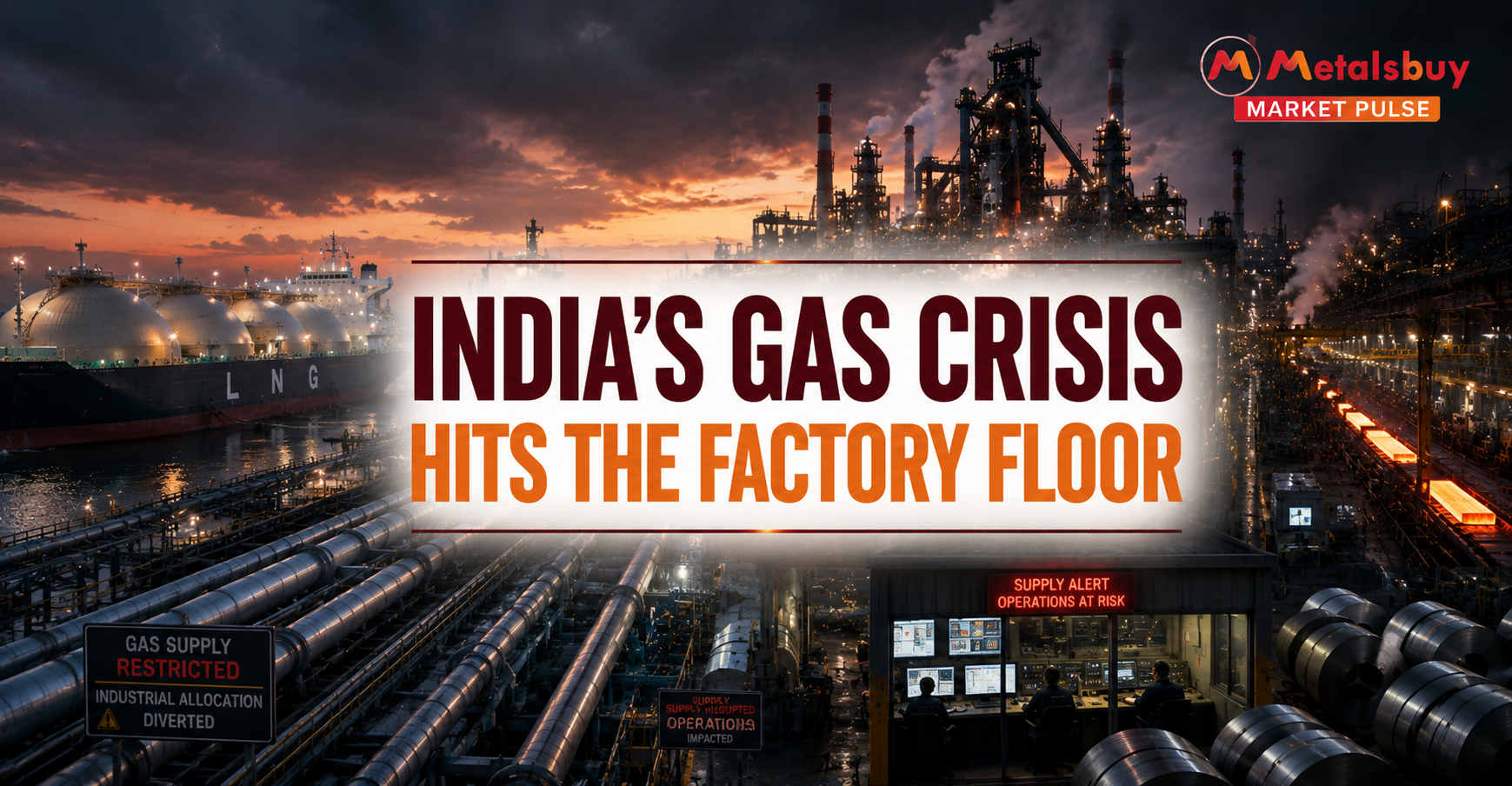
Industrial gas shortages forced supply diversion toward households and essential consumption while companies across manufacturing sectors scrambled to secure replacement fuel access. Petronet LNG declared force majeure on contracted deliveries. Several industrial users faced sharp supply constraints. JSW Steel operations were among the facilities impacted as the country confronted one of its most severe industrial gas disruptions in decades.
The problem was not demand weakness.
It was supply priority.
Governments almost always protect residential consumption first during fuel shortages because political and social consequences arrive quickly when households lose energy access. Industrial consumers absorb the pressure instead. That reality exposed how vulnerable parts of India’s manufacturing system remain when imported LNG markets tighten suddenly or supply chains experience disruption.
Steel producers felt the impact unevenly.
Large integrated players with diversified fuel flexibility, captive energy infrastructure or stronger procurement leverage managed pressure better than smaller operations dependent on continuous industrial gas access. Plants operating closer to operational limits faced difficult decisions around output pacing, heating schedules and cost management once gas availability became uncertain.
The timing made conditions worse.
Global fuel markets were already dealing with freight volatility, shipping disruptions and elevated geopolitical tension affecting energy movement routes. Industrial buyers found themselves competing for limited supply during a period when replacement cargo economics had already become significantly more expensive.
That changes how steel companies think about energy strategy.
Power security is no longer only about electricity tariffs. Fuel resilience itself is becoming strategically important across integrated manufacturing. Companies expanding aggressively across steel and ferro alloys are increasingly pursuing captive infrastructure, renewable integration and diversified energy structures because recent disruptions exposed how quickly operating economics can destabilise when energy availability becomes unpredictable.
The ferro alloy industry understands that risk especially well.
Ferrochrome, silico manganese and ferrosilicon production all depend heavily on uninterrupted high intensity energy input. Any prolonged instability across industrial fuel or electricity systems eventually reshapes competitiveness across the entire metallurgical chain.
The market has started recognising that more clearly now.
⸻
INDUSTRY IMPACT
India’s gas disruption revealed something uncomfortable for industrial producers.
Rapid manufacturing expansion means very little if energy systems cannot scale with it reliably.
Steelmaking, alloy production, ceramics, chemicals and engineering manufacturing all compete for industrial fuel access during periods of supply stress. Once governments prioritise household allocation, industrial operators face exposure immediately unless alternative systems already exist.
That creates competitive separation.
Large integrated companies capable of securing diversified energy access gain resilience advantages during volatile periods. Smaller standalone manufacturers operating without captive power, long duration fuel agreements or renewable integration remain far more exposed to operational disruption when supply conditions tighten suddenly.
The implications extend directly into ferro alloys.
Electric furnace operations depend heavily on predictable operating cycles because interruptions increase production inefficiency and operating costs quickly. Producers across ferrochrome and silico manganese markets are increasingly evaluating whether future competitiveness depends as much on energy security as ore access itself.
The gas crisis also strengthens the case for industrial renewable integration.
Battery supported renewable systems, captive power infrastructure and diversified fuel sourcing strategies are no longer viewed only through sustainability or cost reduction frameworks. They are increasingly being treated as operational survival infrastructure during periods of energy volatility.
That shift may reshape industrial investment decisions across India over the next decade.
⸻
WHAT TO WATCH NEXT
The immediate question is whether industrial gas allocation has stabilised fully or remains vulnerable heading into the second half of 2026.
Markets will closely monitor LNG import conditions, domestic gas allocation policy and future supply flexibility because another disruption during peak industrial demand periods could pressure steel and alloy operations again.
Watch captive energy investment announcements carefully.
Recent disruptions are likely accelerating internal discussions around renewable integration, storage infrastructure and long duration fuel security across major manufacturing groups. Companies that previously treated energy diversification cautiously may now move much faster.
Steel output trends also matter.
If plants impacted during the disruption begin restoring full utilisation consistently, markets may interpret the crisis as temporary. If operational caution persists longer, procurement behaviour across fuel and alloy markets could remain defensive through coming quarters.
⸻
MARKET OUTLOOK
India’s March gas disruption matters because it exposed a structural reality industrial markets increasingly cannot ignore.
Manufacturing growth now depends as much on energy resilience as raw material access.
The country’s steel industry is expanding aggressively across Odisha, Maharashtra and Chhattisgarh through giant integrated projects designed around long term demand growth. But those facilities require enormous uninterrupted energy support once operational. Recent events demonstrated how quickly industrial systems come under pressure when supply chains tighten unexpectedly.
That does not weaken India’s steel growth story.
It changes the strategic priorities underneath it.
The next phase of industrial competition may increasingly be shaped not only by who controls ore, logistics and furnace capacity, but also by who secures the most reliable energy systems before the next disruption arrives.
India’s Gas Crisis Hits Steel Plants. When Fuel Supply Collapses, Furnaces Do Not Wait.