KEY NUMBERS
- SiMn (ExW Raipur): ₹75,200 per tonne
- SiMn (ExW Raigarh): ₹74,900 per tonne
- Market Sentiment: Stable to Cautiously Positive
- Current Seller Strategy: Mostly Standard Offers
- Key Market Concern: Dispatch & Logistics Disruptions
- Demand Trend: Moderately Slow but Stable
- Margin Situation: Producers Operating on Thin Margins
MARKET ANALYSIS
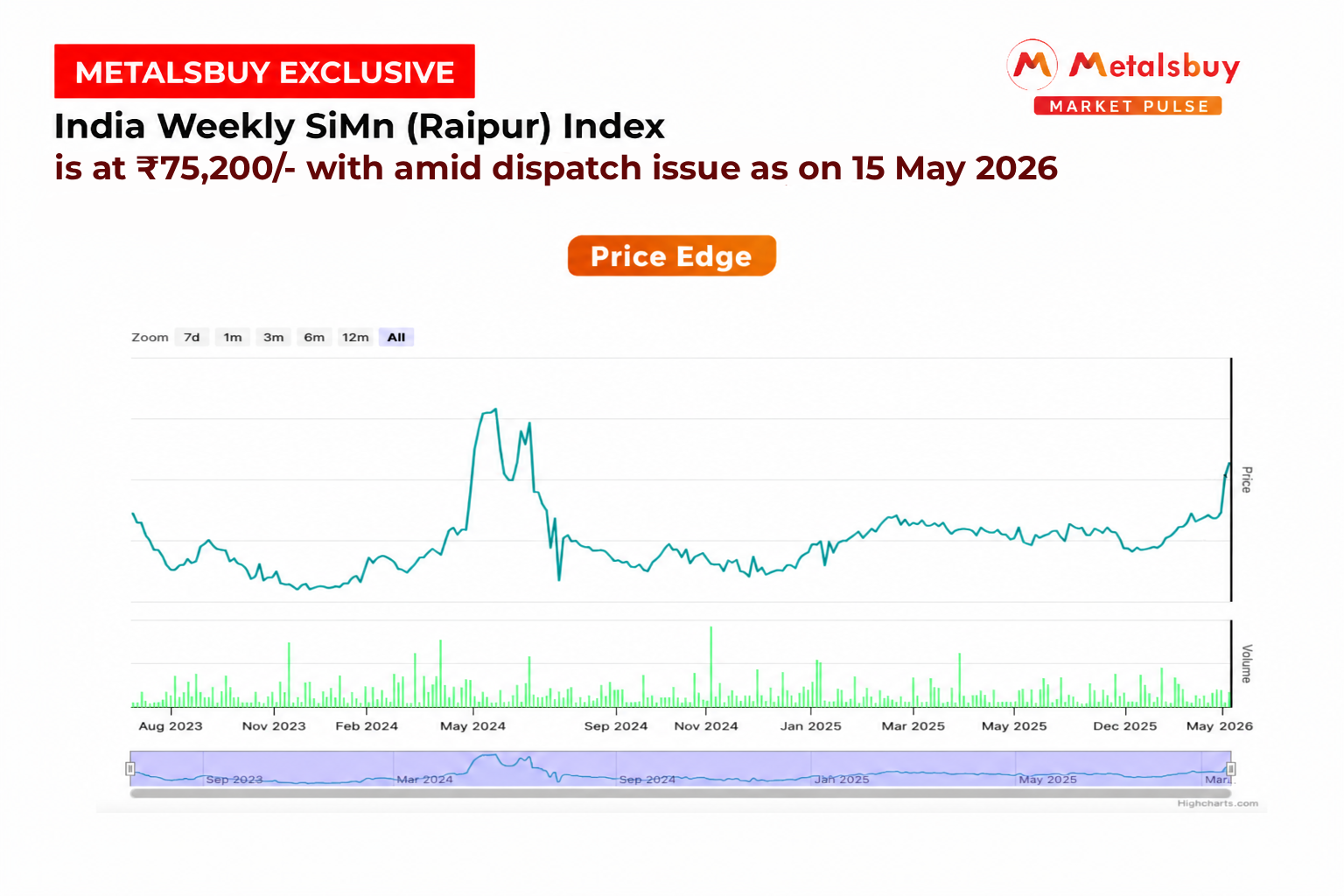
India’s domestic silico manganese market witnessed another round of correction this week, with the SiMn (ExW) Raipur index assessed at ₹75,200 per tonne while Raigarh prices were heard around ₹74,900 per tonne. The decline largely reflects slower buying activity across key steelmaking regions combined with mounting logistical disruptions impacting dispatch movement from Central India. Despite the softer pricing trend, overall market sentiment remains relatively stable as producers continue showing resistance toward aggressive discounting due to already compressed operating margins.
One of the most significant developments affecting the market this week has been the growing dispatch crisis across Chhattisgarh, particularly in and around Raipur. Market participants reported severe transportation bottlenecks linked to fuel supply disruptions and unusually long queues at petrol and diesel stations across the region. Multiple media reports confirmed panic buying and temporary fuel shortages across Raipur, Bilaspur, and nearby industrial zones, which has directly affected truck movement and dispatch planning for industrial cargo.
The logistical disruption comes at a sensitive time for the ferro alloys market, where smooth dispatch operations remain critical for maintaining cash flow cycles and inventory movement. Several traders and suppliers indicated that truck availability has tightened considerably over the last few days as transporters faced delays in fuel access and turnaround times. This has slowed movement of finished silico manganese material toward consuming regions despite stable production activity at most manufacturing units.
At the same time, sellers are largely maintaining standard offer levels rather than aggressively reducing prices. Market participants noted that most producers are currently unwilling to offer significant discounts because current market prices are already approaching difficult operating levels for several manufacturers. Production costs linked to manganese ore, power tariffs, reductants, freight, labour, and finance costs continue keeping margin pressure elevated across the sector.
Another important factor supporting market stability is that raw material economics have not weakened proportionately. Imported manganese ore prices have recently corrected, but ore procurement costs for several domestic alloy producers still remain relatively elevated because of inventory cycles and earlier higher-priced purchases. Producers therefore continue attempting to protect workable conversion margins despite softer finished alloy demand conditions.
Demand from the steel sector has remained comparatively slow but not severely weak. Buyers are continuing procurement activity on a need-based basis while avoiding large inventory positions amid cautious sentiment across the broader steel value chain. However, unlike previous sharp downcycles, the current market correction appears more linked to temporary demand moderation and logistical disruptions rather than any severe collapse in steel production activity.
Market participants also indicated that many ferro alloy producers are currently focusing more on inventory discipline and dispatch management instead of chasing volumes aggressively. With transportation disruptions affecting material movement, several suppliers are prioritising fulfilment of committed orders while limiting fresh negotiation flexibility. This has created a relatively balanced market structure despite slower spot demand conditions.
The fuel supply situation in Chhattisgarh has further complicated freight planning across industrial clusters. Reports suggest that panic buying triggered unusually heavy crowds at fuel stations, leading to delays in tanker replenishment and temporary stock exhaustion at several pumps across Raipur and surrounding regions. Although authorities and pump operators have clarified that fuel supply remains fundamentally stable, the temporary disruption has still affected logistics movement across the metals and mining ecosystem.
From a broader perspective, the current market phase increasingly resembles a consolidation cycle rather than a structural downturn. Ferro alloy prices have corrected steadily over recent weeks, helping partially improve purchasing comfort for steelmakers. At the same time, falling prices are gradually approaching levels where further downside may become difficult without causing significant operational stress for alloy manufacturers.
The relatively disciplined approach by suppliers is also preventing panic selling across the market. Producers appear more willing to reduce operating rates or accept lower dispatch volumes rather than aggressively liquidate material at sharply discounted prices. This behaviour indicates that the market may be gradually moving toward a more balanced price discovery zone after several weeks of correction.
Looking ahead, logistics normalisation may become one of the most important short-term triggers for market recovery. Once transportation movement stabilises and dispatch bottlenecks ease across Central India, trading activity could gradually improve. Buyers who are currently delaying procurement decisions due to delivery uncertainty may return more actively once freight movement normalises.
INDUSTRY IMPACT
The current dispatch and logistics disruption highlights how operational bottlenecks outside core supply-demand fundamentals can temporarily influence ferro alloy pricing and market activity. Transportation efficiency remains critically important for the ferro alloys sector because of its dependence on continuous raw material inflow and finished goods movement across multiple steel-producing regions.
The developments in Chhattisgarh also reinforce the strategic importance of Central India within the domestic ferro alloys ecosystem. Raipur and Raigarh continue serving as major production and trading hubs for silico manganese, with pricing trends in these regions often influencing broader market sentiment across India’s alloy industry.
At the same time, the relatively disciplined pricing behaviour by suppliers suggests that the industry is becoming increasingly cautious about protecting operating sustainability rather than prioritising short-term volume growth. This may help prevent excessive volatility and support healthier market stabilisation over the medium term.
The ongoing situation additionally demonstrates how closely linked the ferro alloys market is with logistics infrastructure, fuel supply chains, freight availability, and broader industrial movement conditions. Any prolonged transportation disruption can quickly influence dispatch cycles, inventory flows, and short-term pricing dynamics across the sector.
WHAT TO WATCH NEXT
One of the most important factors to monitor will be the pace of normalisation in fuel availability and transportation movement across Chhattisgarh. Improvement in truck movement and dispatch efficiency could immediately help revive spot trading activity and improve material flow toward steelmaking regions. Market sentiment may stabilise further once logistics disruptions ease.
Another critical area to watch will be steel sector procurement behaviour over the coming weeks. Steelmakers are currently purchasing cautiously on a need-based basis, but any improvement in finished steel demand or inventory rebuilding activity could provide stronger support to silico manganese prices. Demand recovery from long steel and construction-linked steel producers will remain particularly important.
Raw material pricing trends will also continue influencing supplier behaviour. Imported manganese ore prices, coke costs, power tariffs, and freight expenses remain major variables affecting alloy production economics. If input costs remain relatively firm, producers may continue resisting deeper price corrections despite slower spot demand.
Market participants will additionally monitor operating rates across ferro alloy plants in Central India. If prices remain under pressure for a prolonged period, some producers may gradually reduce production intensity to balance supply with market demand. Such adjustments could eventually help stabilise the market more effectively.
MARKET OUTLOOK
The near-term outlook for India’s domestic silico manganese market remains cautiously stable despite ongoing logistical disruptions and softer demand conditions. Current prices are increasingly approaching levels where producers may find it difficult to absorb further margin pressure without operational adjustments. This may naturally limit aggressive downside movement over time.
India’s long-term steel demand outlook continues remaining supportive for ferro alloys consumption, driven by infrastructure expansion, manufacturing growth, construction activity, and industrial development. As steel production capacity continues increasing across the country, underlying demand visibility for silico manganese remains structurally positive over the medium and long term.
While the market may continue witnessing short-term volatility linked to logistics and procurement cycles, the broader industry structure currently appears more balanced than during previous sharp correction phases. Once transportation movement normalises and buying confidence improves, the market could gradually transition toward stronger price stability and healthier trading conditions.