India is rapidly repositioning its heavy industries within the global trade landscape. By deepening strategic ties with the United States and the European Union, India's Ministry of Heavy Industries is accelerating the "China Plus One" strategy to build a resilient, high-tech ecosystem for auto components and advanced chemistry cell (ACC) batteries.
The Strategic Convergence: What is Changing?
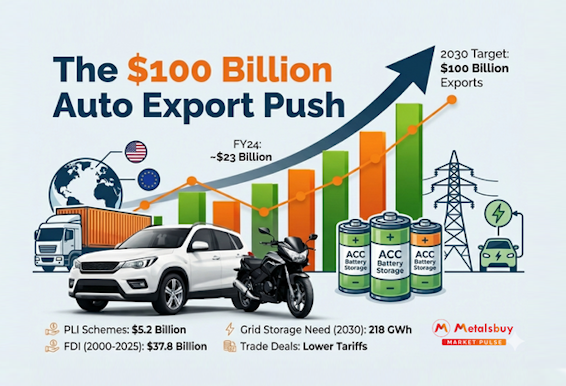
The government is actively utilizing Production Linked Incentive (PLI) schemes to integrate Indian Tier-1 and Tier-2 suppliers into Western OEM value chains. Specifically, $3.1 billion (₹25,938 crore) has been allocated for the automotive sector and $2.1 billion (₹18,100 crore) for ACC battery storage. This push is backed by robust foreign interest; the Indian automobile sector attracted over $37.8 billion in Foreign Direct Investment (FDI) between 2000 and 2025. Furthermore, recent India-US interim trade agreements promise preferential tariff rate quotas, mitigating previous US national security tariffs that had impacted certain Indian auto parts by up to 50%.
The Geopolitical Push: Why Now?
Post-pandemic supply chain vulnerabilities and the push for mineral security are driving Western economies toward "friend-shoring." The transition to Electric Vehicles (EVs) requires a steady, diversified supply of critical minerals. Platforms like the India-EU Trade and Technology Council (TTC) facilitate the joint development of battery tech and sustainable mining. Additionally, the impending India-EU Free Trade Agreement (FTA) is expected to significantly alter the pricing landscape—potentially dropping effective customs duties on imported cars priced below $40,000 from 70% to 10%, and completely knocked down (CKD) units from 16.5% to 8.25%, fostering a heavily integrated two-way market.
Data and Sectoral Implications
The numbers tell a compelling story of growth and strategic potential. The Indian auto component industry, which currently stands at roughly $80 billion, is expanding rapidly on the back of domestic demand and a booming export market. According to recent government and industry projections, the sector is targeting an ambitious $100 billion in exports alone by the end of the decade.
Key Growth Metrics for India's Auto Component Sector
|
Industry Metric |
Current Status (FY24/25) |
Target Projection (By 2030) |
|
Total Industry Valuation |
~$80 Billion |
$145 Billion – $200 Billion |
|
Total Export Value |
~$23 Billion |
$100 Billion |
|
Major Export Destinations |
US ($6.2B), Europe (12% YoY growth) |
High integration with Western OEMs |
|
Foreign Direct Investment (FDI) |
$37.8 Billion (Cumulative) |
Accelerated growth via PLI schemes |
|
Direct Employment |
~1.5 Million Jobs |
Projected to be top national job creator |
Simultaneously, India’s goal of reaching 500 GW of non-fossil power capacity by 2030 is driving massive stationary and EV battery demand. While the ACC PLI scheme has successfully awarded 40 GWh of capacity to domestic manufacturers, the overall grid requirement will necessitate aggressive scaling over the next five to seven years.
India's Energy Storage & ACC Battery Roadmap
|
Strategic Parameter |
Current / Baseline Status |
Future Requirement (2030–2032) |
|
Non-Fossil Power Capacity |
Transitioning rapidly |
500 GW target by 2030 |
|
Total Grid Energy Storage Needed |
Early deployment stages |
218 GWh (2030) ➔ 362 GWh (2032) |
|
Advanced Battery (ACC) Demand |
~28 GWh (Est. 2025) |
Exponential growth driven by EV push |
|
Required Capital Investment |
$2.1 Billion (PLI Allocation) |
$40 Billion – $50 Billion by 2032 |
The Road Ahead: Future Outlook
Future success depends on scaling localization and aligning with stringent global regulations, such as the EU’s Carbon Border Adjustment Mechanism (CBAM). As India shifts from frugal engineering to high-tech manufacturing, indigenous R&D and decarbonized production are imperative. Driven by data-backed export goals and multi-billion-dollar storage investments, the "Made in India" label is rapidly evolving from a low-cost alternative to a global standard for precision components and advanced battery cells.