Steel Sector Performance: A New Ceiling Breached
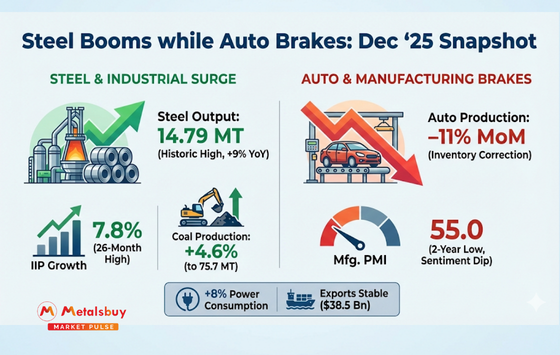
The headline for December 2025 is the sheer volume of metal churned out by Indian mills. Crude steel production vaulted to an all-time monthly high of 14.79 million metric tonnes (mt). This represents a significant 8% month-on-month (MoM) surge and a 9% year-on-year (YoY) growth.
This production ramp-up appears strategic rather than reactive. With the fourth quarter (Q4) typically signaling peak construction activity due to favorable weather and project deadlines, mills have built substantial inventories.
Trade Dynamics: The EU Pivot and Tariff Shields
India’s trade position remained net positive throughout Q3 FY26.
- Exports: Despite a slight MoM moderation, export volumes held firm. The primary driver remains the European Union. Indian mills are racing to capitalize on demand before the Carbon Border Adjustment Mechanism (CBAM) fully tightens its grip.
- Imports: Inbound shipments stayed low, effectively curbed by safeguard duties and tariff barriers, insulating domestic players from global dumping.
Raw Material Security: Coal and Iron Ore Trends
The upstream supply chain showed mixed signals, reflecting the intensity of domestic steel production.
- Coal: Domestic miners rose to the occasion, with production climbing to 75.7 million mt, a 4.6% YoY increase. Improved mine productivity has allowed buyers to pivot back to domestic sourcing, causing both MoM and YoY declines in coal imports.
- Iron Ore: Conversely, domestic iron ore supply struggled to keep pace with the steelmakers' voracious appetite, keeping import dependency elevated for this specific feedstock.
Downstream Demand: The "Slowdown" Anomaly
The narrative of "slowing downstream activity" requires a nuanced look at the data, particularly in the automotive and general manufacturing sectors.
- The Automobile Correction
The auto sector witnessed a sharp monthly correction, but the annual picture tells a story of structural growth.
- Production: Dropped 11% MoM to 2.63 million units.
- Sales: Fell 17% MoM to 2.09 million units.
Analysis: The monthly drop is largely a hangover from the festive season's high base and inventory corrections. However, the YoY growth of 37% in production and 35% in sales indicates that the long-term demand curve remains aggressively upward, supported by income tax reliefs and GST reforms introduced earlier in 2025.
- Manufacturing & Industrial Output (IIP)
India’s Index of Industrial Production (IIP) hit a 26-month high of 7.8%, with manufacturing expanding by 8.1%. However, the Purchasing Managers’ Index (PMI) for manufacturing slid to a two-year low of 55.0.
The Divergence: While actual output (IIP) is robust, sentiment (PMI) is being dampened by global competitive pressures and trade uncertainties. Business confidence has hit a three-year low, even as factories continue to hum.
Macro-Economic Resilience
Two key indicators suggest that the economic floor remains solid:
- Power Consumption: Rose 8% MoM to 4,470 million units, driven by severe winter heating demands in North India and sustained industrial usage.
- Export Stability: Despite the United States doubling import tariffs on Indian goods to 50%, merchandise exports to the US remained stable at $6.89 billion. Total merchandise exports edged up marginally to $38.5 billion.
Key Performance Indicators: December 2025 Snapshot
|
Indicator |
Value (Dec '25) |
MoM Change |
YoY Change |
Sentiment |
|
Crude Steel Production |
14.79 MT |
▲ +8.0% |
▲ +9.0% |
Bullish |
|
Coal Production |
75.7 MT |
N/A |
▲ +4.6% |
Stable |
|
Manufacturing PMI |
55.0 Points |
▼ (2-yr low) |
N/A |
Cautious |
|
IIP Growth |
7.8% |
▲ (from 7.2%) |
N/A |
Positive |
|
Auto Production |
2.63 Million Units |
▼ -11.0% |
▲ +37.0% |
Mixed |
|
Auto Sales |
2.09 Million Units |
▼ -17.0% |
▲ +35.0% |
Correction |
|
Power Consumption |
4,470 Million Units |
▲ +8.0% |
N/A |
Strong |
|
Merchandise Exports |
$38.5 Billion |
▲ Marginal |
▲ Marginal |
Resilient |
Future Outlook: Q4 and Beyond
The immediate outlook for Q4 FY26 remains optimistic. The divergence between record steel output and slowing PMI suggests that steelmakers are betting on a massive infrastructure push in the final quarter. With the FY26 GDP forecast revised upward to 7.4%, and capital goods expansion continuing (albeit slower at 8.1%), the domestic consumption story remains intact.
The industry’s ability to absorb the shock of US tariff hikes and navigate the EU's green transition policies will be the defining theme for early 2026.