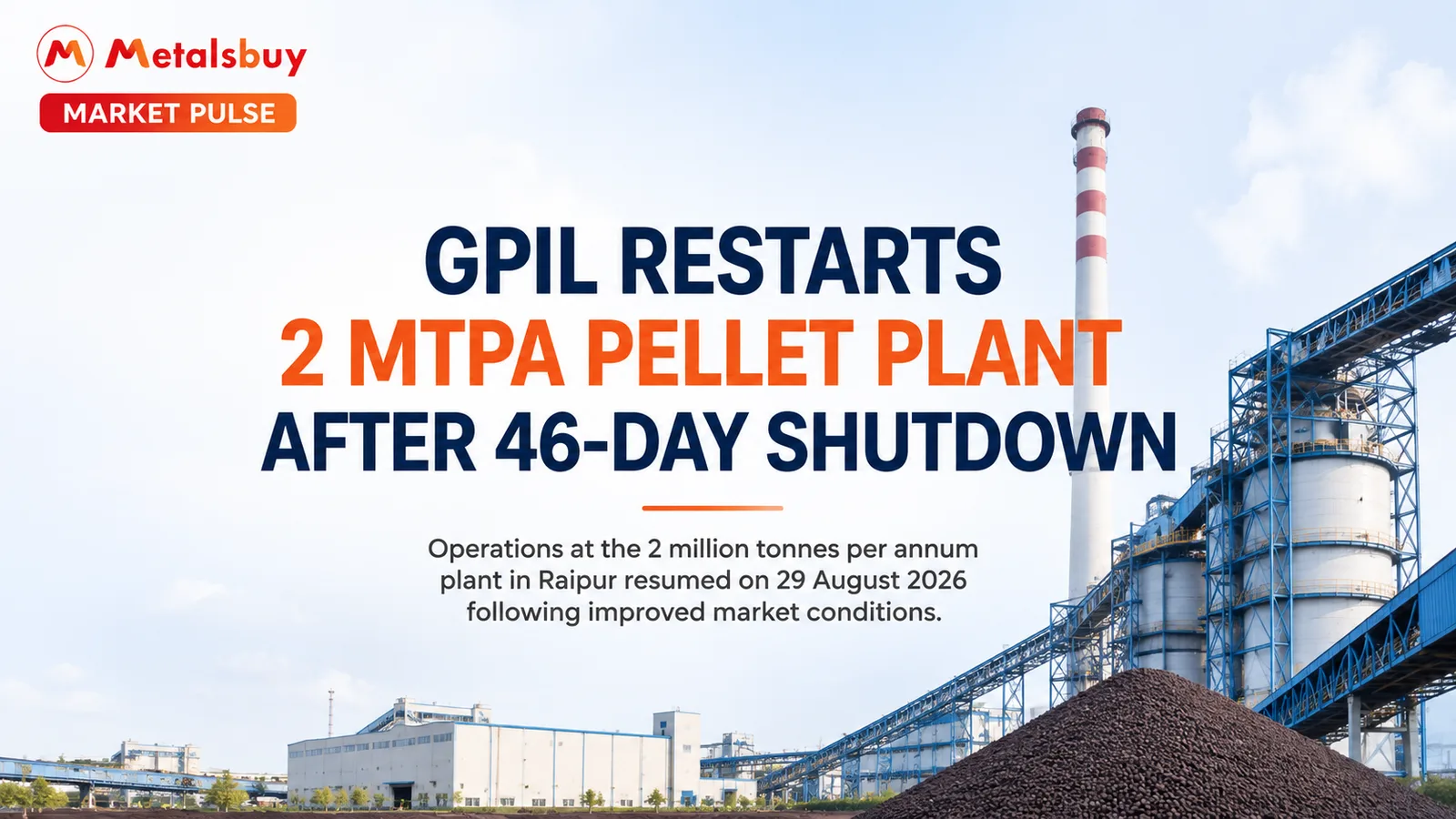
Godawari Power & Ispat Ltd. (GPIL) has resumed normal operations at its 2.0 million tonnes per annum (MTPA) iron ore pellet plant at Phase-II of the Siltara Industrial Area in Raipur, Chhattisgarh. The restart was announced on 29 August 2026, bringing an end to a shutdown that began on 14 July. The company has cited improved market conditions for the decision to resume production.
The restart is important because this was not a routine maintenance stoppage. When GPIL suspended operations in July, the company was dealing with a combination of higher gas costs and lower availability of captive iron ore during the monsoon period. Those conditions had made pellet production at the facility economically unviable at the time.
1. A 2 MTPA plant was taken offline in July
GPIL temporarily suspended production at the 2.0 MTPA plant with effect from 14 July 2026. At the time, the company said contracted gas supplies had been curtailed following changes in the natural gas supply framework. This increased the cost of sourcing gas beyond contracted volumes.
The problem was compounded by the monsoon. Iron ore production from GPIL's Ari Dongri mines was lower during the rainy season, forcing the company to look at market purchases to supplement its raw material requirement. Higher-priced gas and the additional cost of sourcing iron ore from outside together changed the economics of pellet production. GPIL had specifically warned that the shutdown would affect pellet production and sales volumes during the second quarter of FY27.
2. The shutdown lasted around six and a half weeks
From 14 July to 29 August, the plant remained out of normal operation for roughly 46 days. For a facility with an annual capacity of 2 million tonnes, that is a meaningful interruption even though the actual production impact will depend on utilisation levels and the pace at which the plant returns to regular output.
The company has not disclosed the exact tonnage lost during the shutdown. It has also not provided a revised production forecast following the restart. What it has confirmed is that production at the facility has now resumed normally, with improved market conditions allowing the plant to come back into operation.
3. The restart brings GPIL's pellet capacity back into play
The Phase-II Siltara plant itself has a capacity of 2.0 MTPA, making it a sizeable part of GPIL's pellet operations. The company describes the unit as a relatively newer pellet facility, producing material with silica content in the 3–4% range.
For an integrated producer like GPIL, pellet operations are closely linked to both raw material availability and the cost of energy. The July shutdown showed how quickly those economics can change. The plant was not stopped because of a technical breakdown or a lack of installed capacity; production was paused because the combination of input costs and raw material availability no longer made commercial sense.
That distinction matters. The decision to restart now suggests that the company sees enough improvement in the operating environment to put the capacity back into production.
4. Monsoon conditions were a major part of the July decision
The timing of the shutdown was closely connected with seasonal mining conditions. GPIL had pointed to lower iron ore production from its Ari Dongri mines during the rainy season, which increased its dependence on material from the open market. At the same time, the company was facing higher natural gas costs.
Neither issue in isolation may have required a complete shutdown. Together, however, they pushed the cost of pellet production to a level that GPIL considered economically unviable.
With the plant now restarted, the next few weeks will indicate whether the improvement is sustainable or primarily linked to a temporary change in market conditions. For now, the immediate development is straightforward: 2 MTPA of pellet capacity that had been idle since mid-July is back in operation.
The restart also removes one operational pressure heading into the remainder of the quarter. GPIL had earlier acknowledged that the shutdown would affect Q2 FY27 volumes. A prolonged closure would have increased that impact. By resuming operations before the end of August, the company has at least brought the plant back into the production cycle ahead of the post-monsoon period.
Disclaimer: This article is based on publicly available company disclosures and market information and is intended for general industry discussion only.