Key Numbers
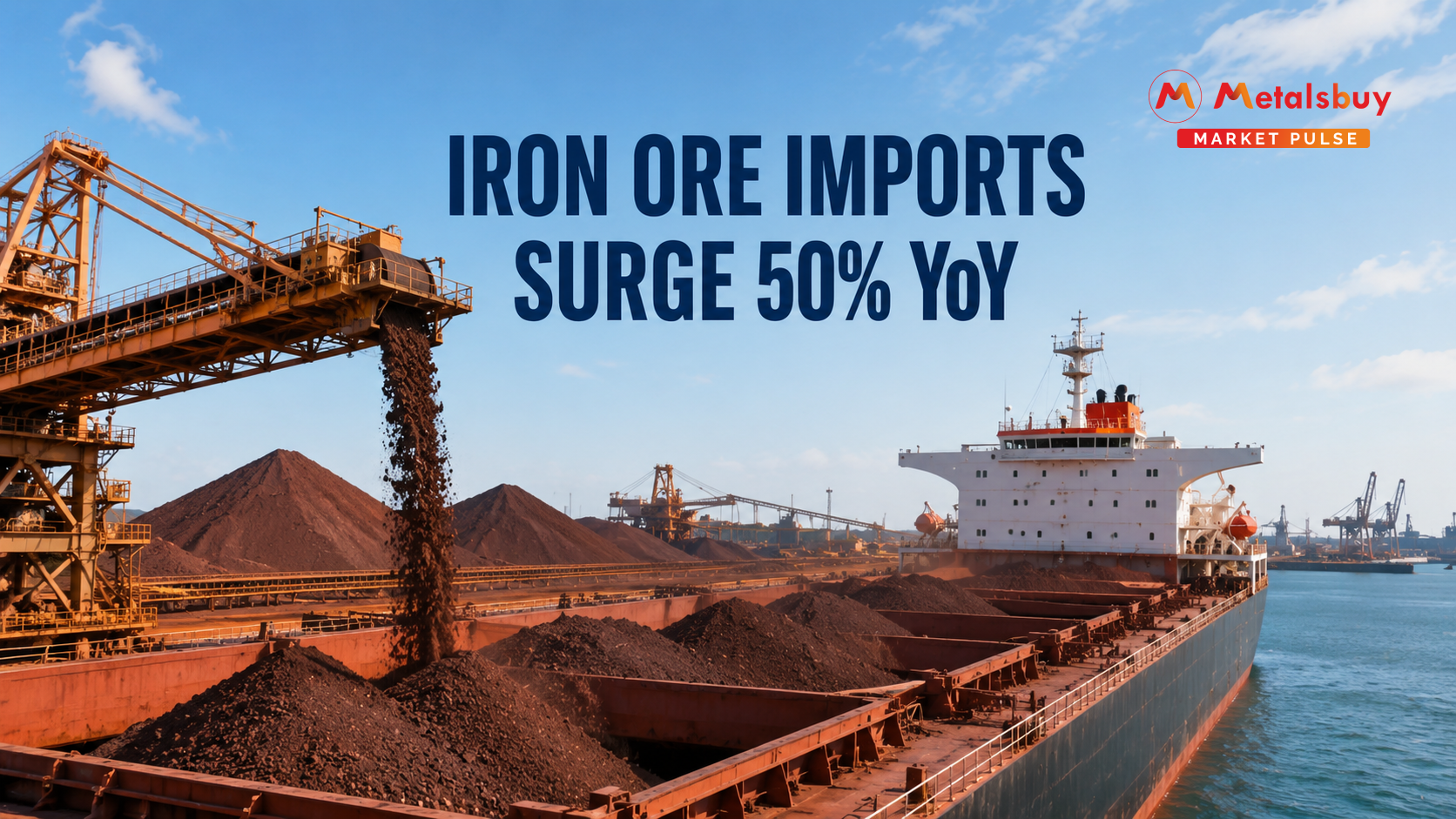
• Total Iron Ore & Pellet Imports (Jan–May 2026): 4.8 Million Tonnes
• Growth Over Jan–May 2025: +50% YoY
• Iron Ore Imports (Jan–May 2026): 4.28 Million Tonnes
• Pellet Imports (Jan–May 2026): Just Over 0.40 Million Tonnes
• Iron Ore Imports FY26: 12.35 Million Tonnes (7-Year High)
• Share of High-Grade (65%+ Fe) Ore in India's Production:
- FY17: 20%
- FY26: 11%
• JSW Group Share in Total Imports: 85%
• Brazil's Share in Total Imports: 56%
• India's Iron Ore Production FY26: ~310 Million Tonnes
• India's Crude Steel Production FY26: ~169 Million Tonnes
Market Analysis
1. Iron Ore Imports Continue Rising Despite Record Domestic Production
India's combined imports of iron ore and pellets reached approximately 4.8 million tonnes during January-May 2026, representing a sharp 50% increase compared to around 3.2 million tonnes imported during the corresponding period last year. The growth is particularly noteworthy because it comes despite India producing nearly 310 million tonnes of iron ore in FY26, one of the highest production levels on record. The trend highlights a structural mismatch between the quality of ore available domestically and the requirements of modern steelmaking operations. While India remains one of the world's largest iron ore producers, steelmakers continue to depend on imported material to secure higher-grade ore with lower impurity levels. This growing dependence is increasingly shaping procurement strategies across the domestic steel industry.
2. High-Grade Ore Shortage Emerging as a Structural Challenge
The primary factor driving imports is the declining availability of premium-grade iron ore within India. Industry data indicates that ore with iron content exceeding 65% accounted for only 11% of India's total production in FY26, compared with nearly 20% in FY17. This gradual depletion of high-grade reserves is forcing steel producers to seek alternative sources from overseas markets. Brazilian ore, in particular, remains highly preferred because of its iron content of 64–65% and significantly lower silica and alumina levels compared with domestic material. The use of higher-grade imported ore improves blast furnace productivity, reduces coke consumption, lowers slag generation, and enhances overall operational efficiency. As steelmakers focus increasingly on productivity and sustainability, demand for premium imported ore is expected to remain strong.
3. Brazil Consolidates Position as India's Largest Supplier
Brazil continues to dominate India's iron ore import market, accounting for approximately 56% of total shipments during January-May 2026. In May alone, Brazil supplied around 0.72 million tonnes of ore, significantly ahead of South Africa at 0.18 million tonnes and Norway at 0.16 million tonnes. Brazilian ore has become particularly attractive because of its superior quality characteristics and suitability for large integrated steel plants. The concentration of imports from Brazil also reflects the growing importance of quality over quantity in raw material procurement decisions. As Indian steelmakers continue expanding capacity and targeting higher operational efficiencies, Brazilian suppliers are likely to remain key beneficiaries of rising import demand.
4. Steel Demand Growth Continues to Support Raw Material Imports
India's steel industry remains one of the fastest-growing globally, creating sustained demand for iron ore and pellets. Crude steel production reached approximately 169 million tonnes during FY26, while finished steel consumption continued to grow on the back of infrastructure development, manufacturing expansion, and urbanization. Several large steel producers have commissioned new capacity or expanded existing operations, increasing their raw material requirements. Strong domestic demand is therefore offsetting the increase in domestic ore production and supporting higher import volumes. The trend indicates that India's steel sector is prioritizing consistent quality and operational efficiency over exclusive reliance on local ore availability.
5. Pellet Imports Decline Amid Logistics Disruptions
Unlike iron ore imports, pellet imports witnessed a sharp decline during the first five months of 2026. Total pellet imports fell to just over 400,000 tonnes as geopolitical tensions in the Middle East and shipping disruptions affected trade flows. Earlier, imported pellets had gained popularity because of competitive pricing and favourable quality characteristics. However, logistics constraints and improved domestic pellet availability reduced dependence on imported material. The decline in pellet imports demonstrates that while India remains increasingly dependent on imported high-grade ore, the pellet segment remains more sensitive to freight economics and geopolitical developments. Market participants expect pellet imports to remain volatile in the near term depending on freight costs and regional supply conditions.
6. Imports Reflect Quality Gap Rather Than Supply Deficit
The most important takeaway from the import surge is that India is not facing an iron ore shortage in volume terms. Domestic production continues to rise and is expected to expand further as mines ramp up output. However, the shortage of premium-grade ore suitable for efficient blast furnace operations is becoming increasingly evident. Consequently, imports are being driven by quality requirements rather than availability concerns. This distinction is critical because it suggests that import demand may remain elevated even if domestic production increases further. Unless significant new reserves of high-grade ore become available or beneficiation capacities expand substantially, steelmakers are likely to continue relying on imported material to optimize production efficiency.
Industry Impact
The rise in iron ore imports highlights the changing dynamics of India's raw material supply chain. Steel producers are increasingly prioritizing ore quality, furnace productivity, and operational efficiency over simple access to domestic material. This trend could support stronger trade relationships with suppliers from Brazil, South Africa, and other premium ore-producing regions.
For domestic miners, the growing preference for imported high-grade ore underscores the need for increased beneficiation, exploration, and development of premium-quality reserves. The development may also influence future investment decisions across the mining sector as producers seek to bridge the widening quality gap in the domestic market.
Outlook
Outlook
India's iron ore imports are expected to remain elevated through 2026 despite rising domestic production. Strong steel demand, expanding blast furnace capacity, and limited availability of premium-grade ore are likely to continue supporting overseas procurement. While domestic output may increase further as mining operations ramp up, the structural shortage of low-impurity, high-grade ore is unlikely to be resolved in the near term.
Market participants will closely monitor iron ore production trends, beneficiation investments, freight costs, and global pricing movements. Unless domestic availability of premium-grade ore improves significantly, imports are expected to remain an important component of India's steelmaking raw material strategy. The current trend reinforces the growing importance of quality-driven procurement in shaping the future of India's steel industry.
---